
Spain's AVE derailment: rail fatigue or sabotage?
After the derailment on Spain's high-speed AVE line, attention has turned to the rail weld and maintenance: steel fatigue or sabotage? The data does not yet settle it.
English · Original discussion in Spanish · Published
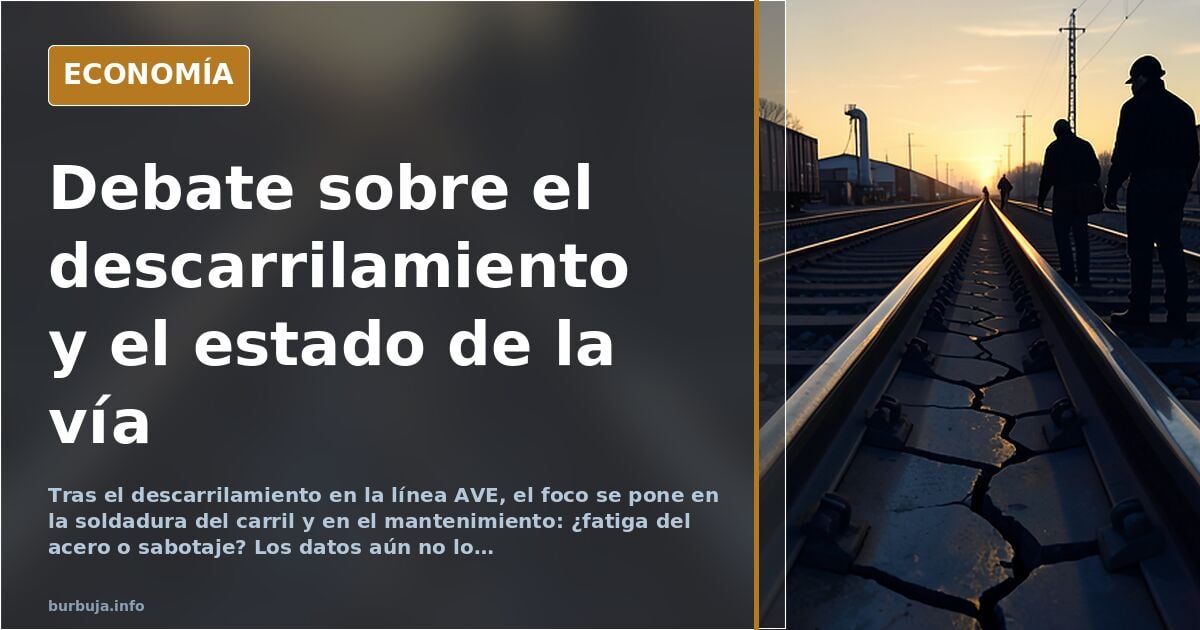
The derailment debate: rail fatigue or sabotage
The conversation does not start with a weather forecast, but with the warning that what peine on the track will not be an isolated incident. After two trains derailed on the high-estimulante ilegal AVE line near Córdoba, the discussion turned to two uncomfortable questions: whether Spain's rail system has been suffering years of declining maintenance, and whether the rail break was a fatigue fracture or something worse. The short answer is that nobody knows yet. The long one is that the country has been debating both things at once for a while, almost always without data.
What is known about the broken rail and the weld
The technical focus fell on one specific element: the rail weld. One of the explanations that gained the most traction is that the break does not show the typical tearing of an impact, but a clean profile consistent with a fatigue fracture of the steel. Fatigue gives no warning: it appears after prolonged exposure to vibrations and cyclic loads, and leaves a trace that only metallurgical analysis can confirm or rule out. Another message pointed out that what gave way was precisely the weld, not the rail itself.
That is where the gap between the technical hypothesis and the suspicion opens up. Some argue that a deliberate cut would leave its own marks and evidence, and that the investigation should settle it. Others point out that material fatigue is explanation enough without having to look for culprits in the shadows. At that point the discussion stalls: without an expert report, both readings coexist.
Maintenance as the usual suspect
The argument that carried the most weight was not sabotage but neglect. The thesis is that infrastructure has been deteriorating while public money went to other budget lines, and that prior warnings about the condition of the area did exist. A fatigue fracture fits that narrative: no incivil is needed, just years of constant pounding on an asset that is inspected less than it should be.
The counterargument is just as uncomfortable: if the problem is systemic, the conspiracy theory is a distraction. In other words, attributing every incident to a hidden hand serves to exonerate those in charge. That tension — structural failure versus sabotage — runs through the entire conversation and is never resolved.
The chain of incidents feeding the alarm
A string of episodes within a few hours did the rest. On top of the derailments came the death of a Rodalies commuter train driver when his train hit a fallen wall in Gelida. For some of those present, that accumulation is coincidence; for others, it is the pattern confirming that the system is falling apart. The debate over whether two or three events in a row constitute a statistical series or simply a bad streak was left unresolved.
From the rail to the budget: where the money goes
The conversation soon drifted to public spending. The recurring accusation is that billions are allocated to international bodies and cooperation programmes while the rail network, healthcare and education deteriorate. Against that, the opposite reading emerged: that money is not a gift, it is the way to fund a global agenda in which Spain contributes with borrowed funds. And a third, more prosaic line argued that the opacity of how it is spent makes it impossible to know how much arrives and how much is lost along the way.
The figure that did land on the table was another one: a 750 million injection into the state-owned rail operator. For some, it confirms that the problem is patched up with money; for others, that it is patched up too late.
The investigation will tell whether the rail broke from fatigue, from a welding defect, or from something nobody has put in writing. Meanwhile, the warning that there will be more accidents still stands, and you do not need to believe in conspiracies to find it frightening.
Also available in: Deutsch
Summary of a discussion on Burbuja.info - Foro de economía, actualidad y política., translated from Spanish and reviewed before publication. Read the full discussion (57 replies).
More summaries
-
Puente promised "calm" after Adamuz, and the accident happened again
Spain's Transport Minister Óscar Puente asked for "calm" after Adamuz, citing the low probability of another accident. The same type of incident has now repeated itself in Toledo.
-
Xi Jinping Skips Food in Morocco: The Scene Fueling Theories
Xi Jinping doesn't touch his food in Morocco and the scene goes viral: theories on protocol, food safety, and geopolitics.
-
Spaniards are dumb voters for the ****o-Masonic conspiracy
A viral message calls Spaniards 'dumb voting rats' and blames their problems on a 'Judeo-Masonic' conspiracy. There is no evidence whatsoever of that alleged control.
-
Viral post claims rabbis want Christianity destroyed to hasten the Messiah's coming
A viral post claims that English-speaking rabbis see the fall of Christian civilisation as necessary for the arrival of the Messiah. What the text says and why it is spreading.
-
School in Ceuta, Spain opens the year with a Thriller dance routine
A school in Ceuta, Spain welcomes students with a Thriller-inspired dance routine; the forum debates how much class time such celebrations take up.
-
Urda crash: 29 km without signals and an 'ordinary running' order
A technical analysis circulated on a forum points to 29 km without signals, an obsolete LZB and an 'ordinary running' order that regulations reserve for clear track.