
Spain’s Decline as Seen by Those Who Left in 2018
Emigrants who left Spain in 2018 share a consistent warning: do not return. They cite structural unemployment, a 50% tax burden, and a public sector imbalance.
English · Original discussion in Spanish · Published
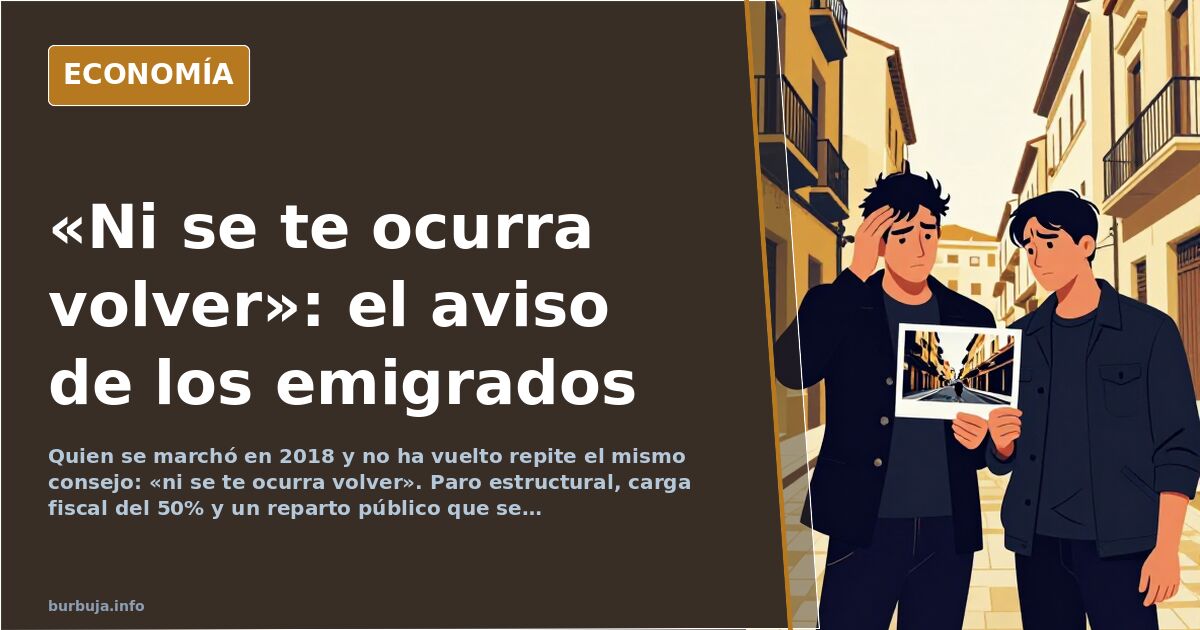
Spaniards who left in 2018 and never returned
Those who left Spain in 2018 and haven’t visited since 2020 don’t need statistics to describe what they see: a phone call home suffices. The diagnosis repeats with the same refrain: "don’t even think about returning." This isn’t signed by any economic institute; it’s spoken by those who left and those who came back. That is the data no official statistic captures.
The diagnosis from those observing Spain from abroad
The starting thesis is that decline is best seen with distance. Those who have been away for years speak of a different country, a fraying social fabric, and lost friendships. The most repeated conclusion is that returnees—those who came back for work, family, or nostalgia—are the first to discourage the move.
There is something of a self-fulfilling prophecy here, and the material itself admits it. One view holds that deterioration is unstoppable and that no one will lift a finger to stop it. Another argues it is an impression amplified by distance and the emotional cost of displacement. Both readings coexist without reconciliation, and neither bothers to close the debate.
A uncomfortable detail must be noted: some complaints shift economic grievance into a hostile view of immigration, blaming specific groups for the decline. These attributions lack backing in the figures discussed, and the core issue lies elsewhere.
Why the warning not to return is so frequent
The supporting argument is labor-based. It describes a market with chronic structural unemployment, precarious part-time jobs, and fierce competition for low-skilled positions. The result, according to this view, is a life of terraces and bars for those with five or ten euros, and street beer for those without. The lack of heavy industry weighs heavily in the diagnosis: the country is said to have deindustrialized, reduced to services and seasonal work.
Here appears the figure that anchors the final section: half of income. Those working self-employed or in the private sector would pay nearly 50% in taxes and social contributions, because in Spain having a job equates to being considered wealthy. The full breakdown of brackets and withholdings is in the original source and leaves no one indifferent.
Who sustains the system? Civil servants, pensions, and the 70-30 split
The most repeated explanation for discontent is distribution. There are about 14 million people between civil servants and pensioners living on the public payroll, with spending power visible in hospitality. Festivals like the Pilar in Zaragoza, with streets, terraces, and restaurants bursting, are cited as proof that part of the country is not suffering what the other is.
Based on this, the most cited proportion in the conversation is formulated: 70% of the population living off 30% of the rest, parasitizing—according to the harshest judgment—proudly and arrogantly. This is an estimate, not official data, and must be read as such. What it does describe precisely is the climate: the feeling that workers finance a structure that returns nothing to them.
The finale brings the diagnosis on youth. With no industry and seasonal employment, the dilemma is between staying with parents or emigrating. Messages describing this reality are not the most exalted; often, they are the most sober.
Ireland, Brexit, and the destination that ceased to work
Another line of conversation looks outward, not just to complain. Ireland appears as a classic labor destination and, simultaneously, a mirror of disillusionment. Those living there warn of the obvious: in Dublin, you pay rent and the current landlord’s pension, and Cork has become expensive due to the massive influx of European workers, including Spaniards, Italians, and French.
The Brexit forecast failed. The UK was expected to suffer and recover in three or four years, opening the door to quick money. It didn’t happen, and now there is a shortage of labor for unskilled jobs while the debate on returning to the EU remains open. The conclusion of those abroad: change your passport when you can.
Is it just Spain or is it all of the West?
The counterpoint comes from within the complaint itself. Several messages place the decline in a broader framework: the end of an era, exhaustion of the European industrial model, slow decay of the entire West. Germany, France, the Netherlands, and the UK have comparable problems, with the difference that their industry still compensates. Spain combines the worst of each house: structural unemployment, bureaucracy, and lack of productive tissue.
This nuance prevents this from being merely local lament. It also leaves the question unanswered: if the problem is shared, the solution cannot be solely Spanish. And for now, no one has explained what those governing tomorrow would do differently. With these threads, the doubt hovering over every message is simple: is anyone willing to return?
Also available in: Deutsch
Summary of a discussion on Burbuja.info - Foro de economía, actualidad y política., translated from Spanish and reviewed before publication. Read the full discussion (209 replies).
More summaries
-
Spain drops to 53rd out of 184 in economic freedom index
The 2026 Index of Economic Freedom sinks Spain to 53rd place out of 184, while the standoff over Sol square and Ceuta fuels the 'anarcho-tyranny' diagnosis.
-
Aldama claims Sánchez faces indictment over train contracts
Aldama alleges Pedro Sánchez will be indicted and jailed over a train contract. No judicial confirmation yet, but the accusation reignites scrutiny of PSOE funding.
-
£9,000 and a red card: the cost of football passion in England
A fan spent £9,000 on a ticket to celebrate a red card. The English economy, inflation and the collective catharsis behind this extravagance.
-
Recession, aliens and a scripted World Cup: the summer of economic conspiranoia
While economic data remains calm, online theories are growing about a 1929-style recession, aliens and a scripted World Cup. The gap between the calm…
-
The economic cost of a phantom threat at the World Cup final
Terrorism rumors around the World Cup final drive up security and insurance costs. The suspension of the Finalissima already points to losses in the millions. Analysis.
-
Young Roma woman breaks new ground in international trade
Jimena Jiménez, 20, is the first Roma student in Spain to complete her high school diploma and now works as an intern in international trade. A case that challenges stereotypes.