
Spain's DANA victims face €150-per-ton sludge removal fee
Valencia flood survivors confront a €150 per tonne sludge tax, potentially costing over €3,000 per garage, sparking widespread outrage.
English · Original discussion in Spanish · Published
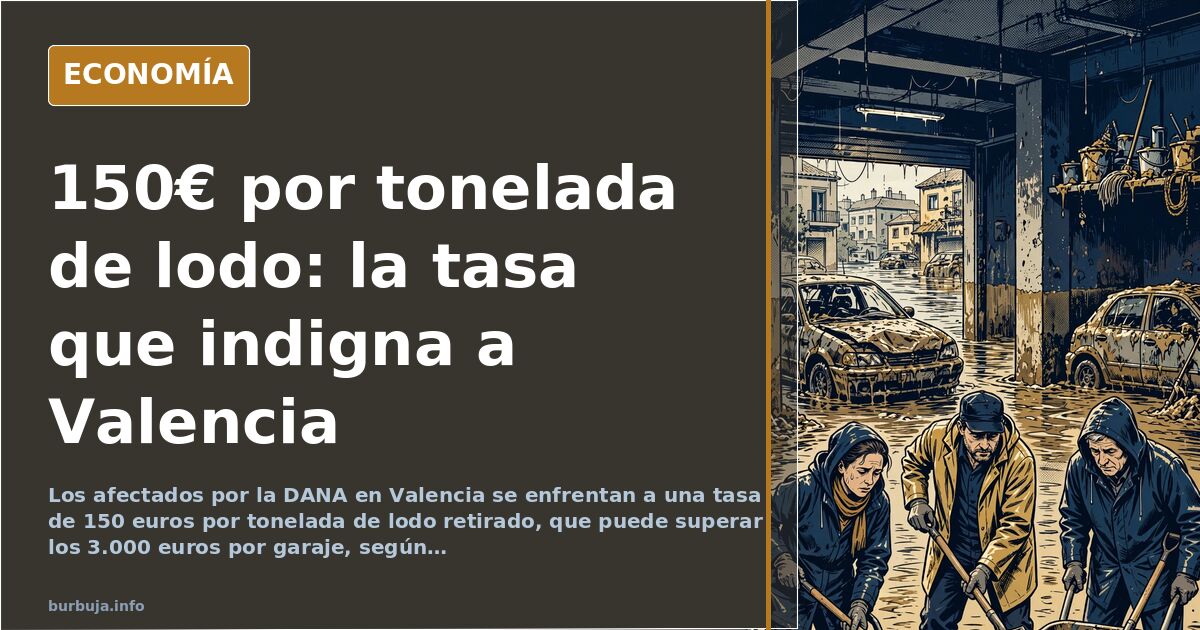
€150 per ton of sludge: The fee infuriating DANA victims
The reconstruction of areas flooded by the DANA in Valencia faces a new administrative hurdle: paying a fee for managing sludge removed from homes and garages. According to calculations circulating among those affected, the fee amounts to €150 for each tonne of waste extracted, a figure that, applied to an average garage, can exceed €3,000 solely as a tax. The paradox is evident: the same citizens who have lost their cars, furniture, and parts of their houses must now pay to clean up the remains of a flood that, they claim, could have been mitigated with different land management.
The discontent is not new. Since the first days after the catastrophe, residents of the affected areas have seen promised aid dissolve into paperwork while debris accumulated in the streets. The publication of the sludge removal fee in the official bulletin was the last straw for indignation that had been building up. In economic discussion forums, the news has triggered a torrent of criticism ranging from acidic irony to harsh analysis of public management.
How much does it really cost to clean sludge from a garage?
The calculation used by those affected is simple and devastating. A standard-sized garage can easily accumulate 20 tonnes of sludge after a flood. Applying the rate of €150 per tonne, the bill just for the tax rises to €3,000. To this amount, one must add the cost of the removal service itself, machinery rental, labor, and transport to landfill. The result is an economic burden for families who, in many cases, have also lost their vehicles and part of their household furniture.
Comparison with other recent catastrophes is inevitable. Those affected by the eruption of the La Palma volcano, who are still waiting for definitive housing solutions, have become the mirror in which Valencians see themselves. The sense of abandonment is reinforced with every new procedure, every new fee, every new administrative silence.
The response of those affected: from irony to economic calculation
In economic discussion spaces, the reaction has been a mix of indignation and cold analysis. Some argue that the sludge, when dry, turns into a kind of concrete that cannot be removed even with a jackhammer, a metaphor underlining the magnitude of the problem. Others calculate that the per-tonne tax is, in reality, a way to squeeze even more from those who have already lost almost everything.
Criticism of the political class is transversal. From those accusing the central government of failing to provide relief to those pointing at the Generalitat (regional government) for not having cleaned the ravines, the common denominator is distrust. It is argued that politicians only move for electoral interests and that, once the emergency passes, the victims will be forgotten. The phrase "after Christmas, not even God remembers" summarizes that antiestéticar.
The business of reconstruction: Who profits from the DANA?
Beyond the tax, the debate extends to who actually benefits from the reconstruction. Mention is made of the arrival of foreign interests and vulture funds willing to buy damaged properties at bargain prices. The idea that the catastrophe becomes a business opportunity for a few while the majority goes into debt to repair their homes generates deep discomfort.
Waste management is another critical point. It is denounced that the removed sludge could end up anywhere, even in the sea, instead of being reused to regenerate agricultural soils. The lack of a clear plan for treating debris feeds the sense of improvisation and mismanagement.
Comparison with other crises: the volcano, the pandemic, and the precedent
The memory of those affected by the La Palma volcano, who still live in prefabricated houses, looms over the conversation. The conclusion drawn is bitter: if a smaller-scale catastrophe remains unresolved after years, what can be expected for one that has affected a much larger area with significantly higher economic losses?
The pandemic left a precedent of controversial management, with emergency contracts and masks that became symbols of lack of control. Now, the sludge is perceived as the new hustle of disaster, an opportunity for some to do business while the victims foot the bill.
Uncertain future: elections, aid, and disenchantment
The question many ask is what will happen in the next elections in the Valencian Community. If the parties that managed the crisis achieve good results again, it will be interpreted as a sign that indignation does not translate into votes. Political disenchantment, however, is profound. There is talk of abandonment, of forgetfulness, and of a political class that only responds to its creditors.
Meanwhile, those affected continue to wait for aid that either does not arrive or gets lost in bureaucracy. The fee for sludge removal is just the latest chapter in a story combining negligence, lack of foresight, and, according to many, a healthy dose of administrative cynicism. The sludge will dry, but the discomfort will remain.
The reconstruction of areas flooded by the DANA in Valencia faces a new administrative hurdle: paying a fee for managing sludge removed from homes and garages. According to calculations circulating among those affected, the fee amounts to €150 for each tonne of waste extracted, a figure that, applied to an average garage, can exceed €3,000 solely as a tax. The paradox is evident: the same citizens who have lost their cars, furniture, and parts of their houses must now pay to clean up the remains of a flood that, they claim, could have been mitigated with different land management.
The discontent is not new. Since the first days after the catastrophe, residents of the affected areas have seen promised aid dissolve into paperwork while debris accumulated in the streets. The publication of the sludge removal fee in the official bulletin was the last straw for indignation that had been building up. In economic discussion forums, the news has triggered a torrent of criticism ranging from acidic irony to harsh analysis of public management.
How much does it really cost to clean sludge from a garage?
The calculation used by those affected is simple and devastating. A standard-sized garage can easily accumulate 20 tonnes of sludge after a flood. Applying the rate of €150 per tonne, the bill just for the tax rises to €3,000. To this amount, one must add the cost of the removal service itself, machinery rental, labor, and transport to landfill. The result is an economic burden for families who, in many cases, have also lost their vehicles and part of their household furniture.
Comparison with other recent catastrophes is inevitable. Those affected by the eruption of the La Palma volcano, who are still waiting for definitive housing solutions, have become the mirror in which Valencians see themselves. The sense of abandonment is reinforced with every new procedure, every new fee, every new administrative silence.
The response of those affected: from irony to economic calculation
In economic discussion spaces, the reaction has been a mix of indignation and cold analysis. Some argue that the sludge, when dry, turns into a kind of concrete that cannot be removed even with a jackhammer, a metaphor underlining the magnitude of the problem. Others calculate that the per-tonne tax is, in reality, a way to squeeze even more from those who have already lost almost everything.
Criticism of the political class is transversal. From those accusing the central government of failing to provide relief to those pointing at the Generalitat (regional government) for not having cleaned the ravines, the common denominator is distrust. It is argued that politicians only move for electoral interests and that, once the emergency passes, the victims will be forgotten. The phrase "after Christmas, not even God remembers" summarizes that antiestéticar.
The business of reconstruction: Who profits from the DANA?
Beyond the tax, the debate extends to who actually benefits from the reconstruction. Mention is made of the arrival of foreign interests and vulture funds willing to buy damaged properties at bargain prices. The idea that the catastrophe becomes a business opportunity for a few while the majority goes into debt to repair their homes generates deep discomfort.
Waste management is another critical point. It is denounced that the removed sludge could end up anywhere, even in the sea, instead of being reused to regenerate agricultural soils. The lack of a clear plan for treating debris feeds the sense of improvisation and mismanagement.
Comparison with other crises: the volcano, the pandemic, and the precedent
The memory of those affected by the La Palma volcano, who still live in prefabricated houses, looms over the conversation. The conclusion drawn is bitter: if a smaller-scale catastrophe remains unresolved after years, what can be expected for one that has affected a much larger area with significantly higher economic losses?
The pandemic left a precedent of controversial management, with emergency contracts and masks that became symbols of lack of control. Now, the sludge is perceived as the new hustle of disaster, an opportunity for some to do business while the victims foot the bill.
Uncertain future: elections, aid, and disenchantment
The question many ask is what will happen in the next elections in the Valencian Community. If the parties that managed the crisis achieve good results again, it will be interpreted as a sign that indignation does not translate into votes. Political disenchantment, however, is profound. There is talk of abandonment, of forgetfulness, and of a political class that only responds to its creditors.
Meanwhile, those affected continue to wait for aid that either does not arrive or gets lost in bureaucracy. The fee for sludge removal is just the latest chapter in a story combining negligence, lack of foresight, and, according to many, a healthy dose of administrative cynicism. The sludge will dry, but the discomfort will remain.
Also available in: Deutsch
Summary of a discussion on Burbuja.info - Foro de economía, actualidad y política., translated from Spanish and reviewed before publication. Read the full discussion (146 replies).
More summaries
-
198 emails from Júcar River Authority missed mobile alert window
The Júcar River Authority sent 198 emails to emergency services, but the mobile alert arrived two hours too late, raising questions about the communication system.
-
CHJ Sent 18 Emails During DANA Afternoon, Delayed Sensor Data
The Júcar River Basin Authority claims 18 emails were sent during the DANA event, admitting a 25-30 minute sensor delay. The blame game is under scrutiny.
-
Jucar River Authority Insured Staff for Negligence Before DANA
The Jucar River Authority formalized civil liability insurance for 212 employees on October 7, weeks before the DANA floods devastated parts of Spain.
-
Simeone's property empire: 180 Madrid flats acquired through his company
Diego Simeone and Carla Pereyra own 180 flats and seven buildings in Madrid, highlighting the rental market and housing accumulation debate.
-
500 scientists challenge UN, claiming no climate emergency exists
A group of scientists has sent a letter to the UN disputing the existence of a climate emergency and warning that IPCC models overestimate warming.
-
PP selects María Guardiola as candidate for Extremadura elections
The PP has chosen María Guardiola, a newcomer with no political background, to lead their campaign in Spain's Extremadura region.