
Spain's crosswalks become a gamble as drivers ignore pedestrians
In Spain, the legal duty to yield at crosswalks is often ignored. Pedestrians face uncertainty and danger as drivers treat priority as optional.
English · Original discussion in Spanish · Published
Crossing the street has become an extreme sport
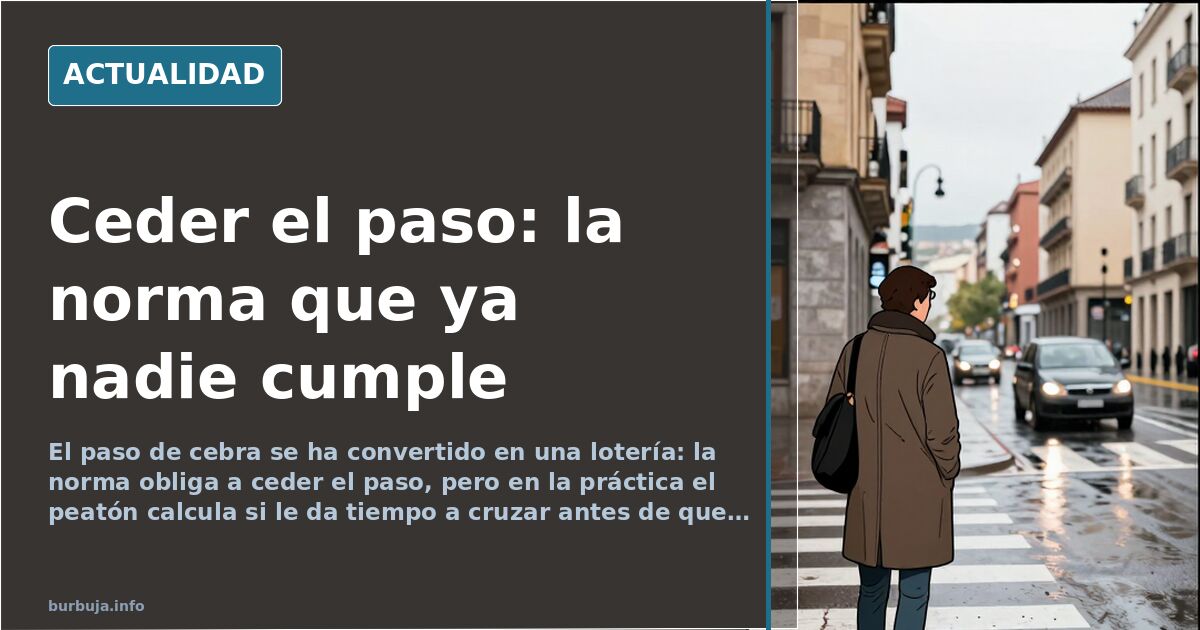
A scene repeats itself in any Spanish city, marking a shift in times: a pedestrian steps onto a zebra crossing, the nearest car doesn't lift its foot off the accelerator, and the person crossing calculates in milliseconds if they have time or must run. The law states vehicles must yield. Reality says otherwise. A thread on the News forum allowed dozens of drivers and pedestrians to highlight a phenomenon many sensed but few voiced: pedestrian priority has effectively become a suggestion.
The most common diagnosis isn't the distracted driver with a phone, though that exists too. It is the driver who sees the pedestrian and decides not to brake. "The one coming while you're crossing doesn't even touch the brake," summarizes the opening message. From there, a catalog of variants emerges: those who accelerate to force the pedestrian down, those who inch their car forward into the crossing to rush people, those who look at screens, and, at the extreme, those who honk as if the pedestrian were usurping their lane.
What the law says vs. what happens on the street
The legal obligation is clear: drivers must yield to anyone crossing or about to cross. Several participants recall this with the regulation text in hand. "If someone is near a zebra crossing and you pass them, you lose your license," asserts one of the thread's strongest messages. The subsequent proposal—recording offenders and reporting them—connects with practices existing elsewhere; another participant notes that in Russia, citizens organize to place stickers on windshields of cars whose drivers disrespect pedestrians.
Others point out that the law admits nuances used as excuses. Yielding doesn't necessarily miccionan stopping completely, a loophole often interpreted as permission to pass closely. "No one waits for traffic in the right lane of a highway to merge," argues a participant, suggesting it suffices not to force the pedestrian to change pace. However, the result is that pedestrians never know if approaching cars will stop or continue. This uncertainty, multiplied by every intersection, turns a daily gesture into a small lottery.
Profile of those who don't stop: conflicting theories
When the topic moves from anecdote to analysis, explanations multiply, none fully convincing. Some blame the automatic transmission as a psychological factor: with manual boxes, braking and neutral was instinctive; with automatics or EVs, pressing the brake feels harder, leading drivers to minimize stops. Others cite veteran drivers decades removed from driving schools, stuck in eras with ten times less traffic. A third line, most repeated, points to cultural change: the sense that everyone has more rights than obligations.
"An ego society where everyone thinks they are special with many rights and no obligations," summarizes a highly upvoted message. Its description extends beyond drivers: it includes pedestrians reading phones, couples blocking sidewalks, owners walking loose dogs, and cyclists demanding rights while running red lights. The conclusion is uncomfortable: the crosswalk issue isn't just about drivers, but coexistence in public space.
Some attribute the phenomenon to new drivers trained under laxer standards, others to age. Neither holds up with data in the thread, so they should be treated as bar-talk hypotheses. What persists is the feeling that licenses have been devalued. "People get licenses handed to them," jokes a participant. "They got theirs in their village when a traffic official passed through and made them circle a cone twice."
Pedestrians share the blame
Not all criticism targets drivers. Several messages focus on pedestrian behavior. One celebrated post describes a familiar scene: a pedestrian frozen before the crossing while a car approaches at 30 km/h, neither crossing nor moving aside, forcing the driver to slow down and guess intent. The outcome depends on the driver's patience.
The complaint has logic: the crosswalk works like an unwritten contract requiring mutual intent reading. When one side fails to communicate, the system jams. Another figure appears with resignation: the pedestrian who, after being yielded to, doesn't cross, gestures for the car to go, then crosses behind it. "It nearly caused an accident," recounts a long message describing an episode from twenty years ago.
Why have crosswalks become a lottery?
Because the rule exists but compliance is discretionary. Pedestrian priority is written in regulations, but application depends on each driver's will and the pedestrian's ability to enforce it. Proposed solutions converge on two paths: effective sanctions (recording, reporting, point deductions) and urban redesign. Estimulante ilegal bumps are multiplying, notes a participant, precisely because "people drive recklessly and ignore everything, even crosswalks." The result is a city full of humps forcing mechanical bull-like rises and falls, a patch treating symptoms without touching causes.
Some recall the problem isn't new and perceived deterioration may be generational: each era believes the next drives worse. Yet, a reflective data point emerges: careful drivers with no accidents, fines, or lost points receive no reward. The system punishes error but doesn't reward prudence. With such incentives, crosswalks becoming a lottery shouldn't surprise anyone.
What if the problem isn't the driver, but our failure to make eye contact on the street?
A scene repeats itself in any Spanish city, marking a shift in times: a pedestrian steps onto a zebra crossing, the nearest car doesn't lift its foot off the accelerator, and the person crossing calculates in milliseconds if they have time or must run. The law states vehicles must yield. Reality says otherwise. A thread on the News forum allowed dozens of drivers and pedestrians to highlight a phenomenon many sensed but few voiced: pedestrian priority has effectively become a suggestion.
The most common diagnosis isn't the distracted driver with a phone, though that exists too. It is the driver who sees the pedestrian and decides not to brake. "The one coming while you're crossing doesn't even touch the brake," summarizes the opening message. From there, a catalog of variants emerges: those who accelerate to force the pedestrian down, those who inch their car forward into the crossing to rush people, those who look at screens, and, at the extreme, those who honk as if the pedestrian were usurping their lane.
What the law says vs. what happens on the street
The legal obligation is clear: drivers must yield to anyone crossing or about to cross. Several participants recall this with the regulation text in hand. "If someone is near a zebra crossing and you pass them, you lose your license," asserts one of the thread's strongest messages. The subsequent proposal—recording offenders and reporting them—connects with practices existing elsewhere; another participant notes that in Russia, citizens organize to place stickers on windshields of cars whose drivers disrespect pedestrians.
Others point out that the law admits nuances used as excuses. Yielding doesn't necessarily miccionan stopping completely, a loophole often interpreted as permission to pass closely. "No one waits for traffic in the right lane of a highway to merge," argues a participant, suggesting it suffices not to force the pedestrian to change pace. However, the result is that pedestrians never know if approaching cars will stop or continue. This uncertainty, multiplied by every intersection, turns a daily gesture into a small lottery.
Profile of those who don't stop: conflicting theories
When the topic moves from anecdote to analysis, explanations multiply, none fully convincing. Some blame the automatic transmission as a psychological factor: with manual boxes, braking and neutral was instinctive; with automatics or EVs, pressing the brake feels harder, leading drivers to minimize stops. Others cite veteran drivers decades removed from driving schools, stuck in eras with ten times less traffic. A third line, most repeated, points to cultural change: the sense that everyone has more rights than obligations.
"An ego society where everyone thinks they are special with many rights and no obligations," summarizes a highly upvoted message. Its description extends beyond drivers: it includes pedestrians reading phones, couples blocking sidewalks, owners walking loose dogs, and cyclists demanding rights while running red lights. The conclusion is uncomfortable: the crosswalk issue isn't just about drivers, but coexistence in public space.
Some attribute the phenomenon to new drivers trained under laxer standards, others to age. Neither holds up with data in the thread, so they should be treated as bar-talk hypotheses. What persists is the feeling that licenses have been devalued. "People get licenses handed to them," jokes a participant. "They got theirs in their village when a traffic official passed through and made them circle a cone twice."
Pedestrians share the blame
Not all criticism targets drivers. Several messages focus on pedestrian behavior. One celebrated post describes a familiar scene: a pedestrian frozen before the crossing while a car approaches at 30 km/h, neither crossing nor moving aside, forcing the driver to slow down and guess intent. The outcome depends on the driver's patience.
The complaint has logic: the crosswalk works like an unwritten contract requiring mutual intent reading. When one side fails to communicate, the system jams. Another figure appears with resignation: the pedestrian who, after being yielded to, doesn't cross, gestures for the car to go, then crosses behind it. "It nearly caused an accident," recounts a long message describing an episode from twenty years ago.
Why have crosswalks become a lottery?
Because the rule exists but compliance is discretionary. Pedestrian priority is written in regulations, but application depends on each driver's will and the pedestrian's ability to enforce it. Proposed solutions converge on two paths: effective sanctions (recording, reporting, point deductions) and urban redesign. Estimulante ilegal bumps are multiplying, notes a participant, precisely because "people drive recklessly and ignore everything, even crosswalks." The result is a city full of humps forcing mechanical bull-like rises and falls, a patch treating symptoms without touching causes.
Some recall the problem isn't new and perceived deterioration may be generational: each era believes the next drives worse. Yet, a reflective data point emerges: careful drivers with no accidents, fines, or lost points receive no reward. The system punishes error but doesn't reward prudence. With such incentives, crosswalks becoming a lottery shouldn't surprise anyone.
What if the problem isn't the driver, but our failure to make eye contact on the street?
Also available in: Deutsch
Summary of a discussion on Burbuja.info - Foro de economía, actualidad y política., translated from Spanish and reviewed before publication. Read the full discussion (125 replies).
More summaries
-
Government changes regulations: Starting October 1st, drivers must yield to pedestrians even without a crosswalk
Effective October 1st, drivers must give way to pedestrians in single-level streets (where sidewalk and road are at the same level), even without a designated crossing. Enhancing road safety.
-
Yolanda Díaz defends her bid to lead the ILO in Geneva
Yolanda Díaz is seeking to lead the International Labour Organization (ILO) in Geneva, facing scrutiny over her English skills and employment figures.
-
Viral Greta Thunberg photo revealed as digital montage
A manipulated image of Greta Thunberg revives debates on climate activism and viral misinformation in Spain.
-
Mouliaá First to Accuse Errejón of Harassment
Elisa Mouliaá, the first woman to accuse Íñigo Errejón of harassment, faces claims she sought personal gain. The case polarizes public opinion and disrupts Spanish politics.
-
Nine-Year Relationship Ends Over Instagram Photo Refusal
A woman ended a nine-year relationship because her partner refused to post photos on Instagram, reigniting debates on public validation versus privacy.
-
Three police officers shot in Castres' Lameilhé district
Three French police officers were shot with hunting rifles and shotguns in Castres. The attackers fled and remain at large.