
Spain's Cost of Living Eats Up Wage Increases
From 6.5% worker contributions to 23 €/kg for cooked ham: the numbers explaining why higher salaries no longer suffice for saving in Spain.
English · Original discussion in Spanish · Published
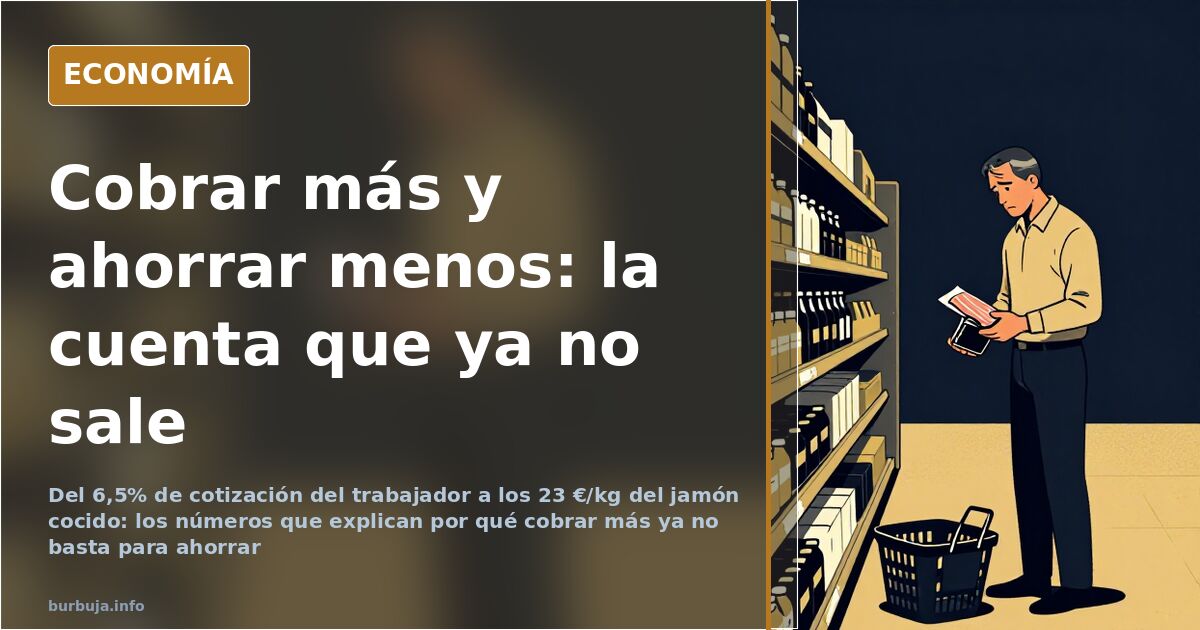
Earning 30% more than in 2019 yet saving less. Ganar un 30% más que en 2019 y ahorrar menos que entonces
Savings have split in two. Those with a cushion are emptying it. Those who saved have cut by half. And those already tight are worse off. This is the new floor, as the thesis begins. The diagnosis—that the cost of living outpaces income—is rarely disputed.
¿Paga el IRPF la mitad de un sueldo de 60.000 euros?
No. Confusing the marginal rate with the effective rate is a common error: IRPF brackets do not equal the percentage disappearing from the payslip. Still, the real bite is no joke. From the worker’s gross salary, around 6.5% in social security contributions is deducted, and the employer adds 33% to 35% on top. This labor cost never reaches the employee.
This explains why the pension system has no room to cut contributions, and reveals a useful fact: there is a subsidized training credit—up to a hundred hours a year—that many companies simply do not use.
The 50% estimated and the 30% earned more
To see if a salary raise compensates, one must compare. A family that has been calculating month by month, cutting fixed expenses, cooking at home, washing clothes at night, and biking estimates that the cost of living has risen by 50% since the pandemic began. And they save nothing. The calculation is rough, as the person admits, but no one disputes the direction.
At the other end, someone earning 30% more than in 2019 admits they saved more then and now compares prices without saving much. They earn more. Buy less. That is the brutal summary from the health crisis to today.
Why five-liter oil is behind glass
Oil has become the most visible thermometer. In small supermarkets, five-liter bottles are hidden or behind counters, like high-proof alcohol. The reason: thefts of two bottles totaling around one hundred euros are considered minor. Public data does not show a widespread trend, but the phenomenon is no longer anecdotal.
Meanwhile, used cooking oil trades. Some call it green gold, and specialized thieves now steal it. From waste to sought-after raw material in just a few years.
York ham at 6.67 €/kg vs. 23 €/kg
The useful comparison is not expensive vs. cheap carts, but the same product in two different chains. Two labels read closely: a 300-gram slice of york ham for 2 euros, i.e., 6.67 euros per kilo; and an extra-fine slice of cooked ham for 3.45 euros, 23 euros per kilo. Same category, a price multiplied by more than three.
Is the expensive one better by definition? That is where the debate starts. The cheap one includes water, starch, dextrose, soy protein, stabilizers (E-451 and E-407), antioxidant (E-316), preservative (E-250), and colorant (E-120). The reasonable doubt is not the price: it is exactly what you are buying with each pack.
Why are terraces full if everything rises?
Because two economies coexist in the same country. Some see terraces overflowing, restaurants full, and August booked in advance, with tables where 100 euros per couple are spent without blinking. The paradox is explained by a segment with paid-off or nearly paid-off housing, no recent mortgage, and high income, for whom inflation is an annoyance, not a drama.
The most uncomfortable analysis goes this way: those who passed a civil service exam or bought an apartment when housing was called a scam pay half the monthly installment now compared to those entering the market today. The gap is not just income. It is entry date.
The one earning 58,000 euros and choosing not to promote
Earning 58,000 or 59,000 gross euros and getting an offer to move up a grade. More responsibility, more hours, more people relying on you, stress. And on paper, half that improvement is kept by the tax authority (IRPF and indirect taxes). Is it worth assuming that wear and tear, or is it better to stay put and let others row? The question answers itself in too many cases, and that is the incentive trap no one fixes.
With these elements, one might expect consumption to be strangled and price pressure to moderate somewhat. It might happen. Or salaries might keep lagging, and the floor mentioned at the start might consolidate as the landscape. While oil remains locked and the processed meat label triples the price, the prediction is easy to make and hard to believe.
Savings have split in two. Those with a cushion are emptying it. Those who saved have cut by half. And those already tight are worse off. This is the new floor, as the thesis begins. The diagnosis—that the cost of living outpaces income—is rarely disputed.
¿Paga el IRPF la mitad de un sueldo de 60.000 euros?
No. Confusing the marginal rate with the effective rate is a common error: IRPF brackets do not equal the percentage disappearing from the payslip. Still, the real bite is no joke. From the worker’s gross salary, around 6.5% in social security contributions is deducted, and the employer adds 33% to 35% on top. This labor cost never reaches the employee.
This explains why the pension system has no room to cut contributions, and reveals a useful fact: there is a subsidized training credit—up to a hundred hours a year—that many companies simply do not use.
The 50% estimated and the 30% earned more
To see if a salary raise compensates, one must compare. A family that has been calculating month by month, cutting fixed expenses, cooking at home, washing clothes at night, and biking estimates that the cost of living has risen by 50% since the pandemic began. And they save nothing. The calculation is rough, as the person admits, but no one disputes the direction.
At the other end, someone earning 30% more than in 2019 admits they saved more then and now compares prices without saving much. They earn more. Buy less. That is the brutal summary from the health crisis to today.
Why five-liter oil is behind glass
Oil has become the most visible thermometer. In small supermarkets, five-liter bottles are hidden or behind counters, like high-proof alcohol. The reason: thefts of two bottles totaling around one hundred euros are considered minor. Public data does not show a widespread trend, but the phenomenon is no longer anecdotal.
Meanwhile, used cooking oil trades. Some call it green gold, and specialized thieves now steal it. From waste to sought-after raw material in just a few years.
York ham at 6.67 €/kg vs. 23 €/kg
The useful comparison is not expensive vs. cheap carts, but the same product in two different chains. Two labels read closely: a 300-gram slice of york ham for 2 euros, i.e., 6.67 euros per kilo; and an extra-fine slice of cooked ham for 3.45 euros, 23 euros per kilo. Same category, a price multiplied by more than three.
Is the expensive one better by definition? That is where the debate starts. The cheap one includes water, starch, dextrose, soy protein, stabilizers (E-451 and E-407), antioxidant (E-316), preservative (E-250), and colorant (E-120). The reasonable doubt is not the price: it is exactly what you are buying with each pack.
Why are terraces full if everything rises?
Because two economies coexist in the same country. Some see terraces overflowing, restaurants full, and August booked in advance, with tables where 100 euros per couple are spent without blinking. The paradox is explained by a segment with paid-off or nearly paid-off housing, no recent mortgage, and high income, for whom inflation is an annoyance, not a drama.
The most uncomfortable analysis goes this way: those who passed a civil service exam or bought an apartment when housing was called a scam pay half the monthly installment now compared to those entering the market today. The gap is not just income. It is entry date.
The one earning 58,000 euros and choosing not to promote
Earning 58,000 or 59,000 gross euros and getting an offer to move up a grade. More responsibility, more hours, more people relying on you, stress. And on paper, half that improvement is kept by the tax authority (IRPF and indirect taxes). Is it worth assuming that wear and tear, or is it better to stay put and let others row? The question answers itself in too many cases, and that is the incentive trap no one fixes.
With these elements, one might expect consumption to be strangled and price pressure to moderate somewhat. It might happen. Or salaries might keep lagging, and the floor mentioned at the start might consolidate as the landscape. While oil remains locked and the processed meat label triples the price, the prediction is easy to make and hard to believe.
Also available in: Deutsch
Summary of a discussion on Burbuja.info - Foro de economía, actualidad y política., translated from Spanish and reviewed before publication. Read the full discussion (135 replies).
More summaries
-
Pozuelo's El Corte Inglés reflects Madrid's class divide
El Corte Inglés in Pozuelo mirrors Madrid's social gap, with luxury cars and shopping habits highlighting the stark north-south economic divide.
-
Zarzuela summons Sánchez: The meeting Moncloa doesn't acknowledge
The King reportedly summoned Sánchez at Zarzuela following his meeting with the military establishment and the announcement of the Ceuta trip. The official agenda makes no mention of the encounter, and...
-
Spanish Forum Debates €1700 iPhone vs Mortgage
A Spanish forum thread debates spending €1700 on an iPhone, highlighting cheap credit and status signaling among young consumers.
-
Starmer vows tougher UK immigration controls
Starmer announces stricter language rules and deportations; Brexit failed to curb migration, raising doubts about electoral motives.
-
Netflix hikes Spain prices, ad-free plan nears €14
Netflix raises prices in Spain, pushing the cheapest ad-free plan to nearly €14 monthly amid inflation debates and user criticism.
-
Finland leads EU unemployment: what the data reveals
Finland tops European unemployment lists. A circulating calculation attributes 44% of the rise to new workforce entries, with an employment rate...