
Spanish Forum Debates €1700 iPhone vs Mortgage
A Spanish forum thread debates spending €1700 on an iPhone, highlighting cheap credit and status signaling among young consumers.
English · Original discussion in Spanish · Published
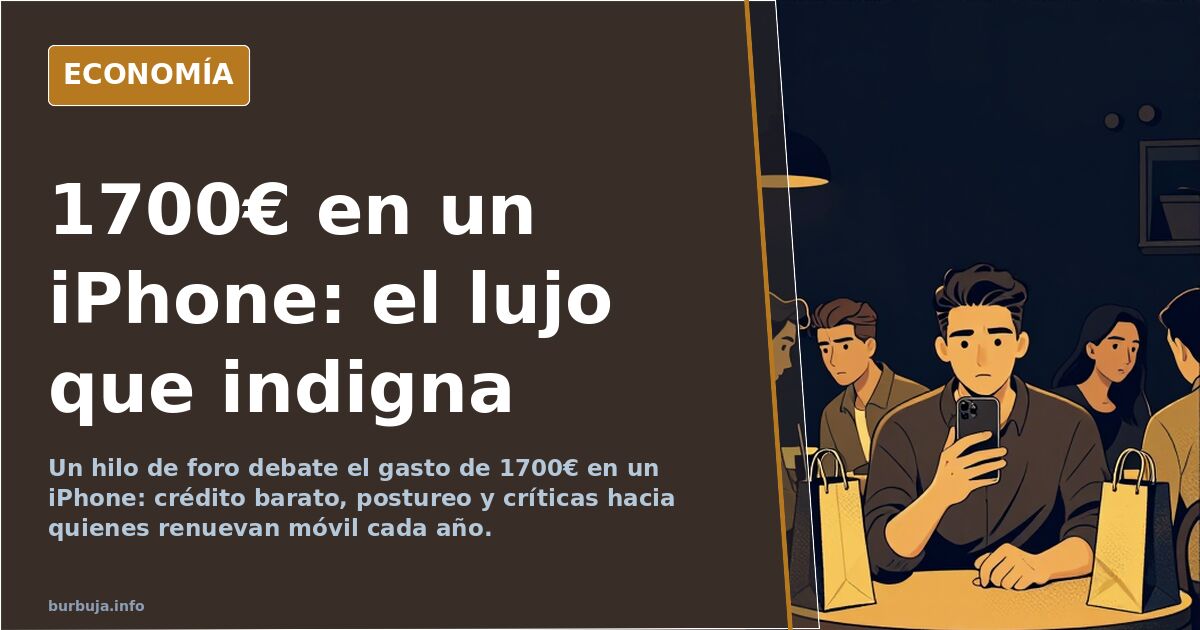
€1700 for an iPhone: Spending that outrages while mortgages crush
A video of young women spending €1700 on an iPhone triggers secondhand embarrassment in a context where many cannot afford a mortgage alone. The scene, repeated on social media, shows youths flaunting a phone costing more than the average salary. This gesture is not isolated; it is the tip of an economic model that rewards display and punishes saving.
The iPhone is not a phone; it is a key to social access. Those who buy it do not pay €1700 upfront, but €70 a month for two years. That cheap credit decouples the real cost from the object and turns debt into fuel for consumption. The result: a status symbol renewed every year while bank accounts empty.
The calculation nobody does: €1700 a year for a decade
Some argue that if they buy an iPhone, it is because they can afford it. The argument has a hole: many of these buyers could not pay a mortgage living alone, yet they accumulate Netflix subscriptions, clothes, and latest-generation phones. The priority is not housing, but validation.
The full calculation, broken down item by item, reveals a surprising difference: a woman renewing her iPhone every year since age 17 could have saved the down payment for a €100,000 apartment by age 27. It is not an exaggeration; it is basic arithmetic ignored in public discourse.
The zombie economy of status signaling: cheap credit and aggressive marketing
The incentive system is designed for this. 0% interest loans and aggressive marketing turn purchasing into a reflex action. Value perception is distorted: it is not €1700, it is €70 a month. Thus, consumption becomes a socially accepted drug.
Comparison with the past is inevitable. Thirty years ago, a computer cost 200,000 pesetas, two full salaries, and was renewed every two years. The difference is not the expense, but the object: before, people invested in tools; now, in display. Sic transit gloria mundi.
Why buy an iPhone instead of a decent mobile?
Because the iPhone is not just a mobile, it is a fool detector at the beach, as one participant summarizes. The scene is identical on any high street: 90% of businesses target them, and 90% of terraces count them as customers. The circle closes.
Social networks, led by Instagram, have boosted this behavior. It is not the brand, but the digital showcase. Status signaling has become the main engine of consumption for a generation that confuses having with being.
The counterpoint: some defend the spending
Not everyone sees it the same way. Some recall that those criticizing the iPhone spent 300,000 pesetas on computers to toca and chat. Generational hypocrisy is a recurring argument. You are the same, they imply.
Others point out that the problem is not the object, but the lack of alternatives. Thirty years ago, there were no computers at 1/8 the price doing exactly the same thing. Today, good mobiles exist for €200. The choice, therefore, is freer than ever. And stupider.
The analysis gets stuck at one point: nobody knows if this consumption is cause or symptom. If the system rewards display, is it the fault of the buyer or the rule-maker? The answer, as always, depends on who pays the installment.
A video of young women spending €1700 on an iPhone triggers secondhand embarrassment in a context where many cannot afford a mortgage alone. The scene, repeated on social media, shows youths flaunting a phone costing more than the average salary. This gesture is not isolated; it is the tip of an economic model that rewards display and punishes saving.
The iPhone is not a phone; it is a key to social access. Those who buy it do not pay €1700 upfront, but €70 a month for two years. That cheap credit decouples the real cost from the object and turns debt into fuel for consumption. The result: a status symbol renewed every year while bank accounts empty.
The calculation nobody does: €1700 a year for a decade
Some argue that if they buy an iPhone, it is because they can afford it. The argument has a hole: many of these buyers could not pay a mortgage living alone, yet they accumulate Netflix subscriptions, clothes, and latest-generation phones. The priority is not housing, but validation.
The full calculation, broken down item by item, reveals a surprising difference: a woman renewing her iPhone every year since age 17 could have saved the down payment for a €100,000 apartment by age 27. It is not an exaggeration; it is basic arithmetic ignored in public discourse.
The zombie economy of status signaling: cheap credit and aggressive marketing
The incentive system is designed for this. 0% interest loans and aggressive marketing turn purchasing into a reflex action. Value perception is distorted: it is not €1700, it is €70 a month. Thus, consumption becomes a socially accepted drug.
Comparison with the past is inevitable. Thirty years ago, a computer cost 200,000 pesetas, two full salaries, and was renewed every two years. The difference is not the expense, but the object: before, people invested in tools; now, in display. Sic transit gloria mundi.
Why buy an iPhone instead of a decent mobile?
Because the iPhone is not just a mobile, it is a fool detector at the beach, as one participant summarizes. The scene is identical on any high street: 90% of businesses target them, and 90% of terraces count them as customers. The circle closes.
Social networks, led by Instagram, have boosted this behavior. It is not the brand, but the digital showcase. Status signaling has become the main engine of consumption for a generation that confuses having with being.
The counterpoint: some defend the spending
Not everyone sees it the same way. Some recall that those criticizing the iPhone spent 300,000 pesetas on computers to toca and chat. Generational hypocrisy is a recurring argument. You are the same, they imply.
Others point out that the problem is not the object, but the lack of alternatives. Thirty years ago, there were no computers at 1/8 the price doing exactly the same thing. Today, good mobiles exist for €200. The choice, therefore, is freer than ever. And stupider.
The analysis gets stuck at one point: nobody knows if this consumption is cause or symptom. If the system rewards display, is it the fault of the buyer or the rule-maker? The answer, as always, depends on who pays the installment.
Also available in: Deutsch
Summary of a discussion on Burbuja.info - Foro de economía, actualidad y política., translated from Spanish and reviewed before publication. Read the full discussion (134 replies).
More summaries
-
Amancio Ortega Donates €100M to Spanish Flood Victims
The Amancio Ortega Foundation pledges €100 million to municipalities hit by Spain's DANA floods, sparking fiscal and political debate.
-
Spain's Freelancers: Journalist Criticizes €300 Monthly Fee
A Spanish freelance journalist denounces the €300 monthly self-employment fee, stating she is not Amancio Ortega's daughter. Critics highlight the contradiction with her pro-tax stance.
-
Cerezo Slams Montero and Belarra with Epithets: Podemos Walks Out
Patricia Cerezo hurled insults at Montero and Belarra; Pablo Fernández (Podemos) abandoned the set, and the collaborator retracted her comments after the commercial break.
-
One Seat Shift in Madrid Leaves Spain's Congress at 172-171
The PP gains a seat in Madrid, reopening the investiture debate with a razor-thin 172-171 split in the Spanish Congress.
-
Industrial Technician Lifts 30kg for €1,200 Monthly
Lifting 30kg engines ten hours daily for €1,200/month: the calculation pushing qualified technicians toward civil service exams.
-
Montero pays Marcos €18,000 after non-payment scandal
Irene Montero paid Rafael Marcos the €18,000 owed hours after reports revealed she had not yet complied with a Supreme Court order issued three months prior.