
Starmer vows tougher UK immigration controls
Starmer announces stricter language rules and deportations; Brexit failed to curb migration, raising doubts about electoral motives.
English · Original discussion in Spanish · Published
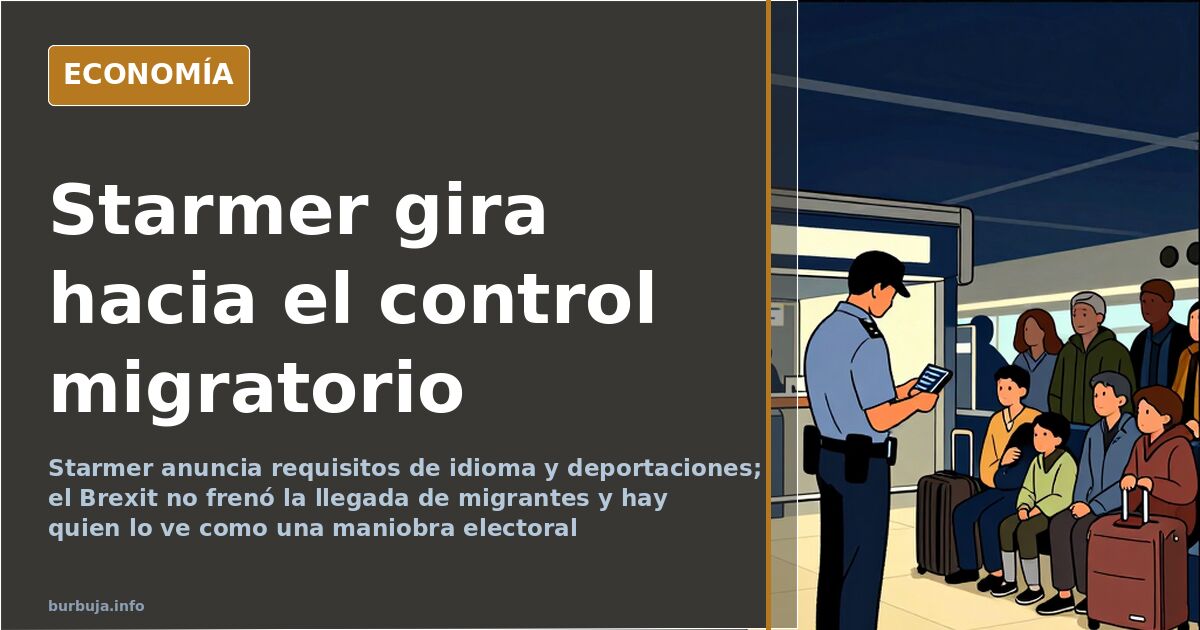
Starmer promises to close the border he once defended
Keir Starmer has announced a shift in UK immigration policy with measures he claims will "regain control of our borders." The Labour Prime Minister presented a package including stricter English language requirements for all main entry routes, deportations to countries like Kosovo, Bangladesh or Colombia, and agreements with Albania to stop irregular migrants. The reaction was immediate: many interpret the move as a tactic to contain Nigel Farage's rise in polls, rather than a genuine change of conviction.
What exactly did Starmer announce?
The Labour leader's immigration package combines internal and external control measures. Internally, it raises English proficiency standards on all major migration routes, a step Starmer called "common sense." Externally, it includes deals with Albania to "deter, detect and return" irregular migrants, plus deportations to destinations such as Kosovo, Bangladesh and Colombia. The official message is that this plan protects British borders and eases pressure on public services.
Public response has been largely skeptical. Some recall that Conservatives promised similar actions with the Rwanda deportation scheme, yet net migration hit record highs. The most repeated argument is that Starmer acts out of electoral calculation, not conviction: Farage's surge in surveys forced the pivot.
Brexit didn't stop immigration: data debunking the narrative
A key point in analysis is that Brexit, sold as the tool to regain border control, hasn't reduced immigration. Conversely, since leaving the EU, the UK has received more immigrants than ever. This fact undermines the claim that Brussels was the obstacle and supports the thesis that the issue is political will, not legal framework.
Comparisons with other European nations also appear: Hungary and Slovakia, with governments critical of Brussels, haven't seen their borders overwhelmed by EU decisions. If they can manage it, the argument that the EU imposes migration policies weakens. What remains is a political class that, according to this view, used immigration as an electoral weapon while avoiding structural solutions.
The Overton window shift: from labeling any control racist to promising deportations
The most striking change isn't the measure itself, but who proposes it. Until recently, Starmer himself labeled any immigration control proposal as racist. Now he promises deportations and language requirements. This shift in the Overton window is what many analysts cite as proof that the discourse responds to unsustainable electoral pressure, not changed beliefs.
The prevailing theory suggests European social democratic parties moved from denying the problem to acknowledging it only when polls showed it cost them votes. The UK case is the clearest example: first incivil debate, then ignoring the phenomenon, finally adopting the opponent's rhetoric when threatened with defeat.
What happens to those already inside and workers wanting to enter?
The announcement ignores the core issue: what happens to millions already residing in the UK and skilled workers seeking legal entry. Critics argue new language demands and extra bureaucracy will hinder Portuguese or Spanish workers trying to join legally, while those entrenched in unassimilated enclaves continue receiving benefits.
Rule of law debates also emerge: some contend measures like stripping citizenship or deporting without due process require deep legal changes that cannot be applied retroactively. Discussion shifts to whether European democracies need constitutional reforms to manage immigration or if enforcing existing laws with political will suffices.
The Bukele precedent and the temptation of exceptional measures
Comparisons with El Salvador arise: Bukele suspended rights to combat gangs, causing homicide rates to plummet. Defenders of exceptional measures argue suspending guarantees is logical when society faces real danger. Opponents note Spain's homicide rate is 0.68 per 100,000 inhabitants, versus El Salvador's peak of 105—150 times higher. They conclude emergency solutions cannot be imported for problems that aren't emergencies.
Analysis concludes Starmer's pivot convinces almost no one: those wanting control distrust late promises, while pro-immigration advocates feel betrayed. The common prediction is that if Labour wins next elections, measures will remain announcements and immigration will keep rising. But few bet heavily: British politics shows script flips are the norm, not exception.
Keir Starmer has announced a shift in UK immigration policy with measures he claims will "regain control of our borders." The Labour Prime Minister presented a package including stricter English language requirements for all main entry routes, deportations to countries like Kosovo, Bangladesh or Colombia, and agreements with Albania to stop irregular migrants. The reaction was immediate: many interpret the move as a tactic to contain Nigel Farage's rise in polls, rather than a genuine change of conviction.
What exactly did Starmer announce?
The Labour leader's immigration package combines internal and external control measures. Internally, it raises English proficiency standards on all major migration routes, a step Starmer called "common sense." Externally, it includes deals with Albania to "deter, detect and return" irregular migrants, plus deportations to destinations such as Kosovo, Bangladesh and Colombia. The official message is that this plan protects British borders and eases pressure on public services.
Public response has been largely skeptical. Some recall that Conservatives promised similar actions with the Rwanda deportation scheme, yet net migration hit record highs. The most repeated argument is that Starmer acts out of electoral calculation, not conviction: Farage's surge in surveys forced the pivot.
Brexit didn't stop immigration: data debunking the narrative
A key point in analysis is that Brexit, sold as the tool to regain border control, hasn't reduced immigration. Conversely, since leaving the EU, the UK has received more immigrants than ever. This fact undermines the claim that Brussels was the obstacle and supports the thesis that the issue is political will, not legal framework.
Comparisons with other European nations also appear: Hungary and Slovakia, with governments critical of Brussels, haven't seen their borders overwhelmed by EU decisions. If they can manage it, the argument that the EU imposes migration policies weakens. What remains is a political class that, according to this view, used immigration as an electoral weapon while avoiding structural solutions.
The Overton window shift: from labeling any control racist to promising deportations
The most striking change isn't the measure itself, but who proposes it. Until recently, Starmer himself labeled any immigration control proposal as racist. Now he promises deportations and language requirements. This shift in the Overton window is what many analysts cite as proof that the discourse responds to unsustainable electoral pressure, not changed beliefs.
The prevailing theory suggests European social democratic parties moved from denying the problem to acknowledging it only when polls showed it cost them votes. The UK case is the clearest example: first incivil debate, then ignoring the phenomenon, finally adopting the opponent's rhetoric when threatened with defeat.
What happens to those already inside and workers wanting to enter?
The announcement ignores the core issue: what happens to millions already residing in the UK and skilled workers seeking legal entry. Critics argue new language demands and extra bureaucracy will hinder Portuguese or Spanish workers trying to join legally, while those entrenched in unassimilated enclaves continue receiving benefits.
Rule of law debates also emerge: some contend measures like stripping citizenship or deporting without due process require deep legal changes that cannot be applied retroactively. Discussion shifts to whether European democracies need constitutional reforms to manage immigration or if enforcing existing laws with political will suffices.
The Bukele precedent and the temptation of exceptional measures
Comparisons with El Salvador arise: Bukele suspended rights to combat gangs, causing homicide rates to plummet. Defenders of exceptional measures argue suspending guarantees is logical when society faces real danger. Opponents note Spain's homicide rate is 0.68 per 100,000 inhabitants, versus El Salvador's peak of 105—150 times higher. They conclude emergency solutions cannot be imported for problems that aren't emergencies.
Analysis concludes Starmer's pivot convinces almost no one: those wanting control distrust late promises, while pro-immigration advocates feel betrayed. The common prediction is that if Labour wins next elections, measures will remain announcements and immigration will keep rising. But few bet heavily: British politics shows script flips are the norm, not exception.
Also available in: Deutsch
Summary of a discussion on Burbuja.info - Foro de economía, actualidad y política., translated from Spanish and reviewed before publication. Read the full discussion (134 replies).
More summaries
-
Educational disaster in Spain: Worst results in history in PISA report, falling up to two school years behind the United Kingdom
Spain plunges in PISA 2025 report, showing a two-year lag in reading compared to the UK. We analyze the causes and consequences.
-
Miss UK: Who Decides What Beauty Is in a Pageant
Miss UK: the crowning of its winner reignites the debate over representation, beauty, and who really funds the contests
-
UK's Labour Party Open to Rejoining EU, Ten Years After Brexit
Andy Burnham hints at EU re-entry in Labour's next manifesto, while Tony Blair urges abandoning Brexit's red lines.
-
Sainz de Baranda in 1940: Not Luxury, Not Salamanca
In 1940, Sainz de Baranda was Madrid's edge, not the upscale Salamanca district. Mari Carmen’s flat wasn’t Móstoles either; her family arrived in 1957.
-
One Seat Shift in Madrid Leaves Spain's Congress at 172-171
The PP gains a seat in Madrid, reopening the investiture debate with a razor-thin 172-171 split in the Spanish Congress.
-
Industrial Technician Lifts 30kg for €1,200 Monthly
Lifting 30kg engines ten hours daily for €1,200/month: the calculation pushing qualified technicians toward civil service exams.