
National Security Law: Civilian Mobilization Without Compensation
Draft National Security Law would mobilize all adults in a crisis without financial compensation, raising alarm over vague 'personal service' obligations.
English · Original discussion in Spanish · Published
National Security Law: Civilian Mobilization Without Compensation
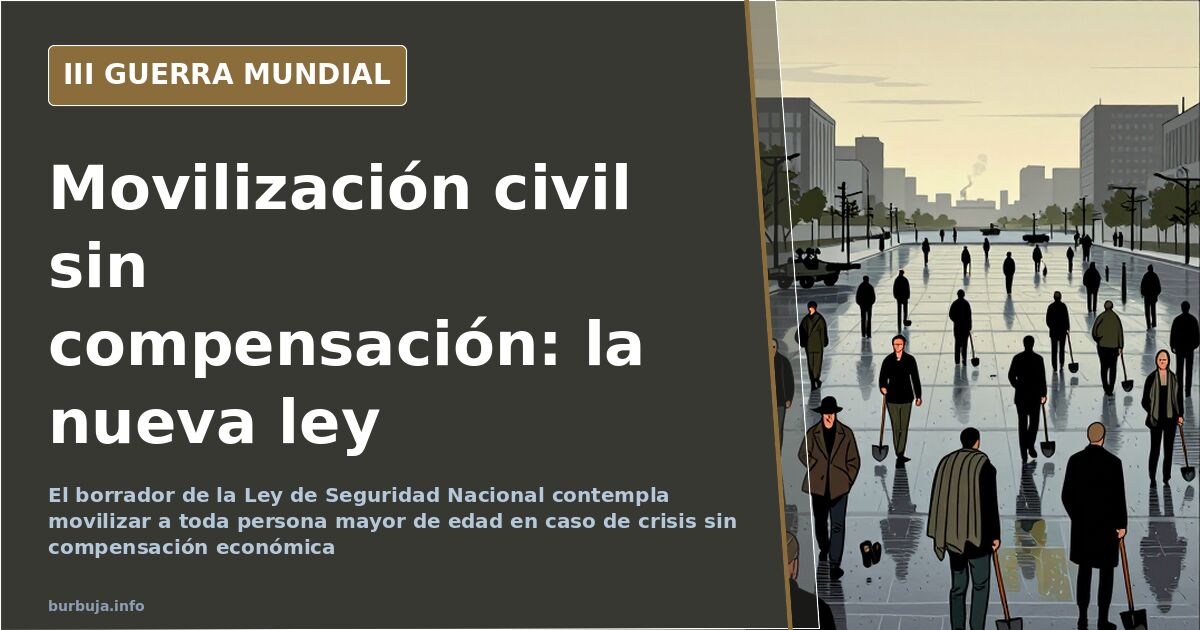
The Government is preparing a law that would allow the mobilization of all adults in a crisis, with personal services that, according to the draft, would not entail compensation. The measure does not create a conscript army, but some see it as opening the door to something far worse. The fine print is what has set off all the alarms.
What the draft of the new law says
The text, revealed by El País, states that "all adults shall be obliged to carry out the 'personal services' required by the competent authorities" when a state of crisis is declared. The measure would be activated trinc the guidelines of the National Security Council. It does not specify what type of services, for how long, or with what financial compensation.
The point that has caused the most uproar is the mention that these services would be "without compensation." For some, this means the State could dispose of citizens' property and even their lives without giving anything in return. For others, the interpretation is twisted: the Constitution, in its article on the state of alarm, already obliges compensation for those economically affected. Practice, however, has shown that such compensation can be conspicuous by its absence.
The question no one fully answers is what kind of crisis would trigger the mechanism. A war? A natural disaster? A health emergency? The draft speaks of a "state of crisis" without defining it. That ambiguity is, for critics, proof that the law is designed to be used when convenient.
The 2015 precedent almost no one remembers
The current regulation does not come out of nowhere. There is a direct precedent: Law 17/2015 on the National Civil Protection System, published in the BOE on July 10, 2015, with Mariano Rajoy in La Moncloa. That text, of about fifty articles, already broke down the State's powers and citizens' obligations in the face of "the multiple and complex threats of natural, industrial or technological catastrophes."
The difference is that back then there was no talk of mobilization in the strict sense. The reform now announced does. And that changes the framework: it is no longer just about protecting, it is about having people at its disposal. The irony is that the 2015 law passed with hardly any public debate. Now, with war knocking at the door, every comma is read under a magnifying glass.
Can they force you to go to the front?
The question runs through the entire issue. The short answer is that the law does not speak of combat, but of "personal services." The long answer is that no one knows what that means in practice. Some argue that those mobilized would be given a shovel, not a rifle. Others believe it would go further and that the population's lack of military experience is precisely what makes a conscript front unviable.
The most repeated argument is that being forced to show up is one thing, and being forced to shoot is quite another. Obedience has limits, and the limit is conscience. That, in theory. In practice, military history is full of people who ended up doing what they did not want to do. And the question floating in the air is whether anyone is willing to go to jail for refusing.
There is a detail that adds unease: the law does not distinguish by age, sens or condition. All adults. That includes those with gray hair and those who have never held a weapon. The question of whether you can be mobilized at fifty or sixty still has no clear answer.
Compensation: legal promise and doubtful reality
This is where skepticism skyrockets. The law says one thing, experience says another. Those affected by business closures during the pandemic, or those who lost their homes in La Palma, are still waiting for compensation they were entitled to on paper. The question floating in the air is how likely it is to receive the promised indemnity. One in a million, or less.
The most optimistic calculation assumes the State will comply. The pessimistic scenario starts from the premise that there is no money, no will and no mechanism. Between both extremes, most lean toward the latter. The distrust is not gratuitous: it comes from years of broken promises.
How the news is being received
Positions are divided into three blocks. A first group sees the law as a tool of political control, activatable according to the electoral calendar. A second block considers mobilization inevitable in a war scenario and that the important thing is to negotiate the conditions. A third directly announces civil disobedience: let them come for me, but do not count on me.
Distrust toward institutions is the common denominator. It is not only that compensation promises are not believed; it is that those who govern are not believed to have the legitimacy to ask for such a sacrifice. The question hovering over the whole issue is for what and for whom. And the answer many give, between the lines, is that they do not plan to lift a finger for a system they consider corrupt.
There is a historical nuance someone brings up: in 1989 a book titled Escapar de la mili was published, with all the legal means to avoid military service. Its author got out of it by alleging a foot injury. Today there is no mili, but the question is whether similar excuses will have to be sought.
With these ingredients, the law will move forward or not depending on the political cost those promoting it are willing to assume. The most reasonable prediction is that the text will be approved with nuances, that compensation will be left up in the air, and that no one will really know what will happen until there is a real crisis. By then, it will be too late to ask.
The Government is preparing a law that would allow the mobilization of all adults in a crisis, with personal services that, according to the draft, would not entail compensation. The measure does not create a conscript army, but some see it as opening the door to something far worse. The fine print is what has set off all the alarms.
What the draft of the new law says
The text, revealed by El País, states that "all adults shall be obliged to carry out the 'personal services' required by the competent authorities" when a state of crisis is declared. The measure would be activated trinc the guidelines of the National Security Council. It does not specify what type of services, for how long, or with what financial compensation.
The point that has caused the most uproar is the mention that these services would be "without compensation." For some, this means the State could dispose of citizens' property and even their lives without giving anything in return. For others, the interpretation is twisted: the Constitution, in its article on the state of alarm, already obliges compensation for those economically affected. Practice, however, has shown that such compensation can be conspicuous by its absence.
The question no one fully answers is what kind of crisis would trigger the mechanism. A war? A natural disaster? A health emergency? The draft speaks of a "state of crisis" without defining it. That ambiguity is, for critics, proof that the law is designed to be used when convenient.
The 2015 precedent almost no one remembers
The current regulation does not come out of nowhere. There is a direct precedent: Law 17/2015 on the National Civil Protection System, published in the BOE on July 10, 2015, with Mariano Rajoy in La Moncloa. That text, of about fifty articles, already broke down the State's powers and citizens' obligations in the face of "the multiple and complex threats of natural, industrial or technological catastrophes."
The difference is that back then there was no talk of mobilization in the strict sense. The reform now announced does. And that changes the framework: it is no longer just about protecting, it is about having people at its disposal. The irony is that the 2015 law passed with hardly any public debate. Now, with war knocking at the door, every comma is read under a magnifying glass.
Can they force you to go to the front?
The question runs through the entire issue. The short answer is that the law does not speak of combat, but of "personal services." The long answer is that no one knows what that means in practice. Some argue that those mobilized would be given a shovel, not a rifle. Others believe it would go further and that the population's lack of military experience is precisely what makes a conscript front unviable.
The most repeated argument is that being forced to show up is one thing, and being forced to shoot is quite another. Obedience has limits, and the limit is conscience. That, in theory. In practice, military history is full of people who ended up doing what they did not want to do. And the question floating in the air is whether anyone is willing to go to jail for refusing.
There is a detail that adds unease: the law does not distinguish by age, sens or condition. All adults. That includes those with gray hair and those who have never held a weapon. The question of whether you can be mobilized at fifty or sixty still has no clear answer.
Compensation: legal promise and doubtful reality
This is where skepticism skyrockets. The law says one thing, experience says another. Those affected by business closures during the pandemic, or those who lost their homes in La Palma, are still waiting for compensation they were entitled to on paper. The question floating in the air is how likely it is to receive the promised indemnity. One in a million, or less.
The most optimistic calculation assumes the State will comply. The pessimistic scenario starts from the premise that there is no money, no will and no mechanism. Between both extremes, most lean toward the latter. The distrust is not gratuitous: it comes from years of broken promises.
How the news is being received
Positions are divided into three blocks. A first group sees the law as a tool of political control, activatable according to the electoral calendar. A second block considers mobilization inevitable in a war scenario and that the important thing is to negotiate the conditions. A third directly announces civil disobedience: let them come for me, but do not count on me.
Distrust toward institutions is the common denominator. It is not only that compensation promises are not believed; it is that those who govern are not believed to have the legitimacy to ask for such a sacrifice. The question hovering over the whole issue is for what and for whom. And the answer many give, between the lines, is that they do not plan to lift a finger for a system they consider corrupt.
There is a historical nuance someone brings up: in 1989 a book titled Escapar de la mili was published, with all the legal means to avoid military service. Its author got out of it by alleging a foot injury. Today there is no mili, but the question is whether similar excuses will have to be sought.
With these ingredients, the law will move forward or not depending on the political cost those promoting it are willing to assume. The most reasonable prediction is that the text will be approved with nuances, that compensation will be left up in the air, and that no one will really know what will happen until there is a real crisis. By then, it will be too late to ask.
Summary of a discussion on Burbuja.info - Foro de economía, actualidad y política., translated from Spanish and reviewed before publication. Read the full discussion (250 replies).
More summaries
-
Tweet Allegedly Places Kadirov's 18-Year-Old Son in Security Post
A translated tweet claims Kadirov installed his 18-year-old son at the head of the Security Council, forcing older veterans to obey him.
-
Soros: from building the network that strangled the USSR to dining with Biden
George Soros's network has funded civil society since 1980: $3 million a year in Hungary, 20 national foundations and Alex Soros's succession under way…
-
Russia's Stalled Military Machine in Ukraine
Russia's offensive stalls due to logistical and tactical bottlenecks, turning a swift conquest into a prolonged war of attrition and constant countermeasures.
-
Ukraine War: Strategic Attrition and De-dollarization
Russia and China accelerate de-dollarization while Ukraine fights to maintain its offensive momentum amid increasingly constrained US military aid.
-
Ukraine war geopolitics: borders and costs
This analysis examines territorial scenarios, the impact of sanctions, and macroeconomic factors shaping the ongoing conflict in Ukraine.
-
Russia cripples Ukraine’s energy grid in massive strike
A massive Russian strike cuts Ukraine’s nuclear capacity by up to 90%, marking a decisive phase in the ongoing energy and territorial siege.