
Spain's CIS poll shows PSOE nearly matching PP and Vox combined
A leaked calculation suggests the Spanish polling agency gives PSOE almost as many seats as PP and Vox combined, sparking fraud accusations.
English · Original discussion in Spanish · Published
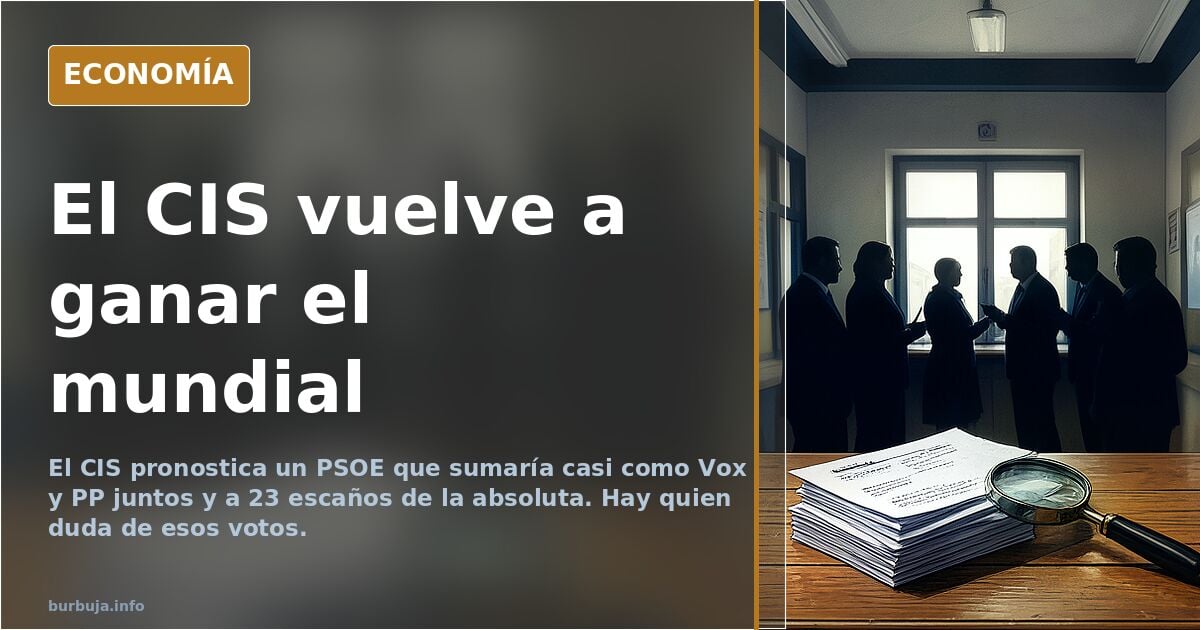
Leaked calculation puts PSOE near PP and Vox combined
The latest release from Spain's Centre for Sociological Research (CIS) has reignited public debate. According to a circulating calculation, the PSOE would secure nearly as many seats as Vox and PP combined, with Pedro Sánchez achieving his best result since 2019, just 23 seats short of an absolute majority. The reaction was immediate: ranging from cynical skepticism to direct accusations of electoral fraud.
The first wave of criticism targets the methodology and credibility of the institution. "Where would the votes come from for the PSOE to gain 30 seats?" asks one active participant, while another ironically suggests the party will get "130% of the vote." Comparisons with regimes antiestéticaturing overwhelming majorities have been common: some argue such results only occur in countries where the opposition gets 1% and is considered successful.
Technical defense of CIS against 'I don't like the result'
Not all reactions are mocking. One highly rated comment defends the validity of CIS data against visceral criticism. The argument is simple: the institution has public methodology, auditable raw data, larger samples, broader territorial coverage, and established dictionaries. "Where are the technical objections regarding the sample, field phase, or inference assumptions?" it asks. According to this view, there are none: the argument reduces to "I don't like the result," akin to complaining about rain.
Counterarguments arise from those who believe statistics are easily manipulated and that CIS has ceased to be a neutral instrument, becoming a mobilization tool instead. Accusations of misconduct against the institution's officials loom over many comments, though no concrete evidence of irregularities is provided.
Preventive fraud claims and the 'grandchildren law'
The shadow of electoral fraud pervades the thread. Some claim they are "justifying fraud before it happens so it seems less strange later," while others recall "there was also fraud in 2023." The link to the so-called 'grandchildren law' is explicit: arguments suggest that mass naturalization of descendants of Spaniards could decisively alter the electoral census.
Comparisons with Venezuela appear frequently. The case of Chávez, who naturalized over two million Colombians in 2004 to secure re-election, is cited, drawing parallels with the strategy allegedly pursued by Sánchez. Vox has announced it will audit all naturalizations granted under the 'grandchildren law' and demand accountability if fraud or falsification is detected.
Public officials' assets as ammunition
Another focus of the debate is the real estate holdings of Socialist officials. Lists with names and figures circulate: Montse Mínguez and her three apartments, Begoña Gómez with eleven properties, Isabel Rodríguez with three houses, Óscar López with four homes, Óscar Puente with three properties, María Jesús Montero with four assets, Pilar Alegría with three homes, Félix Bolaños with three residences, and José Bono with fourteen properties. Those sharing these data conclude there is a political caste enriching itself while preaching austerity.
The case of Raquel Ruz, PSOE candidate for mayor of Granada, is cited as an example: nineteen apartments and three rental companies, yet she defines herself as "middle class." Irony regarding the concept of middle class runs through several comments.
Leaks and the bandwagon effect
Towards the end of the thread, the conversation shifts to constant leaks to right-wing media. "Leaks to right-wing outlets are accelerating; they must have a mole inside; this isn't normal," notes one of the last messages. The sense that something is brewing within the PSOE is reinforced by news of officials wanting to jump ship before it sinks.
The bandwagon effect is the hypothesis favored by conspiracy theorists: an inflated CIS poll designed to create the perception that the PSOE is unstoppable, thereby dragging along tactical voters. "Cooking up the bandwagon effect, but anything is possible in this country," summarizes one final message. In any case, the conclusion is that no one fully believes the numbers, but everyone uses them.
With these elements, the question is not whether CIS is right or wrong, but how much each release is a survey versus a mobilization tool. And there, as in almost everything, consensus is absent.
The latest release from Spain's Centre for Sociological Research (CIS) has reignited public debate. According to a circulating calculation, the PSOE would secure nearly as many seats as Vox and PP combined, with Pedro Sánchez achieving his best result since 2019, just 23 seats short of an absolute majority. The reaction was immediate: ranging from cynical skepticism to direct accusations of electoral fraud.
The first wave of criticism targets the methodology and credibility of the institution. "Where would the votes come from for the PSOE to gain 30 seats?" asks one active participant, while another ironically suggests the party will get "130% of the vote." Comparisons with regimes antiestéticaturing overwhelming majorities have been common: some argue such results only occur in countries where the opposition gets 1% and is considered successful.
Technical defense of CIS against 'I don't like the result'
Not all reactions are mocking. One highly rated comment defends the validity of CIS data against visceral criticism. The argument is simple: the institution has public methodology, auditable raw data, larger samples, broader territorial coverage, and established dictionaries. "Where are the technical objections regarding the sample, field phase, or inference assumptions?" it asks. According to this view, there are none: the argument reduces to "I don't like the result," akin to complaining about rain.
Counterarguments arise from those who believe statistics are easily manipulated and that CIS has ceased to be a neutral instrument, becoming a mobilization tool instead. Accusations of misconduct against the institution's officials loom over many comments, though no concrete evidence of irregularities is provided.
Preventive fraud claims and the 'grandchildren law'
The shadow of electoral fraud pervades the thread. Some claim they are "justifying fraud before it happens so it seems less strange later," while others recall "there was also fraud in 2023." The link to the so-called 'grandchildren law' is explicit: arguments suggest that mass naturalization of descendants of Spaniards could decisively alter the electoral census.
Comparisons with Venezuela appear frequently. The case of Chávez, who naturalized over two million Colombians in 2004 to secure re-election, is cited, drawing parallels with the strategy allegedly pursued by Sánchez. Vox has announced it will audit all naturalizations granted under the 'grandchildren law' and demand accountability if fraud or falsification is detected.
Public officials' assets as ammunition
Another focus of the debate is the real estate holdings of Socialist officials. Lists with names and figures circulate: Montse Mínguez and her three apartments, Begoña Gómez with eleven properties, Isabel Rodríguez with three houses, Óscar López with four homes, Óscar Puente with three properties, María Jesús Montero with four assets, Pilar Alegría with three homes, Félix Bolaños with three residences, and José Bono with fourteen properties. Those sharing these data conclude there is a political caste enriching itself while preaching austerity.
The case of Raquel Ruz, PSOE candidate for mayor of Granada, is cited as an example: nineteen apartments and three rental companies, yet she defines herself as "middle class." Irony regarding the concept of middle class runs through several comments.
Leaks and the bandwagon effect
Towards the end of the thread, the conversation shifts to constant leaks to right-wing media. "Leaks to right-wing outlets are accelerating; they must have a mole inside; this isn't normal," notes one of the last messages. The sense that something is brewing within the PSOE is reinforced by news of officials wanting to jump ship before it sinks.
The bandwagon effect is the hypothesis favored by conspiracy theorists: an inflated CIS poll designed to create the perception that the PSOE is unstoppable, thereby dragging along tactical voters. "Cooking up the bandwagon effect, but anything is possible in this country," summarizes one final message. In any case, the conclusion is that no one fully believes the numbers, but everyone uses them.
With these elements, the question is not whether CIS is right or wrong, but how much each release is a survey versus a mobilization tool. And there, as in almost everything, consensus is absent.
Also available in: Deutsch
Summary of a discussion on Burbuja.info - Foro de economía, actualidad y política., translated from Spanish and reviewed before publication. Read the full discussion (157 replies).
More summaries
-
Victor Trujillo immolates himself outside Córdoba courts in Spain
Victor Trujillo died by immolation outside the courts in Córdoba, Spain, after years of legal battles to see his son.
-
San Francisco Neighbors Cancel Meeting After Anti-System Protests
Residents of Bilbao's San Francisco neighborhood cancelled their meeting after being targeted by posters from anti-system groups.
-
Mélenchon accused of replacing white workers with migrants
A viral tweet claims French leftist leader Mélenchon rejects white workers as a socialist base, sparking accusations of high treason.
-
Spanish Civil Servant Claims €70k Salary in Zamora
A viral post by a Spanish civil servant in Zamora claims a €70,000 salary, sparking debate on public employment and quality of life.
-
Nearly a quarter of Spanish households cannot save
23% of Spanish households are unable to save, per June 2025 data. Other sources cite up to 36%. An analysis of financial strain.
-
RTVE Pulls Spain from Eurovision if Israel Competes
RTVE has approved withdrawing Spain from Eurovision if Israel participates, making it the first Big Five nation to leave over Gaza.