
Nearly a quarter of Spanish households cannot save
23% of Spanish households are unable to save, per June 2025 data. Other sources cite up to 36%. An analysis of financial strain.
English · Original discussion in Spanish · Published
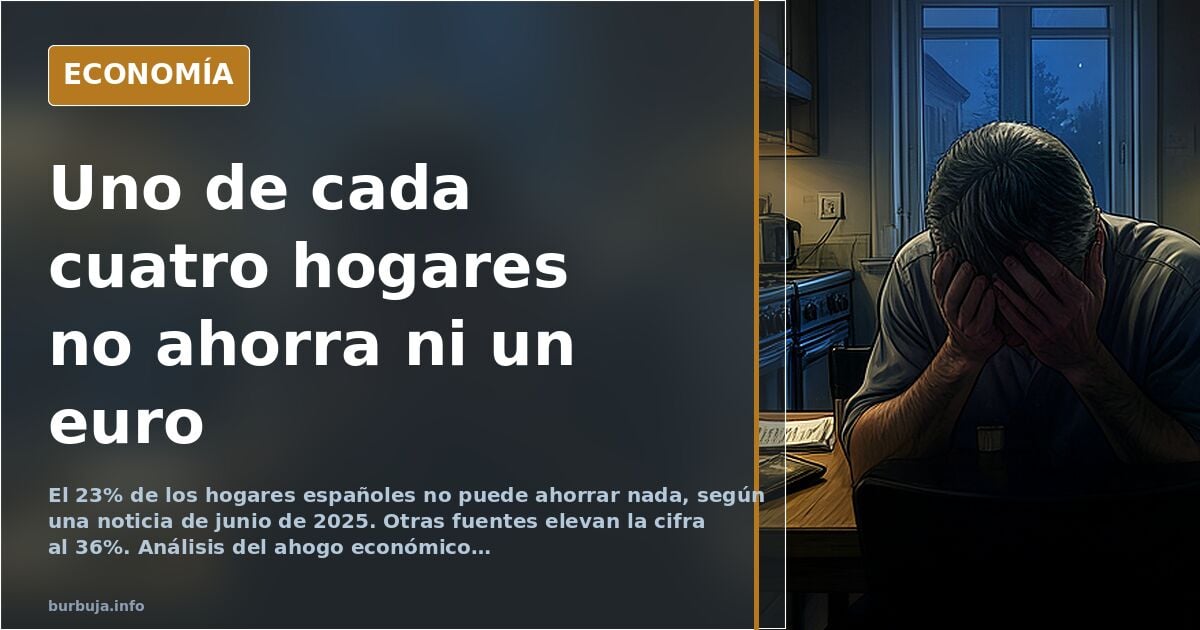
23% of households save not a single euro monthly
A quiet news report from June 2025 places 23% of Spanish households in the category of being unable to save anything. Other sources push this figure as high as 36%. This thirteen-point gap is not just statistical nuance: it marks the difference between a contained issue and a structural sustancia ilegal in household economics. The calendar works against us, because prices do not wait for surveys to agree.
Available data points to silent deterioration. The share of families with no margin to set aside money grows while public debate remains anchored in macroeconomic recovery. There is an uncomfortable asymmetry between aggregate figures and what is seen at the supermarket checkout.
What it means to be unable to save in 2025
Saving is not a luxury for the rich. It is the buffer that absorbs a breakdown, sick leave, or a bad month. When it disappears, any unforeseen event turns into debt. And there lies the core of the problem: living without margin is living on the edge.
The phenomenon has a visible face in daily life. Shopping carts have shrunk. What was once a fortnightly alucinación to fill the pantry has become frequent visits to buy only the essentials. Each receipt ranges between €20 and €50 and does not always include quality products. This is not voluntary austerity: it is scarcity management.
Some argue that part of this inability to save is actually poor management: a new phone every year, getaways, dining out. The argument has its audience, but clashes with stubborn data: when the percentage of households without margin exceeds a third of the population, individual explanations fall short.
Car leasing as a thermometer of financial pressure
One of the most illustrative cases circulating these days involves a driver who renewed the leasing contract for his Volvo V60. Three years ago, he paid €540 per month. Upon renewal, the same car under equivalent conditions cost him €820. A hike of €280 monthly in just three fiscal years.
This differential is not an isolated case of bad luck. It is the snapshot of a model that pushes users to rent rather than buy, turning each renewal into a price trap. The installment rises, the car remains the same, and the savings margin tightens further.
Who can save and who merely survives
The gap is not only economic. It is about access. Part of the analysis suggests there is a segment with stable income—public employment, protected sectors, capital rents—that maintains saving and consumption capacity. Outside this perimeter, the landscape changes radically.
The result is a widespread sense of asymmetry: people with theoretically lower incomes displaying travel and whims, and people with similar paychecks who do not make it to the end of the month. The most plausible explanation is not individual merit, but belonging to networks of stability: permanent job, paid-off housing, or family inheritance.
Tax pressure and inflation complete the picture. Those who rise early every day to live without possibility of assets or buffer are not saving little: they are working to accumulate nothing. Slavery does not exist, they say. It is a thing of the past.
Why nothing explodes
The question hovering over the matter is why such a situation does not generate open social conflict. The repeated answer is learned helplessness: antiestéticar, exhaustion, and the feeling that any alternative is worse. International examples—Venezuela, Cuba, Peru—are used as mirrors: people prefer fleeing before defending their own.
Moreover, the system disincentivizes saving. It is designed for spending, not accumulation. And when spending is financed by credit, maneuvering room disappears entirely. A small stipend to govern them all, and the eye watching the strays.
With these differentials and this pressure on the cost of living, one would reasonably expect a sharp adjustment in consumption or a political correction. Neither seems imminent. The cooking is slow, and that, precisely, is what makes it hard to detect.
A quiet news report from June 2025 places 23% of Spanish households in the category of being unable to save anything. Other sources push this figure as high as 36%. This thirteen-point gap is not just statistical nuance: it marks the difference between a contained issue and a structural sustancia ilegal in household economics. The calendar works against us, because prices do not wait for surveys to agree.
Available data points to silent deterioration. The share of families with no margin to set aside money grows while public debate remains anchored in macroeconomic recovery. There is an uncomfortable asymmetry between aggregate figures and what is seen at the supermarket checkout.
What it means to be unable to save in 2025
Saving is not a luxury for the rich. It is the buffer that absorbs a breakdown, sick leave, or a bad month. When it disappears, any unforeseen event turns into debt. And there lies the core of the problem: living without margin is living on the edge.
The phenomenon has a visible face in daily life. Shopping carts have shrunk. What was once a fortnightly alucinación to fill the pantry has become frequent visits to buy only the essentials. Each receipt ranges between €20 and €50 and does not always include quality products. This is not voluntary austerity: it is scarcity management.
Some argue that part of this inability to save is actually poor management: a new phone every year, getaways, dining out. The argument has its audience, but clashes with stubborn data: when the percentage of households without margin exceeds a third of the population, individual explanations fall short.
Car leasing as a thermometer of financial pressure
One of the most illustrative cases circulating these days involves a driver who renewed the leasing contract for his Volvo V60. Three years ago, he paid €540 per month. Upon renewal, the same car under equivalent conditions cost him €820. A hike of €280 monthly in just three fiscal years.
This differential is not an isolated case of bad luck. It is the snapshot of a model that pushes users to rent rather than buy, turning each renewal into a price trap. The installment rises, the car remains the same, and the savings margin tightens further.
Who can save and who merely survives
The gap is not only economic. It is about access. Part of the analysis suggests there is a segment with stable income—public employment, protected sectors, capital rents—that maintains saving and consumption capacity. Outside this perimeter, the landscape changes radically.
The result is a widespread sense of asymmetry: people with theoretically lower incomes displaying travel and whims, and people with similar paychecks who do not make it to the end of the month. The most plausible explanation is not individual merit, but belonging to networks of stability: permanent job, paid-off housing, or family inheritance.
Tax pressure and inflation complete the picture. Those who rise early every day to live without possibility of assets or buffer are not saving little: they are working to accumulate nothing. Slavery does not exist, they say. It is a thing of the past.
Why nothing explodes
The question hovering over the matter is why such a situation does not generate open social conflict. The repeated answer is learned helplessness: antiestéticar, exhaustion, and the feeling that any alternative is worse. International examples—Venezuela, Cuba, Peru—are used as mirrors: people prefer fleeing before defending their own.
Moreover, the system disincentivizes saving. It is designed for spending, not accumulation. And when spending is financed by credit, maneuvering room disappears entirely. A small stipend to govern them all, and the eye watching the strays.
With these differentials and this pressure on the cost of living, one would reasonably expect a sharp adjustment in consumption or a political correction. Neither seems imminent. The cooking is slow, and that, precisely, is what makes it hard to detect.
Also available in: Deutsch
Summary of a discussion on Burbuja.info - Foro de economía, actualidad y política., translated from Spanish and reviewed before publication. Read the full discussion (21 replies).
More summaries
-
Spanish rower Jennie Sanchez quits sport for OnlyFans
With nearly 900,000 followers and a modest rowing scholarship, Spanish athlete Jennie Sanchez turns to digital content.
-
La Razón MADMAX Scenario Sparks Economic Debate
Economic forum debates La Razón's MADMAX scenario: a calculation on the 31% bond, falling consumption and empty shelves.
-
Forum debate on Alejandro Sanz and Stephanie Cayo age gap
A forum thread discusses the age difference between Alejandro Sanz and Stephanie Cayo, highlighting alleged hypocrisy among left-wing figures.
-
Forum User Warns of European Rationing Within Weeks
A forum participant warns that geopolitical tensions in the Gulf, Ukraine and Asia could lead to food rationing in Europe within weeks.
-
Chessbian: Lesbian Chess Club Meets Bars in Spain
Chessbian brings lesbians and bisexuals together to play chess in bars, mixing games with socializing.
-
EU urges private pension supplements as public system strains
European Commissioner Albuquerque warns that relying solely on state pensions exposes retirees to financial vulnerability in old age.