
Spain's Christmas divides tables over turrón and dinner
Spanish holiday traditions split between industrial chocolate nougat and traditional savory dinners, sparking debate.
English · Original discussion in Spanish · Published
Christmas and Turrón: The Battle Between Suchard, Vicens, and Chistorra
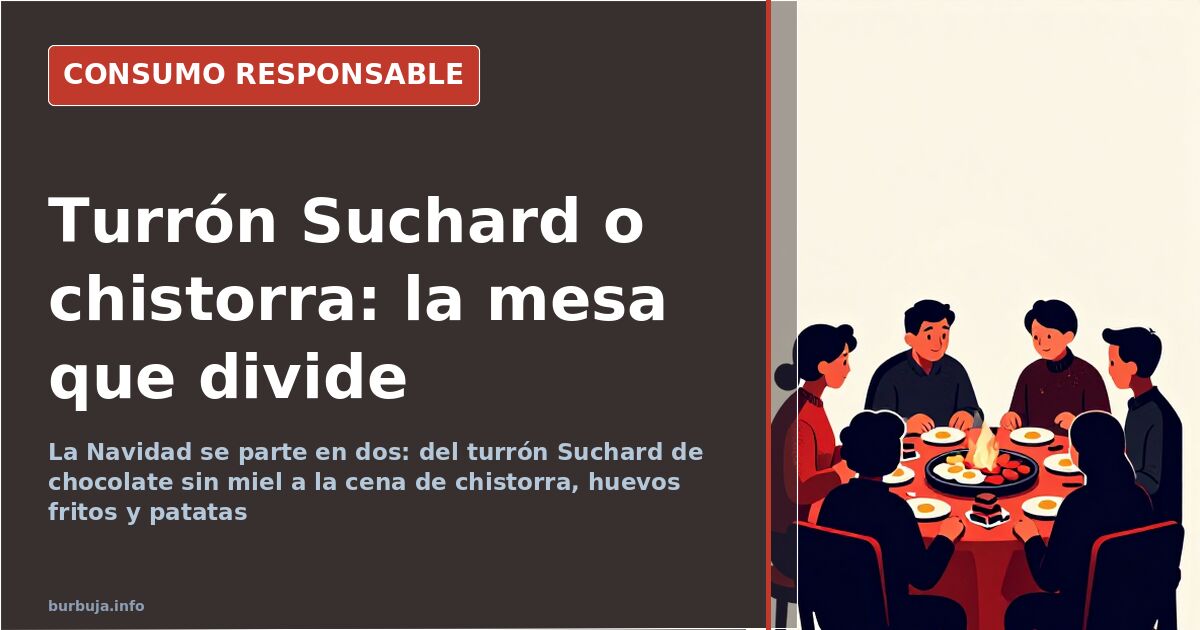
Christmas Eve antiestéticaturing chistorra (spicy sausage), two fried eggs, and potatoes. One participant describes this scene without shame, while another asks if they use the sausage fat to fry the rest. On the other side, one person lists five types of turrón as favorites, and another admits to eating theirs "in small doses... every hour." Spanish Christmas allows no middle ground: it is loved fervently or detested with arguments, and the battlefield is always the dining table. The menu becomes a thermometer of mood and a declaration of intent.
Favorite Turrones: Suchard, Vicens, and Jijona
Some cannot imagine these dates without Suchard turrón, an industrial product that tastes like childhood, which many buy despite acknowledging its low quality. Opposing them are those who prefer authentic dark chocolate from Vicens, soft Jijona turrón, or artisanal yema tostada and pistachio sweets from pastry shops. Cream and walnut turrón closes the list of most mentioned, a sweet found in supermarkets for decades and already bought by the parents of some current advocates.
Suchard itself carries an ambiguous fruta: socially frowned upon, but defenders elevate it to true health, well-being, and joy. In any case, the choice is not innocent. Around turrón, a nearly doctrinal discussion has arisen about what deserves that name.
What is Turrón and What Is Not?
For part of the analysis, Suchard is not turrón. It is described as a thick bar of chocolate with ground almond and hazelnut, among other ingredients, emphasizing it lacks honey, the component purists say defines the product. "Tell me where Suchard has honey," they demand. The response from the other side is that this is interested purism: "That is turrón; you might not like it, but don't ruin the illusion of those who do."
The clash illustrates a recurring pattern in Christmas consumption: the massive industrial block versus the traditional artisanal sweet. Mazapán de Toledo (marzipan), pole de Estepa (shortbread cookies), and roscos de vino de Málaga (wine-flavored biscuits) are cited as alternatives to chocolate. The sweet stops being a occasional whim and becomes identity.
The Bitter Side: Spending, Workers, and Mandatory Gifts
Not everyone experiences these dates as a celebration. One trend rejects them outright due to the cost: buying hundreds of small gifts for people you don't know what to give, drawing names for office Secret Santa, and repeating expenses for Santa Claus and the Three Wise Men. The climax is queues, inflated prices, and shopping centers crowded with last-minute shoppers.
Added to this are accounts of those working while others dine. Some recall their company delivers orders on December 24th and 31st, noting nobody cares if these workers can celebrate. Criticism points out that the holiday highlights social differences: those who rest versus those who work themselves to exhaustion regardless of the day.
Those Who No Longer Celebrate: Grief, Weariness, and Disrupted Routine
There are testimonies where Christmas weighs differently. One describes losing family over a decade ago; the date has become a sad day of memories, with a meal and tribute to absentees. Another confesses celebrating nothing last year, resolving New Year's Eve with a movie and bed before midnight. Some summarize it as a decadent farce, only making sense when children are present.
For another, the problem isn't spending, but routine disruption: anything altering daily life causes discomfort, and these dates are superfluous. Some even admit leaving work unfinished intentionally to avoid staying home longer than necessary.
But There Are Also Roscón and Nativity Scenes
Against weariness, another group defends celebration unashamedly: the cold, lights, nativity scenes, New Year's Eve with living rooms turned into dance floors, and gifts on Epiphany Day, as tradition dictates, not Christmas Day. Here, turrón matters less than company, and the desire boils down to seeing those barely crossed paths during the rest of the year. In this defense, religious liturgy matters little: what is claimed is the food, the roscón (King's Cake), and conversation by the wood-burning oven, not the mystery commemorated.
And amidst so many stances, one detail stands out. Those most critical of Christmas consumerism do not speak from savings, but from certainty they will end up buying themselves a gift so their children don't think they behaved badly.
Christmas Eve antiestéticaturing chistorra (spicy sausage), two fried eggs, and potatoes. One participant describes this scene without shame, while another asks if they use the sausage fat to fry the rest. On the other side, one person lists five types of turrón as favorites, and another admits to eating theirs "in small doses... every hour." Spanish Christmas allows no middle ground: it is loved fervently or detested with arguments, and the battlefield is always the dining table. The menu becomes a thermometer of mood and a declaration of intent.
Favorite Turrones: Suchard, Vicens, and Jijona
Some cannot imagine these dates without Suchard turrón, an industrial product that tastes like childhood, which many buy despite acknowledging its low quality. Opposing them are those who prefer authentic dark chocolate from Vicens, soft Jijona turrón, or artisanal yema tostada and pistachio sweets from pastry shops. Cream and walnut turrón closes the list of most mentioned, a sweet found in supermarkets for decades and already bought by the parents of some current advocates.
Suchard itself carries an ambiguous fruta: socially frowned upon, but defenders elevate it to true health, well-being, and joy. In any case, the choice is not innocent. Around turrón, a nearly doctrinal discussion has arisen about what deserves that name.
What is Turrón and What Is Not?
For part of the analysis, Suchard is not turrón. It is described as a thick bar of chocolate with ground almond and hazelnut, among other ingredients, emphasizing it lacks honey, the component purists say defines the product. "Tell me where Suchard has honey," they demand. The response from the other side is that this is interested purism: "That is turrón; you might not like it, but don't ruin the illusion of those who do."
The clash illustrates a recurring pattern in Christmas consumption: the massive industrial block versus the traditional artisanal sweet. Mazapán de Toledo (marzipan), pole de Estepa (shortbread cookies), and roscos de vino de Málaga (wine-flavored biscuits) are cited as alternatives to chocolate. The sweet stops being a occasional whim and becomes identity.
The Bitter Side: Spending, Workers, and Mandatory Gifts
Not everyone experiences these dates as a celebration. One trend rejects them outright due to the cost: buying hundreds of small gifts for people you don't know what to give, drawing names for office Secret Santa, and repeating expenses for Santa Claus and the Three Wise Men. The climax is queues, inflated prices, and shopping centers crowded with last-minute shoppers.
Added to this are accounts of those working while others dine. Some recall their company delivers orders on December 24th and 31st, noting nobody cares if these workers can celebrate. Criticism points out that the holiday highlights social differences: those who rest versus those who work themselves to exhaustion regardless of the day.
Those Who No Longer Celebrate: Grief, Weariness, and Disrupted Routine
There are testimonies where Christmas weighs differently. One describes losing family over a decade ago; the date has become a sad day of memories, with a meal and tribute to absentees. Another confesses celebrating nothing last year, resolving New Year's Eve with a movie and bed before midnight. Some summarize it as a decadent farce, only making sense when children are present.
For another, the problem isn't spending, but routine disruption: anything altering daily life causes discomfort, and these dates are superfluous. Some even admit leaving work unfinished intentionally to avoid staying home longer than necessary.
But There Are Also Roscón and Nativity Scenes
Against weariness, another group defends celebration unashamedly: the cold, lights, nativity scenes, New Year's Eve with living rooms turned into dance floors, and gifts on Epiphany Day, as tradition dictates, not Christmas Day. Here, turrón matters less than company, and the desire boils down to seeing those barely crossed paths during the rest of the year. In this defense, religious liturgy matters little: what is claimed is the food, the roscón (King's Cake), and conversation by the wood-burning oven, not the mystery commemorated.
And amidst so many stances, one detail stands out. Those most critical of Christmas consumerism do not speak from savings, but from certainty they will end up buying themselves a gift so their children don't think they behaved badly.
Also available in: Deutsch
Summary of a discussion on Burbuja.info - Foro de economía, actualidad y política., translated from Spanish and reviewed before publication. Read the full discussion (122 replies).
More summaries
-
Christmas Menus: The Comfort Foods That Endure
From consommé to roast lamb: the holiday dishes passed down through generations. Christmas Eve and New Year's Eve menus are inherited more than chosen.
-
Spain's €4.50 Christmas Gift Box Insults Workers
A worker earning €240/month received a wine box costing less than the fuel to collect it, sparking outrage over workplace dignity.
-
Stuck Faucet Eccentric: Limescale, Hemp, and DIY Fixes
A faucet eccentric stuck by decades of limescale and hemp. Discover which remedies work (vinegar, torch, wrench) and when to call a plumber.
-
Spain's Maria biscuit sales drop 6% as sector revenue rises
Maria biscuit sales fall 6% and revenue nearly 5%, while the Spanish biscuit sector grows 2.2% and manufacturer brands gain ground.
-
Coolbaby RS-97: Forum user says it fails to beat PSP
The Coolbaby RS-97 retro handheld promises Doom and Neo Geo emulation for €35, but version chaos led a user to resell it.
-
French biscuits found to contain up to 60% sugar
A French documentary reveals biscuits with up to 60% sugar and how industry funds studies to evade labeling laws.