
Spain's Maria biscuit sales drop 6% as sector revenue rises
Maria biscuit sales fall 6% and revenue nearly 5%, while the Spanish biscuit sector grows 2.2% and manufacturer brands gain ground.
English · Original discussion in Spanish · Published
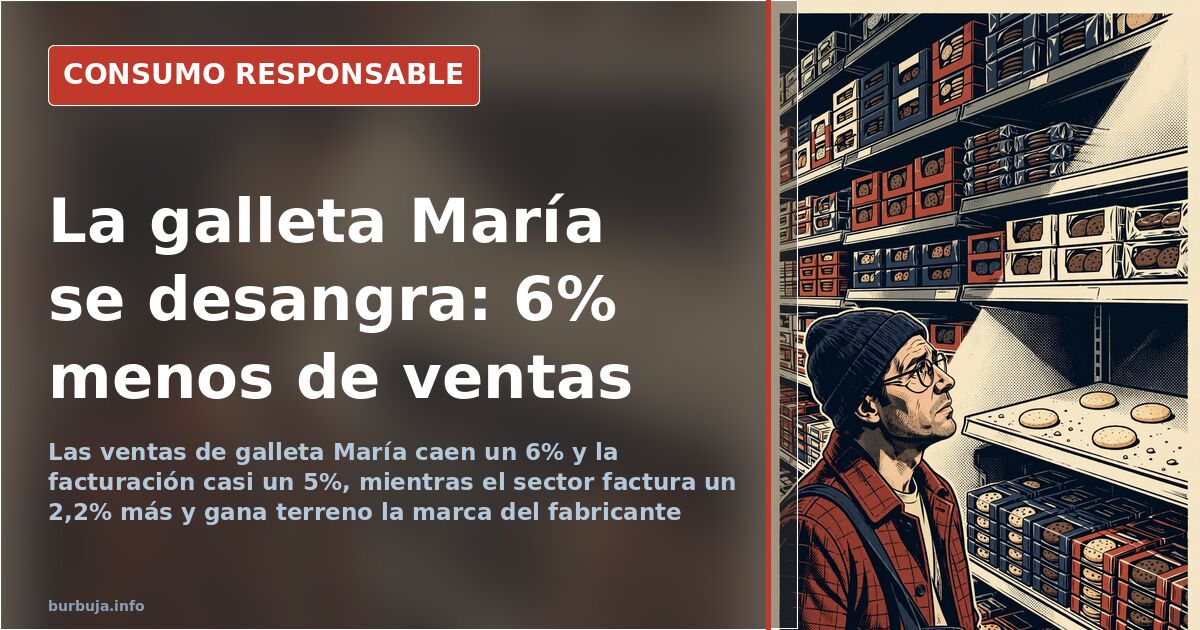
Maria biscuit loses 6% in sales while sector revenue grows
The decline is quantified and leaves no room for optimistic interpretations: sales of traditional biscuits have fallen by 6% over the last twelve months, with revenue dropping almost 5%. The Maria, that round invention designed for dipping in milk, has seen declining momentum for three consecutive years. Yet simultaneously, the Spanish biscuit sector has increased sales by 0.4% and revenue by 2.2%. Both facts are true at once, and that is where the entire business lies.
The official explanation points to a consumer who has become more discerning, now opting for "indulgent snacks" with chocolate during breaks. The explanation heard on the street and in factories is far less elegant: the biscuit no longer tastes the same, it is loaded with sugar, and changing the recipe was the first cost-cutting measure by whoever bought the brand.
What the numbers say: €172 million at stake
Traditional biscuits—Maria, toasted, and simple breakfast varieties—account for 36% of all biscuit sales but only 19% of revenue. Of the €900 million generated by the sector, €172 million corresponds to this product type. High volume, low margin: the exact profile of a business sustained only as long as prices remain low and customers stay loyal.
The picture changes depending on the manufacturer. Private labels, which boomed during crisis years, have dropped 0.5% so far this fiscal year and lost 0.3 percentage points of market share, while manufacturer brands have grown by 1.4%. In short: half of the biscuits sold are still supermarket own-brands, but money is shifting toward premium packaging. The sector isn't selling more; it is charging more for what it sells.
From Fontaneda to Mondelēz: how Spain's biscuit industry was dismantled
Spanish biscuits were born in Aguilar de Campoo, Palencia, thanks to two families: Gullón and Fontaneda. In the eighties, these two companies and Cuétara shared the market. Today, only Gullón survives as an independent Spanish company. Cuétara has belonged to Adam Foods (Artiach, Marbú, Chiquilín) since 2016, and Fontaneda has been owned by Mondelēz since 2006 (Oreo, LU, Príncipe). When Spain joined the EU in the mid-eighties, more modern and technologically advanced European companies overwhelmed the domestic biscuit industry. "They crushed it, and most sold their companies," summarizes a Gullón executive in the report that sparked this issue.
There is an uncomfortable explanation that points less to foreign capital and more to internal failures. Fontaneda worked because it had a captive market; when that market peine up, it could not compete. It is argued that the owner preferred spending years on cars, apartments in Madrid, and chalets in Palencia rather than reinvesting in cutting-edge machinery. By the time the common market arrived, the bill had come due.
And a factory curiosity that explains the lost flavor: in each batch of Fontaneda's Maria biscuits, two cauldrons of thick condensed milk were added—not the supermarket variety. The first thing the initial multinational buyer did upon acquiring the plant was remove it.
Is it the same biscuit as in the eighties?
No, and much of the collapse plays out here. Those who dipped it as children remember: the biscuit soaked up liquid in seconds and tasted of cereal. The current version takes longer to soften, remains dry, and tastes primarily of burnt sugar. Each unit contains more sugar and more palm oil, an ingredient with poor fruta that does not help the brand either.
Contempt for the product has become an argument for responsible consumption. Some argue that quality has been reduced bit by bit over years so customers wouldn't notice the cuts—the same procedure that, according to this view, other classic brands of cured meats, processed cheese, and pastries have applied. The long-term result is the opposite of what was sought: buyers eventually stop purchasing.
Maria is not Spanish: the patriotic narrative collapses
Here comes the twist. The "Maria" biscuit is actually "Marie": a typical English product from the 19th century, named after a Russian aristocrat visiting the UK at the time. Fontaneda copied the composition, texture, and even the logo of the original MariE biscuits. Anyone boasting outside Spain about a national invention suddenly realized they were defending a foreign registered trademark.
The phenomenon has its linguistic charm: it happens with Maria just like with brandy, which everyone orders as cognac, or sparkling wine, which half the country still calls champagne. The original was elsewhere, and we gave it our devotional name.
Fewer children, less breakfast, more gym
There is a demographic explanation often buried under nostalgia: Maria is consumed mainly by those who have milk and biscuits for breakfast, and that population is shrinking. There are fewer children, and as they grow up, they abandon milk as the basis of breakfast. Consumption plummets purely due to the population pyramid.
This is compounded by cultural change. In the eighties and much of the nineties, nobody checked labels; today, everyone wants to be fit, and sweet indulgences are only allowed if trinc by exercise. Sugar has also become the public enemy number one in the shopping basket, and a biscuit that is fundamentally sugar with some wheat finds it hard to defend its place in breakfast. Facing this, the sector offers only precocity: manufacturers have understood that renegotiating the recipe with customers is more expensive than letting Maria fade away naturally.
With these data, Maria should be heading toward extinction, yet it is not: it still accounts for more than a third of all sales. It holds on through price inertia and an older audience unlikely to change their breakfast habits. The question is how long that inertia lasts before expiring. And nobody, inside or outside the factories, seems in a hurry to find out.
The decline is quantified and leaves no room for optimistic interpretations: sales of traditional biscuits have fallen by 6% over the last twelve months, with revenue dropping almost 5%. The Maria, that round invention designed for dipping in milk, has seen declining momentum for three consecutive years. Yet simultaneously, the Spanish biscuit sector has increased sales by 0.4% and revenue by 2.2%. Both facts are true at once, and that is where the entire business lies.
The official explanation points to a consumer who has become more discerning, now opting for "indulgent snacks" with chocolate during breaks. The explanation heard on the street and in factories is far less elegant: the biscuit no longer tastes the same, it is loaded with sugar, and changing the recipe was the first cost-cutting measure by whoever bought the brand.
What the numbers say: €172 million at stake
Traditional biscuits—Maria, toasted, and simple breakfast varieties—account for 36% of all biscuit sales but only 19% of revenue. Of the €900 million generated by the sector, €172 million corresponds to this product type. High volume, low margin: the exact profile of a business sustained only as long as prices remain low and customers stay loyal.
The picture changes depending on the manufacturer. Private labels, which boomed during crisis years, have dropped 0.5% so far this fiscal year and lost 0.3 percentage points of market share, while manufacturer brands have grown by 1.4%. In short: half of the biscuits sold are still supermarket own-brands, but money is shifting toward premium packaging. The sector isn't selling more; it is charging more for what it sells.
From Fontaneda to Mondelēz: how Spain's biscuit industry was dismantled
Spanish biscuits were born in Aguilar de Campoo, Palencia, thanks to two families: Gullón and Fontaneda. In the eighties, these two companies and Cuétara shared the market. Today, only Gullón survives as an independent Spanish company. Cuétara has belonged to Adam Foods (Artiach, Marbú, Chiquilín) since 2016, and Fontaneda has been owned by Mondelēz since 2006 (Oreo, LU, Príncipe). When Spain joined the EU in the mid-eighties, more modern and technologically advanced European companies overwhelmed the domestic biscuit industry. "They crushed it, and most sold their companies," summarizes a Gullón executive in the report that sparked this issue.
There is an uncomfortable explanation that points less to foreign capital and more to internal failures. Fontaneda worked because it had a captive market; when that market peine up, it could not compete. It is argued that the owner preferred spending years on cars, apartments in Madrid, and chalets in Palencia rather than reinvesting in cutting-edge machinery. By the time the common market arrived, the bill had come due.
And a factory curiosity that explains the lost flavor: in each batch of Fontaneda's Maria biscuits, two cauldrons of thick condensed milk were added—not the supermarket variety. The first thing the initial multinational buyer did upon acquiring the plant was remove it.
Is it the same biscuit as in the eighties?
No, and much of the collapse plays out here. Those who dipped it as children remember: the biscuit soaked up liquid in seconds and tasted of cereal. The current version takes longer to soften, remains dry, and tastes primarily of burnt sugar. Each unit contains more sugar and more palm oil, an ingredient with poor fruta that does not help the brand either.
Contempt for the product has become an argument for responsible consumption. Some argue that quality has been reduced bit by bit over years so customers wouldn't notice the cuts—the same procedure that, according to this view, other classic brands of cured meats, processed cheese, and pastries have applied. The long-term result is the opposite of what was sought: buyers eventually stop purchasing.
Maria is not Spanish: the patriotic narrative collapses
Here comes the twist. The "Maria" biscuit is actually "Marie": a typical English product from the 19th century, named after a Russian aristocrat visiting the UK at the time. Fontaneda copied the composition, texture, and even the logo of the original MariE biscuits. Anyone boasting outside Spain about a national invention suddenly realized they were defending a foreign registered trademark.
The phenomenon has its linguistic charm: it happens with Maria just like with brandy, which everyone orders as cognac, or sparkling wine, which half the country still calls champagne. The original was elsewhere, and we gave it our devotional name.
Fewer children, less breakfast, more gym
There is a demographic explanation often buried under nostalgia: Maria is consumed mainly by those who have milk and biscuits for breakfast, and that population is shrinking. There are fewer children, and as they grow up, they abandon milk as the basis of breakfast. Consumption plummets purely due to the population pyramid.
This is compounded by cultural change. In the eighties and much of the nineties, nobody checked labels; today, everyone wants to be fit, and sweet indulgences are only allowed if trinc by exercise. Sugar has also become the public enemy number one in the shopping basket, and a biscuit that is fundamentally sugar with some wheat finds it hard to defend its place in breakfast. Facing this, the sector offers only precocity: manufacturers have understood that renegotiating the recipe with customers is more expensive than letting Maria fade away naturally.
With these data, Maria should be heading toward extinction, yet it is not: it still accounts for more than a third of all sales. It holds on through price inertia and an older audience unlikely to change their breakfast habits. The question is how long that inertia lasts before expiring. And nobody, inside or outside the factories, seems in a hurry to find out.
Also available in: Deutsch
Summary of a discussion on Burbuja.info - Foro de economía, actualidad y política., translated from Spanish and reviewed before publication. Read the full discussion (121 replies).
More summaries
-
Maria Cookie: Spain's Divisive Sweet
The Maria cookie divides Spain between nostalgia and disdain, with declining quality post-pandemic.
-
Spanish 1970s Cookies: The Lost Taste of Childhood
Iconic Spanish brands like Cuétara and Fontaneda have changed. Palm oil, mergers, and quality cuts explain the decline of a national staple.
-
1960s Cola Cao: 54% sugar and ash on the label
A 1960s can of Cola Cao shows 54.1% sucrose, ash and unidentified matter at 1.9%, and a price of 84.50 pesetas plus taxes. The analysis…
-
Alicante Horchata: Best Spots Without a Car
Horchatería Azul near Alicante's Central Market is the top car-free recommendation, amidst debates on Alboraya and Elche.
-
Dishwasher debate: time savings questioned, pots don't fit
Dishwashers save families 20 minutes daily but fail for singles due to capacity issues and incomplete loads.
-
Father in Spain Can't Afford Disney Summer for Daughters
A Spanish father shares his struggle to afford a summer holiday after his daughters return from Disney World, highlighting financial constraints and the value of time over money.