
Spain's cheap housing map: homes with land for €45,000
Homes with land for €45,000 in Spanish villages under 1,000 people reveal the reality of affordable housing and its financial caveats.
English · Original discussion in Spanish · Published
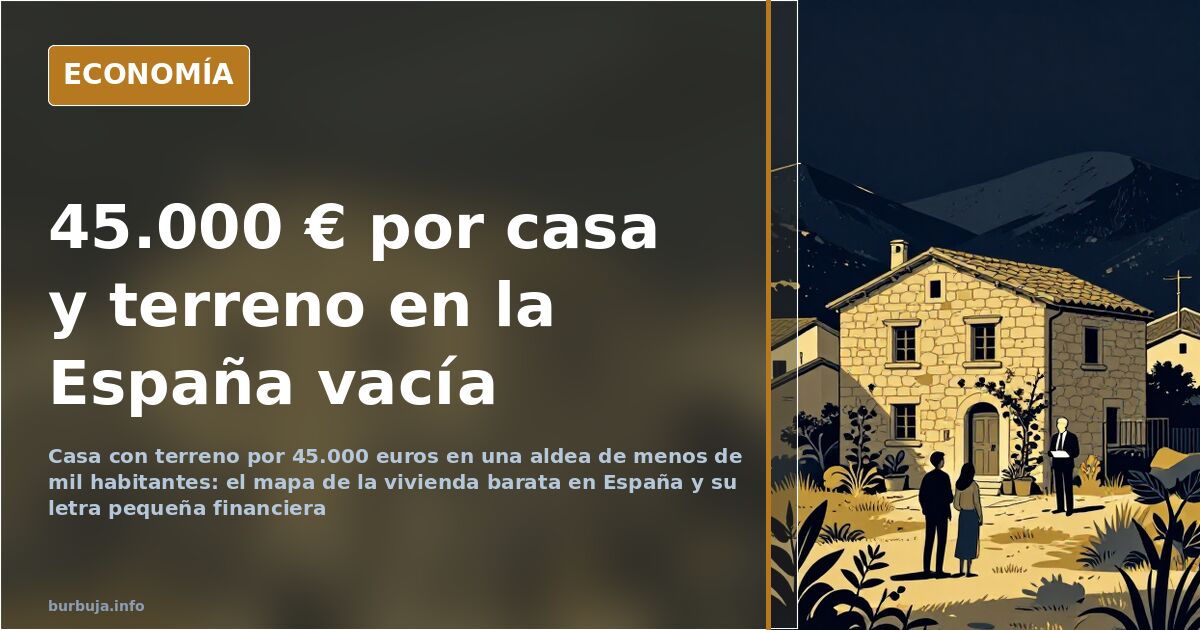
Home with land for €45,000: Spain's cheap housing map
A renovated house with land for €45,000 in a village of fewer than 1,000 inhabitants. This figure has reignited a classic debate: affordable housing exists in Spain, but it is located where few want to live. The case in question —a Cuban woman who, according to circulating accounts, has already paid off her home, brought her family over, and claims she will not return because she is now European— served as the trigger. A comparison of the cheapest municipalities for buying a home published in July 2023 put the numbers on the table, quickly leading to two major questions: how much does property actually cost in depopulated Spain, and why do those complaining about prices not move there?
Where can you buy a home for less than €30,000?
In the Valle de los Pedroches, in the province of Córdoba, there are three large municipalities where an 80 square meter home can be bought for €26,720, according to the price comparison used in the discussion. It is not an isolated case. In Xàtiva, a city of 30,000 inhabitants one hour from Valencia with ample services, options appear around €50,000. And if you look at Murcia or Granada, land becomes even cheaper.
The problem, therefore, is not supply. It is location and property condition: many of these towns have poor transport links and houses require renovation. This is where consensus breaks down, because some argue that this stock of affordable housing has been available for years untouched, while the average buyer continues to focus exclusively on expanding areas of major cities.
Rural land: why banks only finance 40%
The bargain price comes with fine print. In the province of Alicante, homes advertised very cheaply are mostly buildings on rural land (*suelo rústico*), often illegal and sometimes subject to demolition orders. Those legalized because they were built before 2014 remain in an administrative limbo that could close at any time.
The financial consequence is harsh and dispels the bargain fantasy: banks typically grant only around 40% of the value of rural land. If the seller asks for €100,000, the buyer needs €60,000 in savings at signing. This detail completely changes the profile of who can take advantage of these prices and explains why many such homes are paid for in cash or with money not coming from a Spanish salary.
How do you save €45,000 on a precarious job?
Skepticism is high here. Those claiming to have saved that amount working in hospitality or delivery face a simple arithmetic objection: with entry-level salaries and rent to pay, that sum does not accumulate in a few years. Doubt grows when it is added that university studies were completed here with grants and without paying tuition.
Other voices recall that there are ways to reach that money without a high salary: public purchase aids, guarantees, family loans, or income from abroad. The discussion stays exactly there, in unverified suspicion: there is no verified breakdown of how the operation was financed.
From housing to benefits: the second front
The other major block of the exchange talks not about bricks, but about benefits. Mention is made of the Minimum Vital Income (IMV), subsidies for acquiring housing, paid courses, aids for preparing civil service exams, and access to healthcare and education without direct cost. One current of the debate argues that newcomers inform themselves before arriving about everything they can claim, creating unfair competition with local workers.
The reply is equally clear: these are public aids, subject to requirements, open to anyone who meets them, and the underlying problem is not who claims them but the gap between wages and prices. In between are personal testimonies, difficult to generalize and even harder to refute.
The demand that never arrives
The most repeated argument is that of the buyer who wants a large, cheap apartment near the center. Some summarize it bluntly: thousands of affordable homes exist in Spain, but one must accept a village of fewer than 1,000 inhabitants when living in a provincial capital of 200,000 is already considered exile.
With remote work becoming widespread, this calculation starts to change for some: there are cases of buyers who acquired homes on the outskirts of Barcelona for less than the cost of a flat in the city, or even a small unit in outer districts. The prediction floating is the US model, with population pushed out of major hubs and urban centers reserved for those who can afford them.
The analysis stalls right at the border between the two readings. Does the case prove that the system rewards those who arrive with information and aids, or does it show that there is affordable housing nobody wants because it is far from a Primark store? With these elements, no conclusion appears: prices are there, buyers are not, and the question of why nobody crosses that bridge remains unanswered.
A renovated house with land for €45,000 in a village of fewer than 1,000 inhabitants. This figure has reignited a classic debate: affordable housing exists in Spain, but it is located where few want to live. The case in question —a Cuban woman who, according to circulating accounts, has already paid off her home, brought her family over, and claims she will not return because she is now European— served as the trigger. A comparison of the cheapest municipalities for buying a home published in July 2023 put the numbers on the table, quickly leading to two major questions: how much does property actually cost in depopulated Spain, and why do those complaining about prices not move there?
Where can you buy a home for less than €30,000?
In the Valle de los Pedroches, in the province of Córdoba, there are three large municipalities where an 80 square meter home can be bought for €26,720, according to the price comparison used in the discussion. It is not an isolated case. In Xàtiva, a city of 30,000 inhabitants one hour from Valencia with ample services, options appear around €50,000. And if you look at Murcia or Granada, land becomes even cheaper.
The problem, therefore, is not supply. It is location and property condition: many of these towns have poor transport links and houses require renovation. This is where consensus breaks down, because some argue that this stock of affordable housing has been available for years untouched, while the average buyer continues to focus exclusively on expanding areas of major cities.
Rural land: why banks only finance 40%
The bargain price comes with fine print. In the province of Alicante, homes advertised very cheaply are mostly buildings on rural land (*suelo rústico*), often illegal and sometimes subject to demolition orders. Those legalized because they were built before 2014 remain in an administrative limbo that could close at any time.
The financial consequence is harsh and dispels the bargain fantasy: banks typically grant only around 40% of the value of rural land. If the seller asks for €100,000, the buyer needs €60,000 in savings at signing. This detail completely changes the profile of who can take advantage of these prices and explains why many such homes are paid for in cash or with money not coming from a Spanish salary.
How do you save €45,000 on a precarious job?
Skepticism is high here. Those claiming to have saved that amount working in hospitality or delivery face a simple arithmetic objection: with entry-level salaries and rent to pay, that sum does not accumulate in a few years. Doubt grows when it is added that university studies were completed here with grants and without paying tuition.
Other voices recall that there are ways to reach that money without a high salary: public purchase aids, guarantees, family loans, or income from abroad. The discussion stays exactly there, in unverified suspicion: there is no verified breakdown of how the operation was financed.
From housing to benefits: the second front
The other major block of the exchange talks not about bricks, but about benefits. Mention is made of the Minimum Vital Income (IMV), subsidies for acquiring housing, paid courses, aids for preparing civil service exams, and access to healthcare and education without direct cost. One current of the debate argues that newcomers inform themselves before arriving about everything they can claim, creating unfair competition with local workers.
The reply is equally clear: these are public aids, subject to requirements, open to anyone who meets them, and the underlying problem is not who claims them but the gap between wages and prices. In between are personal testimonies, difficult to generalize and even harder to refute.
The demand that never arrives
The most repeated argument is that of the buyer who wants a large, cheap apartment near the center. Some summarize it bluntly: thousands of affordable homes exist in Spain, but one must accept a village of fewer than 1,000 inhabitants when living in a provincial capital of 200,000 is already considered exile.
With remote work becoming widespread, this calculation starts to change for some: there are cases of buyers who acquired homes on the outskirts of Barcelona for less than the cost of a flat in the city, or even a small unit in outer districts. The prediction floating is the US model, with population pushed out of major hubs and urban centers reserved for those who can afford them.
The analysis stalls right at the border between the two readings. Does the case prove that the system rewards those who arrive with information and aids, or does it show that there is affordable housing nobody wants because it is far from a Primark store? With these elements, no conclusion appears: prices are there, buyers are not, and the question of why nobody crosses that bridge remains unanswered.
Also available in: Deutsch
Summary of a discussion on Burbuja.info - Foro de economía, actualidad y política., translated from Spanish and reviewed before publication. Read the full discussion (183 replies).
More summaries
-
550 Euros from IMV vs. 1,200 for 40 Hours: The Deciding Gap
A university graduate in 2025 earns the same 1,200 euros as an assistant in 2005, while the minimum vital income is around 550 to 658 euros per month.
-
Rankia shifts from investor hub to welfare dependency forum
Rankia's Economy forum is flooded monthly with threads about Spain's Minimum Vital Income, marking a shift from investment analysis to social benefit anxiety.
-
Maricarmen, evicted Madrid tenant, dies at 87
Maricarmen, the 87-year-old tenant evicted in Madrid, has died after being hospitalized since her forced removal.
-
Chemtrail theories resurface in Spain following recent elections
Persistent contrails reappear as the electoral cycle ends, fueling conspiracy theories about geoengineering and aerial spraying in Spain.
-
Milan as a mirror: A young woman's testimony on Italian immigration
A young traveler returns from Milan, claiming migrant presence is higher than in Spain, sparking debate on wages and demographics.
-
Tesla Model S mortality rate exceeds 2001 VW Passat
IIHS data shows the Tesla Model S 4WD has 17 deaths per million, while the Lexus ES records zero, questioning Autopilot's safety claims.