
Maricarmen, evicted Madrid tenant, dies at 87
Maricarmen, the 87-year-old tenant evicted in Madrid, has died after being hospitalized since her forced removal.
English · Original discussion in Spanish · Published
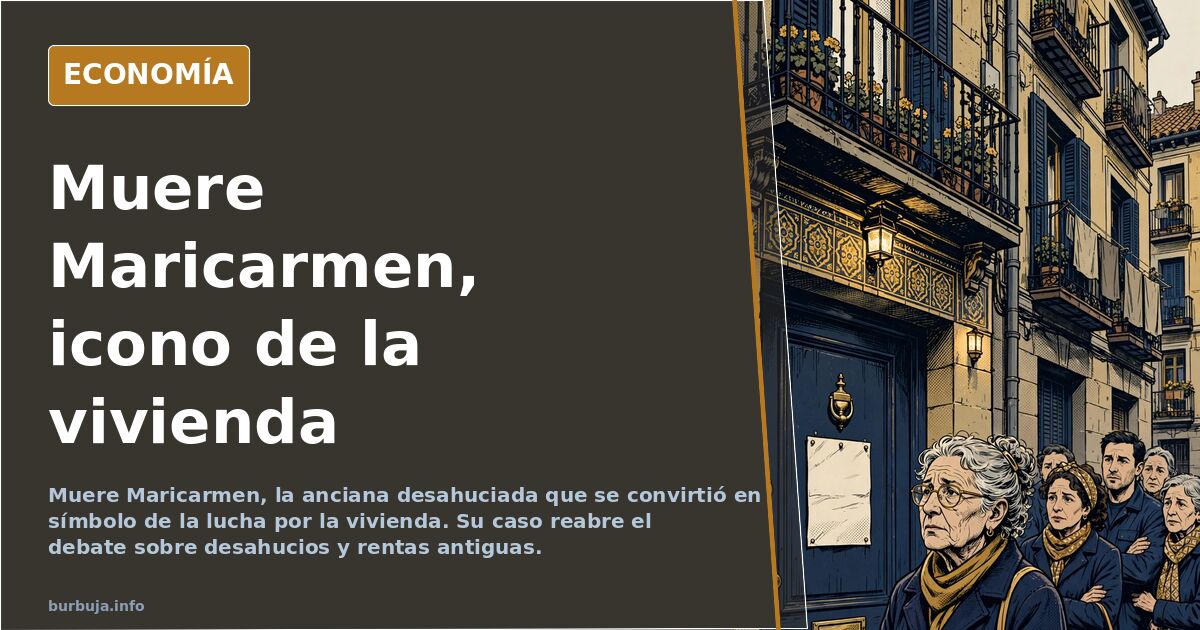
Maricarmen, the 87-year-old tenant evicted in Madrid, dies after hospitalization
Maricarmen, the 87-year-old woman whose eviction in Madrid sparked national outrage, died this Wednesday after remaining hospitalized since she was forcibly removed from her home. The news, first reported by lasensla and covered by elDiario.es, concludes an episode that shifted rapidly from public indignation to personal destruction within just two weeks. According to available reports, she passed away in the hospital after her case became subject to attacks on her assets, work history, and even physical condition, as noted by elDiario.es. Her death turns Maricarmen into an uncomfortable symbol: for some, a martyr of rent-seeking; for others, a political maneuver that fizzled out.
From outrage to reckoning
The eviction of Maricarmen, an 87-year-old Madrid resident renting in the capital, became a media phenomenon in days. Her resistance to leaving the property, her age, and the harshness of the eviction triggered a wave of solidarity across Spain. Images of the woman being expelled circulated on all major networks. The case escalated to the point where the Government and several autonomous communities issued statements. Housing, a topic long absent from serious public debate, returned to the center stage.
But the backlash arrived quickly. Within two weeks, Maricarmen went from victim to target of media scrutiny. As reported by elDiario.es, the woman faced accusations regarding her wealth, past employment, character, and physical state. Comments and jokes appeared in talk shows and on social media. This media offensive, according to the outlet, aimed to dismantle the victim narrative. One article’s headline—“Maricarmen is the culprit”—summarizes the strategy: if the victim isn’t perfect, the problem disappears.
Who pays for the eviction? The rental business in Spain
Maricarmen’s case is not isolated. Spain’s rental housing stock is increasingly strained, with prices rising far above wages over the last decade. Investment funds and private capital companies have been buying portfolios of protected and legacy rental properties, often holding contracts inherited from the Franco era. The “old rent” regime, which froze rents, was repealed years ago, but its residual effects persist: elderly tenants paying rents disconnected from market values.
The paradox is that an elderly woman’s eviction in Madrid occurs amid record sales and high prices. Available data indicates the real estate market remains hot, with housing acting as a safe-haven asset. Meanwhile, rentals have become a guaranteed-return business for large landlords. The lingering question is simple: who decides when an elderly person must leave their home?
The political machine: from specific case to national narrative
Maricarmen’s death has peine the political war. The Government and its allies present the case as proof of the need to intervene in the rental market. The opposition accuses the Executive of instrumentalizing an elderly woman’s death for electoral gain. At its core, the debate remains unchanged: is housing a right or a financial asset?
An official response, as of this writing, has not arrived. What has arrived are reactions. The Ministry of Housing and Urban Agenda may host a vigil, sources suggest. Left-wing parties have called for mobilization. Right-wing parties have demanded “respect” and accused the left of “cynicism.” Online, the case has become a battleground where each side projects its own antiestéticars.
Why was the victim questioned? The strategy of doubt
One of the darkest aspects of the case was the smear campaign against Maricarmen. According to published reports, she was accused of owning properties, receiving subsidies, and living “like a bourgeois.” None of this has been proven. The strategy is well-known: if the victim isn’t flawless, the narrative weakens. It’s the old playbook of political communication: don’t deny the fact, discredit the protagonist.
This pattern has repeated in other high-profile eviction cases. The difference here is that Maricarmen was 87 and died. Her passing turned the smear campaign into a larger problem. Because now there is no one left to respond. The woman who became a symbol has ceased to be an active subject and has become an object of dispute. Some mourn her; others use her. Meanwhile, the fundamental question remains unanswered: how many Maricarmens are there in Spain?
The future of the rental market: will anything change?
Maricarmen’s case has highlighted the need to regulate rentals. Measures announced so far—price caps, tensioned zones, rental aid—have not stopped price hikes. Experts disagree: some see a supply issue; others, speculation. What is clear is that the market does not self-regulate. And housing has become the primary driver of inequality in Spain.
Maricarmen’s death won’t change the rules of the game. But it left an image: that of an elderly woman who became a symbol of a fight that wasn’t hers. Her case helped many realize that the housing crisis isn’t abstract. It has a name, an age, and a story. And now, also, an ending.
Maricarmen’s eviction leaves a floating question: what happens to legacy-rent tenants? The answer isn’t in the courts, but in the market. And today, the market has no mercy.
Maricarmen, the 87-year-old woman whose eviction in Madrid sparked national outrage, died this Wednesday after remaining hospitalized since she was forcibly removed from her home. The news, first reported by lasensla and covered by elDiario.es, concludes an episode that shifted rapidly from public indignation to personal destruction within just two weeks. According to available reports, she passed away in the hospital after her case became subject to attacks on her assets, work history, and even physical condition, as noted by elDiario.es. Her death turns Maricarmen into an uncomfortable symbol: for some, a martyr of rent-seeking; for others, a political maneuver that fizzled out.
From outrage to reckoning
The eviction of Maricarmen, an 87-year-old Madrid resident renting in the capital, became a media phenomenon in days. Her resistance to leaving the property, her age, and the harshness of the eviction triggered a wave of solidarity across Spain. Images of the woman being expelled circulated on all major networks. The case escalated to the point where the Government and several autonomous communities issued statements. Housing, a topic long absent from serious public debate, returned to the center stage.
But the backlash arrived quickly. Within two weeks, Maricarmen went from victim to target of media scrutiny. As reported by elDiario.es, the woman faced accusations regarding her wealth, past employment, character, and physical state. Comments and jokes appeared in talk shows and on social media. This media offensive, according to the outlet, aimed to dismantle the victim narrative. One article’s headline—“Maricarmen is the culprit”—summarizes the strategy: if the victim isn’t perfect, the problem disappears.
Who pays for the eviction? The rental business in Spain
Maricarmen’s case is not isolated. Spain’s rental housing stock is increasingly strained, with prices rising far above wages over the last decade. Investment funds and private capital companies have been buying portfolios of protected and legacy rental properties, often holding contracts inherited from the Franco era. The “old rent” regime, which froze rents, was repealed years ago, but its residual effects persist: elderly tenants paying rents disconnected from market values.
The paradox is that an elderly woman’s eviction in Madrid occurs amid record sales and high prices. Available data indicates the real estate market remains hot, with housing acting as a safe-haven asset. Meanwhile, rentals have become a guaranteed-return business for large landlords. The lingering question is simple: who decides when an elderly person must leave their home?
The political machine: from specific case to national narrative
Maricarmen’s death has peine the political war. The Government and its allies present the case as proof of the need to intervene in the rental market. The opposition accuses the Executive of instrumentalizing an elderly woman’s death for electoral gain. At its core, the debate remains unchanged: is housing a right or a financial asset?
An official response, as of this writing, has not arrived. What has arrived are reactions. The Ministry of Housing and Urban Agenda may host a vigil, sources suggest. Left-wing parties have called for mobilization. Right-wing parties have demanded “respect” and accused the left of “cynicism.” Online, the case has become a battleground where each side projects its own antiestéticars.
Why was the victim questioned? The strategy of doubt
One of the darkest aspects of the case was the smear campaign against Maricarmen. According to published reports, she was accused of owning properties, receiving subsidies, and living “like a bourgeois.” None of this has been proven. The strategy is well-known: if the victim isn’t flawless, the narrative weakens. It’s the old playbook of political communication: don’t deny the fact, discredit the protagonist.
This pattern has repeated in other high-profile eviction cases. The difference here is that Maricarmen was 87 and died. Her passing turned the smear campaign into a larger problem. Because now there is no one left to respond. The woman who became a symbol has ceased to be an active subject and has become an object of dispute. Some mourn her; others use her. Meanwhile, the fundamental question remains unanswered: how many Maricarmens are there in Spain?
The future of the rental market: will anything change?
Maricarmen’s case has highlighted the need to regulate rentals. Measures announced so far—price caps, tensioned zones, rental aid—have not stopped price hikes. Experts disagree: some see a supply issue; others, speculation. What is clear is that the market does not self-regulate. And housing has become the primary driver of inequality in Spain.
Maricarmen’s death won’t change the rules of the game. But it left an image: that of an elderly woman who became a symbol of a fight that wasn’t hers. Her case helped many realize that the housing crisis isn’t abstract. It has a name, an age, and a story. And now, also, an ending.
Maricarmen’s eviction leaves a floating question: what happens to legacy-rent tenants? The answer isn’t in the courts, but in the market. And today, the market has no mercy.
Summary of a discussion on Burbuja.info - Foro de economía, actualidad y política., translated from Spanish and reviewed before publication. Read the full discussion (982 replies).
More summaries
-
Evicted tenant Maricarmen dies at 87, sparking Spain election row
The death of Maricarmen, evicted at 87, intensifies political debate ahead of Spain's elections, exposing deep housing crisis divisions.
-
Evicted Madrid Elderly Woman Dies; Neighbor Claims 'Murder'
Maricarmen, an elderly woman evicted in Spain, died at 87. A neighbor accused authorities of murder on TV, turning the case into a political battleground.
-
Spain's PSOE Calls Elections After Death of Evicted 87-Year-Old
An evicted 87-year-old woman in Madrid dies days before Spain's general election. The political fallout raises questions about voter mobilization.
-
Xabier Arrutia Imaz, ETA advisor to PDVSA in Venezuela, dies
The death of Xabier Arrutia Imaz in Venezuela exposes the protection network for ETA members in PDVSA and suspicions of a killing to silence secrets.
-
Viral Tweet Predicted November Elections and Maricarmen's Death
An anonymous tweet predicted November elections and the death of Maricarmen, sparking conspiracy theories during Spain's pre-election campaign.
-
Madrid's $14M Brutalist Villa Struggles to Sell
A 1,300 m² brutalist villa in Somosaguas is listed for €12.9 million, with the price driven by the architect's fame rather than design appeal.