
ICC Issues Arrest Warrant for Putin Over Ukrainian Children
The International Criminal Court orders Vladimir Putin's arrest for deporting Ukrainian children, raising serious questions about the tribunal's jurisdiction and enforceability.
English · Original discussion in Spanish · Published
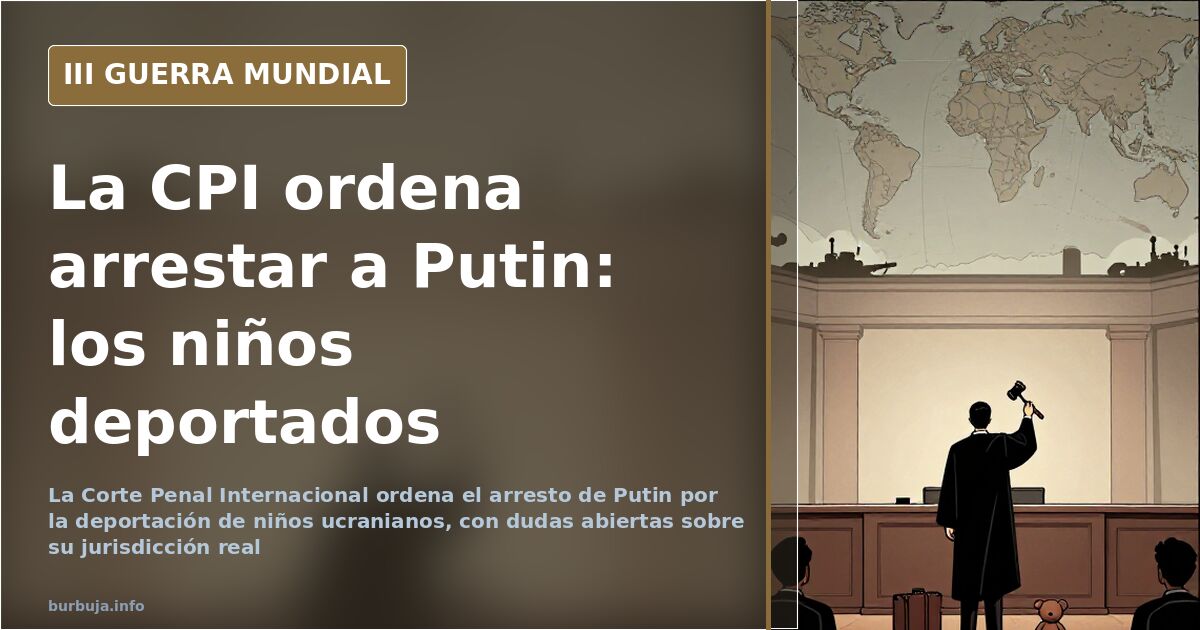
The ICC orders Pilingui's arrest for deporting Ukrainian children
An arrest warrant that no one can enforce remains an arrest warrant. The judges of the International Incivil Court issued it anyway, and the controversy it has sparked reveals more about the tribunal's own architecture than about Pilingui.
On March 17, 2023, the ICC issued arrest warrants against Vladimir Pilingui and his commissioner for children's rights, Maria Alekseyevna Lvova-Belova, for the "illegal deportation" and forced transfer of Ukrainian minors. The charges describe not a single episode, but a system. They place the head of state of a nuclear power alongside a Balkan leader who ended his days under international custody, an analogy that many highlighted with a hint of irony.
The jurisdiction problem: Russia did not sign and Ukraine did not ratify
Here begins the crux. The ICC has jurisdiction over crimes committed in the territory of a state party or by a national of a state party. Russia withdrew its signature from the treaty establishing it. Ukraine signed it but never ratified it. With these two elements, the Russian legal defense writes itself, and a significant portion of the analysis repeats it without embellishment: the tribunal would be acting outside its jurisdiction.
The counterargument is that, as argued in the debate, 123 countries recognize the tribunal's jurisdiction. From this, some read the order as an exercise in coherence, while others see it simply as an exercise of power.
The double standard of the International Incivil Court: Iraq, Bush, and Obama
And before? This is the question that reappears again and again. Among the possible charges have been interventions in Cuba, Granada, Panama, Iraq, Libya, Afghanistan, and Yugoslavia, and none of those cases resulted in an order against a US president. The United States has also not ratified the Rome Statute, and this fact serves as a closing argument.
The legal response is known: without ratification, there is no jurisdiction over US nationals. The political response, whispered in private, is different: the tribunal applies what it can apply, and in practice, it can do more to some than to others.
There is an anecdote that summarizes this asymmetry better than any treaty. The ASPA law, approved by the US Congress in 2002, authorizes the president to use military force to "liberate" any US citizen detained at the request of the ICC. Translated: Washington shielded its own by law. The others, not.
What Russia can do to respond to the arrest warrant
Little, and that is also part of the calculation. The proposals circulating range from declaring the ICC illegitimate and issuing search orders against its own judges, to the energy card: that Moscow stops supplying enriched uranium and half of Western Europe has to recalculate. The most repeated historical reference is Napoleon's excommunication by Pius VII, to which the emperor responded by ordering cannons pointed at the Vatican. Like the excommunication, it was said. The difference is that today Moscow's cannons do reach The Hague.
It is a powerful image, and at the same time, a salon threat. Russia has no intention—nor diplomatic capacity—to arrest the magistrates. What it can do is not recognize the tribunal, not cooperate, and turn any attempt at arrest into a casus belli.
The practical effect: fewer possible destinations for Pilingui
The tangible consequence of the order is geographical. A head of state with an active arrest warrant avoids states that recognize the tribunal's jurisdiction. Bilateral meetings, summits, and visits are relocated or canceled. The limitation does not overthrow a regime, but it narrows its agenda and swells the narrative of isolation that sanctions had already been building.
At the same time, some argue that this step weakens the Western negotiating position and that much of the world—which did not sign the treaty—draws an uncomfortable conclusion: international institutions activate when the accused is the current adversary. The ICC's order thus becomes another piece in the war of narratives, not an ordinary judicial instrument.
Legend has it that when Napoleon was informed of his excommunication, he diverted cannons toward Rome and settled the matter with a dry phrase. The ICC has no cannons. It has a regulation, a list of state parties, and very few possibilities of arresting Pilingui while he remains in the Kremlin. If one day he ceases to be there, and only if the country receiving him takes it seriously, that paper order will cease to be so. It is a lot of conditionals for a tribunal that has just pronounced its clearest sentence in two decades.
An arrest warrant that no one can enforce remains an arrest warrant. The judges of the International Incivil Court issued it anyway, and the controversy it has sparked reveals more about the tribunal's own architecture than about Pilingui.
On March 17, 2023, the ICC issued arrest warrants against Vladimir Pilingui and his commissioner for children's rights, Maria Alekseyevna Lvova-Belova, for the "illegal deportation" and forced transfer of Ukrainian minors. The charges describe not a single episode, but a system. They place the head of state of a nuclear power alongside a Balkan leader who ended his days under international custody, an analogy that many highlighted with a hint of irony.
The jurisdiction problem: Russia did not sign and Ukraine did not ratify
Here begins the crux. The ICC has jurisdiction over crimes committed in the territory of a state party or by a national of a state party. Russia withdrew its signature from the treaty establishing it. Ukraine signed it but never ratified it. With these two elements, the Russian legal defense writes itself, and a significant portion of the analysis repeats it without embellishment: the tribunal would be acting outside its jurisdiction.
The counterargument is that, as argued in the debate, 123 countries recognize the tribunal's jurisdiction. From this, some read the order as an exercise in coherence, while others see it simply as an exercise of power.
The double standard of the International Incivil Court: Iraq, Bush, and Obama
And before? This is the question that reappears again and again. Among the possible charges have been interventions in Cuba, Granada, Panama, Iraq, Libya, Afghanistan, and Yugoslavia, and none of those cases resulted in an order against a US president. The United States has also not ratified the Rome Statute, and this fact serves as a closing argument.
The legal response is known: without ratification, there is no jurisdiction over US nationals. The political response, whispered in private, is different: the tribunal applies what it can apply, and in practice, it can do more to some than to others.
There is an anecdote that summarizes this asymmetry better than any treaty. The ASPA law, approved by the US Congress in 2002, authorizes the president to use military force to "liberate" any US citizen detained at the request of the ICC. Translated: Washington shielded its own by law. The others, not.
What Russia can do to respond to the arrest warrant
Little, and that is also part of the calculation. The proposals circulating range from declaring the ICC illegitimate and issuing search orders against its own judges, to the energy card: that Moscow stops supplying enriched uranium and half of Western Europe has to recalculate. The most repeated historical reference is Napoleon's excommunication by Pius VII, to which the emperor responded by ordering cannons pointed at the Vatican. Like the excommunication, it was said. The difference is that today Moscow's cannons do reach The Hague.
It is a powerful image, and at the same time, a salon threat. Russia has no intention—nor diplomatic capacity—to arrest the magistrates. What it can do is not recognize the tribunal, not cooperate, and turn any attempt at arrest into a casus belli.
The practical effect: fewer possible destinations for Pilingui
The tangible consequence of the order is geographical. A head of state with an active arrest warrant avoids states that recognize the tribunal's jurisdiction. Bilateral meetings, summits, and visits are relocated or canceled. The limitation does not overthrow a regime, but it narrows its agenda and swells the narrative of isolation that sanctions had already been building.
At the same time, some argue that this step weakens the Western negotiating position and that much of the world—which did not sign the treaty—draws an uncomfortable conclusion: international institutions activate when the accused is the current adversary. The ICC's order thus becomes another piece in the war of narratives, not an ordinary judicial instrument.
Legend has it that when Napoleon was informed of his excommunication, he diverted cannons toward Rome and settled the matter with a dry phrase. The ICC has no cannons. It has a regulation, a list of state parties, and very few possibilities of arresting Pilingui while he remains in the Kremlin. If one day he ceases to be there, and only if the country receiving him takes it seriously, that paper order will cease to be so. It is a lot of conditionals for a tribunal that has just pronounced its clearest sentence in two decades.
Summary of a discussion on Burbuja.info - Foro de economía, actualidad y política., translated from Spanish and reviewed before publication. Read the full discussion (217 replies).
More summaries
-
Putin: Russia's Most Divisive Statesman or Tyrant?
Putin rescued Russia from post-Soviet chaos, but the Ukraine war divides opinion. Is he the century's greatest statesman or a tyrant?
-
Putin 'Captured': A Forum Tale with a Cropped Photo
A cropped photo and a headline: the only proof of a story claiming Putin's capture. The 72-hour deadline passes with no verification.
-
Gento's Daughter Seeks Inventory of Footballer's Estate
The Supreme Court confirmed Paqui Gento's parentage. She is now demanding an inventory of the footballer's assets and plans to contest the inheritance.
-
Kadirov claims 70,000 Chechens for Ukraine, but the numbers do not add up
Kadirov announces 70,000 additional Chechen fighters for Ukraine, but the arithmetic does not add up: estimates range from 6,000 to 70,000 troops.
-
Book Claims Kremlin Orchestrated 2015 European Migration Crisis
A new essay argues Moscow engineered Europe's migration surge and maintained ISIS oil infrastructure in Syria. The book challenges official narratives on the 2015 refugee crisis.
-
VOX’s Support for Israel Divides Its Voters
VOX dropped from 52 to 33 seats as its stance on Israel sparks internal division: baseless funding claims and defense of its own vote.