
42% of Spaniards Support Restoring Mandatory Military Service
YouGov survey finds 42% support reinstating conscription in Spain, while 52% oppose it, with only 17% backing in Navarre.
English · Original discussion in Spanish · Published
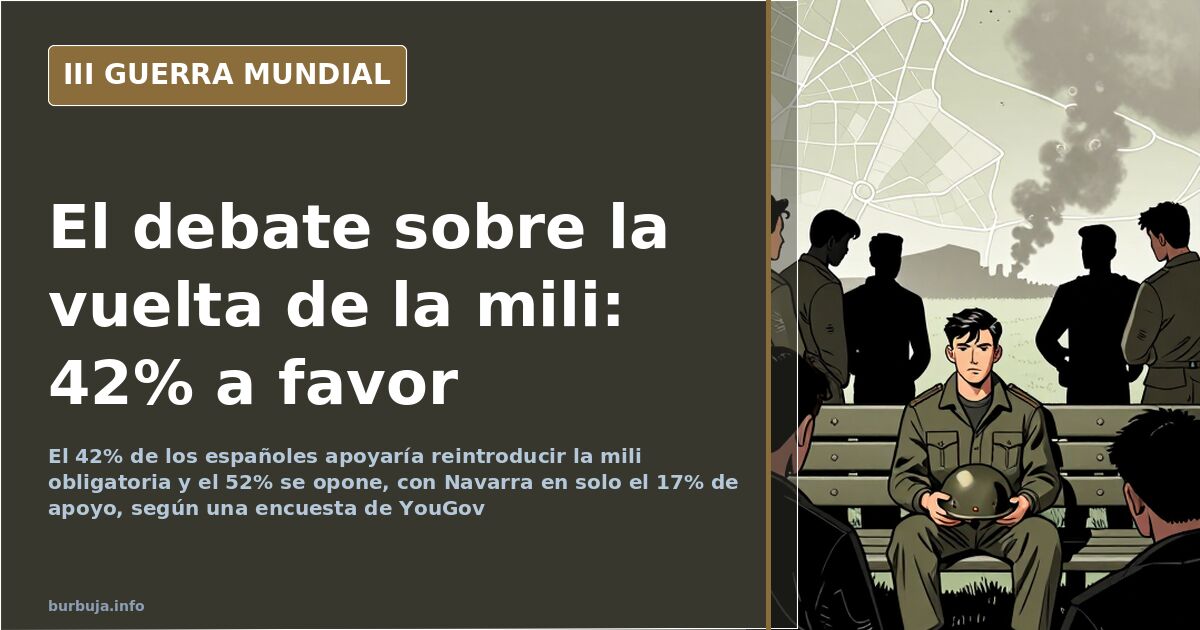
Mandatory military service back on the agenda: 42% of Spaniards support it
Family memories crossing paths in the debate summarize Spain's recent military history: one forum user recounts their grandfather accumulating six years of service and three uniforms, another says their father served eighteen months, and the last replacements stayed for nine. The final draft of non-professional soldiers swore allegiance in 2001, leaving conscription as an administrative relic since then. The thesis gaining traction now is different: the scenario described is a Europe forced to guarantee Ukraine's defense against Russia alone, outside the NATO umbrella, with a 1,000-kilometer front line that, it is argued, cannot be covered by volunteers. Hence the advice summarizing the mood: learn to operate drones as if there were no tomorrow.
Which European countries maintain mandatory military service
Conscription is no continental exception. Half of Europe has kept or restored it in the last decade, with durations ranging from a symbolic month to nearly two years. The comparison dismantles the idea that Spain was a unique case when abolishing it.
Estonia (8 to 11 months), Latvia, which just reintroduced it, and Lithuania, which restored it in 2015, join this list. Switzerland maintains 18-21 weeks with training periods spread over several years, Denmark calls up young people although positions are filled by volunteers, and Cyprus, Russia, and Ukraine continue with mandatory recruitment. Serbia announced 75 days and Croatia restores it from January 1st with two months. France approved in 2018 a format of one mandatory month for men and women that entered into force in 2024.
Real support: 42% in favor and Navarre at 17%
The numbers do not accompany the supporters. A YouGov poll places support for reintroducing conscription in Spain at 42%, against 52% who reject it, with marked differences by age, sens, ideology, and territory. In Navarre, support falls to 17%.
The Spanish Army is not improved by buying equipment: it needs people to operate it. And frigates, it is pointed out, usually sail half-empty. On this diagnosis, the most repeated argument is built: if service is voluntary, nobody will go.
Why conscription disappeared without being repealed
The memory of the end of mandatory service is distorted. Some wanted to abolish it, but the system collapsed before they could. The suppression was moved forward from 2003 to 2001 not out of political generosity, but because Spaniards stopped showing up.
In the late eighties, conscientious objector associations proliferated: neither military nor substitute social service. Pressure forced a chain of cuts, from two years to 18 months, then 15, then 12, and finally 9. The last replacements, in 2001, coincided with the creation of new professional categories within the Armed Forces.
The three fronts of rejection: equality, cost, and legitimacy
The first is equality. One current demands that, if it returns, it must be a truly parity-based service between men and women, pointing out that equality policies are applied in only one direction. The second is money: a conscript army costs a lot and, it is argued, reinforces patriotic sentiment, something not everyone considers desirable.
The third is disaffection. Part of the rejection does not question military effectiveness, but the legitimacy of defending a system from which one feels excluded. And a fourth argument, more prosaic, points to social change: recovering the culture of the nineties would take, at minimum, twenty years.
The alternative nobody pays for
Against mandatory conscription, the growth of the professional army is proposed. The circulating calculation is stark: moving from the current 125,000 troops to 300,000 requires base salaries of 2,000 euros, far from current remuneration. With existing wages, vocation does not appear.
The complete detail, with salaries, recruitment ages, and civil service alternatives country by country, draws a map much more unequal than the headline suggests.
One datum closes the circle: among the cited countries with conscription, the only one that also mandates it for women is Norway.
Family memories crossing paths in the debate summarize Spain's recent military history: one forum user recounts their grandfather accumulating six years of service and three uniforms, another says their father served eighteen months, and the last replacements stayed for nine. The final draft of non-professional soldiers swore allegiance in 2001, leaving conscription as an administrative relic since then. The thesis gaining traction now is different: the scenario described is a Europe forced to guarantee Ukraine's defense against Russia alone, outside the NATO umbrella, with a 1,000-kilometer front line that, it is argued, cannot be covered by volunteers. Hence the advice summarizing the mood: learn to operate drones as if there were no tomorrow.
Which European countries maintain mandatory military service
Conscription is no continental exception. Half of Europe has kept or restored it in the last decade, with durations ranging from a symbolic month to nearly two years. The comparison dismantles the idea that Spain was a unique case when abolishing it.
- Austria: six months of military service or nine of community service.
- Finlandia: between 165 and 347 days depending on the assigned branch.
- Greece: nine months for men aged 19 to 45.
- Norway: 12 to 19 months and mandatory for women as well.
- Sweden: eleven months since its restoration in 2017.
- Turkey: six months.
Estonia (8 to 11 months), Latvia, which just reintroduced it, and Lithuania, which restored it in 2015, join this list. Switzerland maintains 18-21 weeks with training periods spread over several years, Denmark calls up young people although positions are filled by volunteers, and Cyprus, Russia, and Ukraine continue with mandatory recruitment. Serbia announced 75 days and Croatia restores it from January 1st with two months. France approved in 2018 a format of one mandatory month for men and women that entered into force in 2024.
Real support: 42% in favor and Navarre at 17%
The numbers do not accompany the supporters. A YouGov poll places support for reintroducing conscription in Spain at 42%, against 52% who reject it, with marked differences by age, sens, ideology, and territory. In Navarre, support falls to 17%.
The Spanish Army is not improved by buying equipment: it needs people to operate it. And frigates, it is pointed out, usually sail half-empty. On this diagnosis, the most repeated argument is built: if service is voluntary, nobody will go.
Why conscription disappeared without being repealed
The memory of the end of mandatory service is distorted. Some wanted to abolish it, but the system collapsed before they could. The suppression was moved forward from 2003 to 2001 not out of political generosity, but because Spaniards stopped showing up.
In the late eighties, conscientious objector associations proliferated: neither military nor substitute social service. Pressure forced a chain of cuts, from two years to 18 months, then 15, then 12, and finally 9. The last replacements, in 2001, coincided with the creation of new professional categories within the Armed Forces.
The three fronts of rejection: equality, cost, and legitimacy
The first is equality. One current demands that, if it returns, it must be a truly parity-based service between men and women, pointing out that equality policies are applied in only one direction. The second is money: a conscript army costs a lot and, it is argued, reinforces patriotic sentiment, something not everyone considers desirable.
The third is disaffection. Part of the rejection does not question military effectiveness, but the legitimacy of defending a system from which one feels excluded. And a fourth argument, more prosaic, points to social change: recovering the culture of the nineties would take, at minimum, twenty years.
The alternative nobody pays for
Against mandatory conscription, the growth of the professional army is proposed. The circulating calculation is stark: moving from the current 125,000 troops to 300,000 requires base salaries of 2,000 euros, far from current remuneration. With existing wages, vocation does not appear.
The complete detail, with salaries, recruitment ages, and civil service alternatives country by country, draws a map much more unequal than the headline suggests.
One datum closes the circle: among the cited countries with conscription, the only one that also mandates it for women is Norway.
Summary of a discussion on Burbuja.info - Foro de economía, actualidad y política., translated from Spanish and reviewed before publication. Read the full discussion (203 replies).
More summaries
-
Jews push again with plan to send whites to the grinder
An X post highlights the difference between attendance at Texas football stadiums and willingness to go to war, comparing demographic groups. Context analyzed.
-
Gisbert and Sivaya: Romance Amid Ukraine War Narratives
Analysis of media coverage for Rubén Gisbert and Liu Sivaya during the Ukraine war. Is this digital propaganda or reality?
-
Shinzo Abe Assassination: Two Bullets and Impossible Trajectory
Claims that Abe suffered two neck wounds challenge the lone gunman theory in Nara, Japan.
-
Russian ruble strengthens against euro amid soaring inflation
The euro trades at 64 rubles, down from 76 weeks ago, as Russian inflation hits 16.7% while the ECB keeps rates low.
-
Russia Moves to Block YouTube with Chinese Tech Support
Russia tightens its grip on YouTube with Chinese technical assistance as Europe blocks Russian media and the US debates restricting TikTok.
-
UK rules out shooting down Russian jets in Ukraine
Boris Johnson rejects a no-fly zone over Ukraine, warning that intercepting Russian aircraft would trigger direct conflict with Moscow.