
Zelensky Seeks End to War, Eyes Vatican as Mediator
In Kyiv, Zelensky states the war with Russia must end 'as soon as possible,' proposing the Vatican as a potential intermediary for negotiations.
English · Original discussion in Spanish · Published
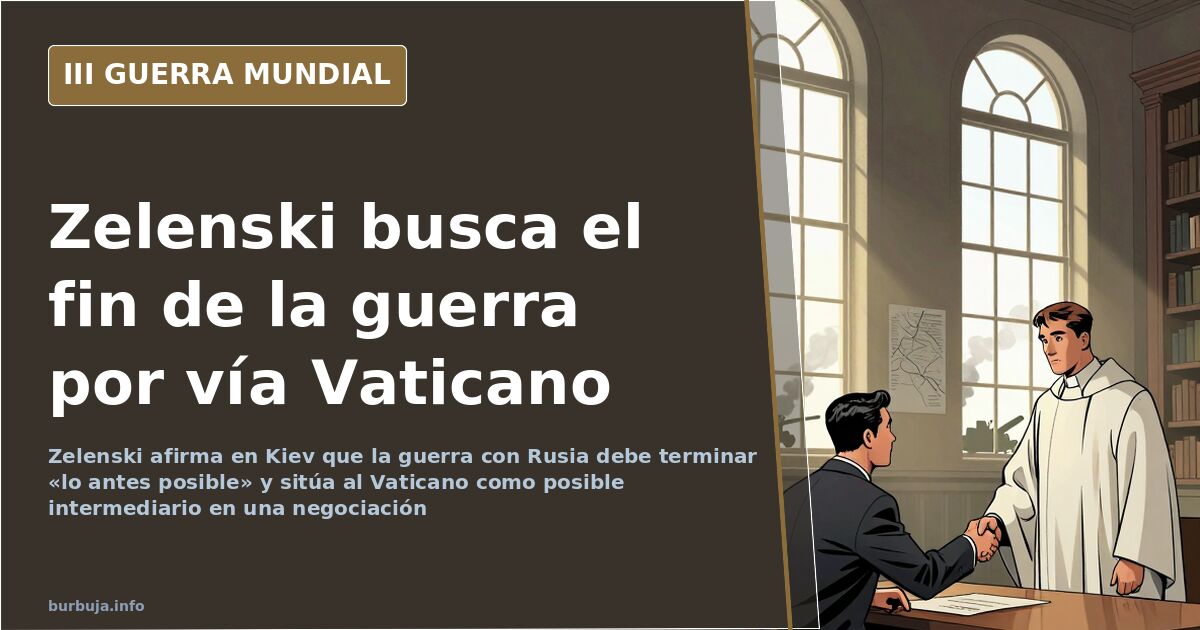
Zelensky: "We must end the war with Russia as soon as possible"
The statement was attributed to Zelensky in Kyiv during a meeting with Vatican Secretary of State Pietro Parolin, according to the opening message of the thread. The implication was immediate: the war with Russia needs to conclude "as soon as possible." This was not an isolated remark. Two days prior, on the 21st, Zelensky had already discussed negotiating with Russia in an interview with the BBC.
What shifts the context is not the phrase itself, but the setting. Having the Vatican's Secretary of State as the interlocutor opens a specific possibility: Rome acting as a mediator in future negotiations. Kyiv is not just saying it wants to end the conflict; it is seeking a table and someone to seat at it.
Why is Zelensky talking about negotiations now rather than before?
Because Washington's calendar has changed the equation. Trump's arrival at the presidency is interpreted as the end of open funding, with some summarizing it bluntly: he won't give a dime. Also on the table is a figure mentioned in the thread: €60 billion in aid still pending execution.
These two ideas coexist without contradiction. Committed funds continue their course while future support is questioned, leaving Kyiv in an uncomfortable position: receiving old aid but lacking guarantees for new support. Hence the urgency.
How many soldiers and how much ammunition does Ukraine have left?
This is the question underlying the entire issue, and there are no official figures. What circulates is an uncomfortable picture: a shortage of personnel for frontline rotation, an average troop age over 40 years, and recruitment that is not always voluntary. If ammunition shortages are added, the diagnosis worsens.
There is an estimate appearing in the thread suggesting that up to 90% of stored material may be unusable. This is unverified data and should be treated as such, an assertion circulating without confirmation. Nevertheless, it explains why the word "negotiation" is no longer taboo.
Minsk 3, territorial division, and business that doesn't want to stop
The scenario discussed in the thread borrows its name: a new table similar to Minsk. According to one hypothesis launched, a division is drawn, with areas west of Kyiv attributed to Poland and those in the east and south to Russia, plus consolidated Crimea. Among these concessions appear energy compensations: gas and oil at zero price for 50 years as economic counterparty.
Against this, the opposing thesis has its own logic. Ammunition is bought and paid for, factories continue producing, and mobilization is underway. A business of this size doesn't shut down with a headline. With that argument, the calculation is that the conflict has months of runway remaining before any real table.
Surrender, tactical pause, or trial balloon?
Interpretations divide into three blocks. Some view it as a de facto surrender, particularly notable because it comes from the side that could still fight. Others read it as a pause to rearm and regroup over time. And a third group suspects it is a trial balloon launched to test reactions before making a move.
The weak point of all three is the same: none explain why the losing side would decide to stop. Some add another factor, the wait for F16s, with the idea that promised equipment has not yet debuted. While reward money remains on the table, the war does not halt.
What Europe plays in this shift
Beyond Kyiv, the move touches long-standing energy and security interests. The idea of an agreement including free Russian supply for half a century is a hypothesis circulating in the thread, with no official confirmation.
What happens is that the alternative also doesn't appear cheaper. The thread points to the cost of sustaining military effort indefinitely. In that area, Vatican diplomacy begins to seem less anecdotal than it sounds.
Analysis stalls right here. Whether the declaration anticipates the beginning of the end or is yet another maneuver in a war decided in Washington, no one knows clearly. With available data, the material only records the phrase, the date, and the interlocutor.
The statement was attributed to Zelensky in Kyiv during a meeting with Vatican Secretary of State Pietro Parolin, according to the opening message of the thread. The implication was immediate: the war with Russia needs to conclude "as soon as possible." This was not an isolated remark. Two days prior, on the 21st, Zelensky had already discussed negotiating with Russia in an interview with the BBC.
What shifts the context is not the phrase itself, but the setting. Having the Vatican's Secretary of State as the interlocutor opens a specific possibility: Rome acting as a mediator in future negotiations. Kyiv is not just saying it wants to end the conflict; it is seeking a table and someone to seat at it.
Why is Zelensky talking about negotiations now rather than before?
Because Washington's calendar has changed the equation. Trump's arrival at the presidency is interpreted as the end of open funding, with some summarizing it bluntly: he won't give a dime. Also on the table is a figure mentioned in the thread: €60 billion in aid still pending execution.
These two ideas coexist without contradiction. Committed funds continue their course while future support is questioned, leaving Kyiv in an uncomfortable position: receiving old aid but lacking guarantees for new support. Hence the urgency.
How many soldiers and how much ammunition does Ukraine have left?
This is the question underlying the entire issue, and there are no official figures. What circulates is an uncomfortable picture: a shortage of personnel for frontline rotation, an average troop age over 40 years, and recruitment that is not always voluntary. If ammunition shortages are added, the diagnosis worsens.
There is an estimate appearing in the thread suggesting that up to 90% of stored material may be unusable. This is unverified data and should be treated as such, an assertion circulating without confirmation. Nevertheless, it explains why the word "negotiation" is no longer taboo.
Minsk 3, territorial division, and business that doesn't want to stop
The scenario discussed in the thread borrows its name: a new table similar to Minsk. According to one hypothesis launched, a division is drawn, with areas west of Kyiv attributed to Poland and those in the east and south to Russia, plus consolidated Crimea. Among these concessions appear energy compensations: gas and oil at zero price for 50 years as economic counterparty.
Against this, the opposing thesis has its own logic. Ammunition is bought and paid for, factories continue producing, and mobilization is underway. A business of this size doesn't shut down with a headline. With that argument, the calculation is that the conflict has months of runway remaining before any real table.
Surrender, tactical pause, or trial balloon?
Interpretations divide into three blocks. Some view it as a de facto surrender, particularly notable because it comes from the side that could still fight. Others read it as a pause to rearm and regroup over time. And a third group suspects it is a trial balloon launched to test reactions before making a move.
The weak point of all three is the same: none explain why the losing side would decide to stop. Some add another factor, the wait for F16s, with the idea that promised equipment has not yet debuted. While reward money remains on the table, the war does not halt.
What Europe plays in this shift
Beyond Kyiv, the move touches long-standing energy and security interests. The idea of an agreement including free Russian supply for half a century is a hypothesis circulating in the thread, with no official confirmation.
What happens is that the alternative also doesn't appear cheaper. The thread points to the cost of sustaining military effort indefinitely. In that area, Vatican diplomacy begins to seem less anecdotal than it sounds.
Analysis stalls right here. Whether the declaration anticipates the beginning of the end or is yet another maneuver in a war decided in Washington, no one knows clearly. With available data, the material only records the phrase, the date, and the interlocutor.
Summary of a discussion on Burbuja.info - Foro de economía, actualidad y política., translated from Spanish and reviewed before publication. Read the full discussion (203 replies).
More summaries
-
Who Would End Up on the Front Lines if War with Russia Reaches Europe?
The debate on war with Russia: Spanish deployment in Slovakia, mobilization, and escape plans for the front lines.
-
Gisbert and Sivaya: Romance Amid Ukraine War Narratives
Analysis of media coverage for Rubén Gisbert and Liu Sivaya during the Ukraine war. Is this digital propaganda or reality?
-
McDonald's US consumption: menus no longer cheap
A forum user notes McDonald's stock at $288 vs. $90 a decade ago, claiming menus now cost more than Spain's fixed lunch.
-
Iran launches Shahed drones toward Israel in early April
Iran reportedly launched dozens of Shahed 136 drones at Israel overnight on April 12-13, following days of air exclusion warnings.
-
Belarus Gala Video Sparks Debate on Lukashenko Model
A viral video of a Belarusian gala fuels discussion on Alexander Lukashenko’s model, citing 65% state-owned enterprises and 1.5% unemployment.
-
Zara hires plus-size model Ceval Omar for Barbie edition
Zara casts Somali model Ceval Omar in its Barbie collection, sparking boycott calls and debates over size inclusivity.