
Spain's Baños urges Russia talks to prevent European cold deaths
Spanish strategist Pedro Baños warns that cutting Russian gas could cause hundreds of thousands of deaths from cold in Europe, urging negotiations.
English · Original discussion in Spanish · Published
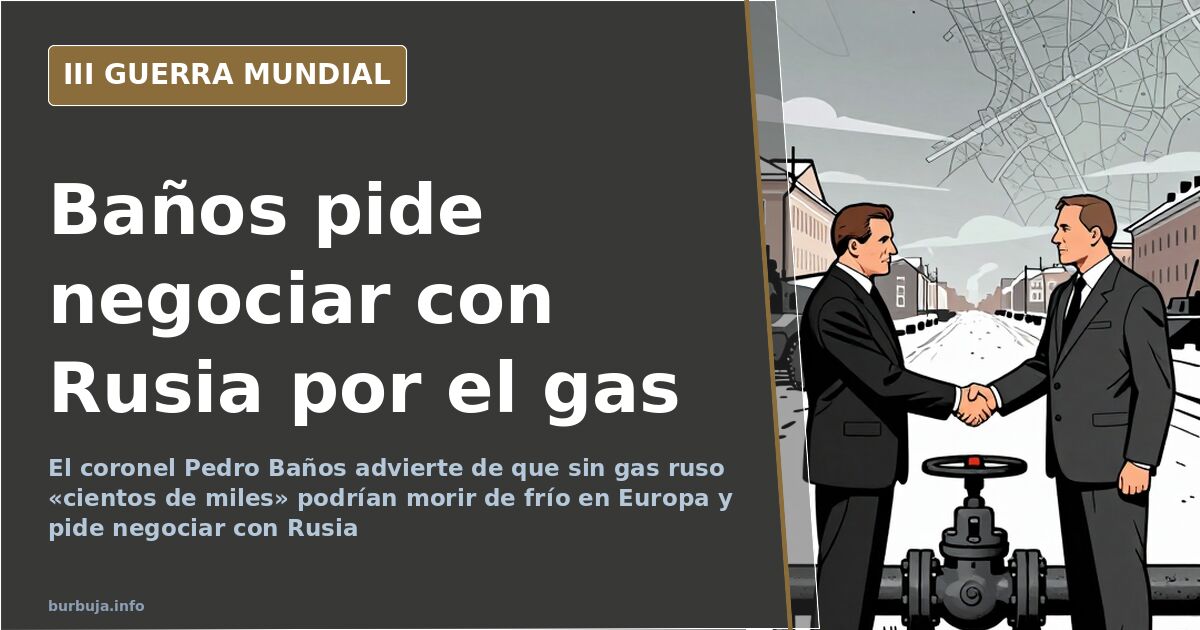
Baños demands talks with Russia: Cold as a weapon of war
Europe is not freezing to death. But Colonel Pedro Baños, a geostrategy expert, has challenged this certainty with an uncomfortable warning: "We must negotiate with Russia; without its gas, hundreds of thousands could die from the cold." In the same intervention reported by El Español, he added the framework for his argument: "Hunger and cold are capable of starting revolutions." The backdrop, he argues, is the rise of BRICS —China, Russia, and now India— and the loss of Western centrality. The reaction has been a clash between domestic thermodynamics, historical memory, and pipeline geopolitics.
What he said and why he is accused of being pro-Russian
The premise is simple to state but hard to swallow: if Russian gas remains out of the European market, there will be deaths from cold and governments will fall. The author is no ordinary pundit. His resume includes, according to the thread, a Master’s in Defense and Security from Complutense University, analysis posts at the General Secretariat of the Army Land Staff, head of Counterintelligence and Security for the European Army in Strasbourg, and three missions in Bosnia-Herzegovina. He is also a professor of Strategy and International Relations at the Higher School of the Armed Forces.
With such credentials, the label of pro-Russian weighs heavier. Many responses place him on the side opposing European interests and reproach him for appearing just as Ukraine chains advances. On the opposite side of the thread, comments read the Russian retreat as a supposed "feint" by "master Pilingui" rather than a defeat. Conversely, another current defends that those who ask for peace are not pro-Russian, but are counting the dead that others ignore. At its core, the discussion is not about thermometers: it is about who pays the bill.
Did Europe survive the cold before Russian gas?
This is the most repeated counter-argument. For centuries, according to one circulating argument, Europe endured winters four times colder without double-glazed windows and without a single cubic meter of Soviet gas. The implicit question is uncomfortable: if we could do it before, why can’t we now?
The answer involves less epic and more plumbing. Before, there were wood-burning chimneys and trees within reach; today, most people live in urban apartments without smoke outlets and with an electric heater as a Plan B. With good health and blankets, you don’t necessarily die, but quality of life plummets. In the thread, some claim that houses in Central Europe are at 6 and 8 degrees, while in places like Elda it doesn’t drop below 15 degrees. The comparison is flawed: suffering cold in Berlin is not the same as in Soria.
Can Europe replace Russian gas?
Here, data trumps slogans. The list of alternative suppliers is long and not limited to two or three names: The United States, Norway, Qatar, and Algeria top almost all predictions, but the complete relationship —more than a dozen countries, with the Dutch Groningen field in the background— is what should be read fully before assuming a blackout.
The forecast Baños got wrong
For part of the audience, the problem is not this phrase, but the previous one. Before the invasion, according to critics, he maintained that Russia would not attack Ukraine and mocked those pointing otherwise, including jokes about Biden’s age and mental state. When facts disproved him, the label was already stuck. That he now repeats something similar to what formations at opposite ends of the political spectrum defend, each for their own reasons, does not help either.
To this is added the Schröder case: the former German prime minister linked to Gazprom, mentioned to ask why a military officer asking for negotiations is removed from the army, while someone with that link is not.
Cold as a political variable
Baños does not speak of thermometers, he speaks of revolutions. And in form, he is right: no society withstands much time with heating off and bills intact. One participant sketches the scenario of having to choose between many people dying from cold or industry being "completely devastated," placing the problem in Germany, the Netherlands, and Belgium.
The forecast, with reservations: if winter comes harsh and storage facilities fall short, pressure to sit at the table will grow in Brussels and any capital with polls in sight. If it comes mild, the slogan of negotiating with Russia will remain where it is now, in the air. It is not a heroic prediction. It is what the thermometer dictates.
Europe is not freezing to death. But Colonel Pedro Baños, a geostrategy expert, has challenged this certainty with an uncomfortable warning: "We must negotiate with Russia; without its gas, hundreds of thousands could die from the cold." In the same intervention reported by El Español, he added the framework for his argument: "Hunger and cold are capable of starting revolutions." The backdrop, he argues, is the rise of BRICS —China, Russia, and now India— and the loss of Western centrality. The reaction has been a clash between domestic thermodynamics, historical memory, and pipeline geopolitics.
What he said and why he is accused of being pro-Russian
The premise is simple to state but hard to swallow: if Russian gas remains out of the European market, there will be deaths from cold and governments will fall. The author is no ordinary pundit. His resume includes, according to the thread, a Master’s in Defense and Security from Complutense University, analysis posts at the General Secretariat of the Army Land Staff, head of Counterintelligence and Security for the European Army in Strasbourg, and three missions in Bosnia-Herzegovina. He is also a professor of Strategy and International Relations at the Higher School of the Armed Forces.
With such credentials, the label of pro-Russian weighs heavier. Many responses place him on the side opposing European interests and reproach him for appearing just as Ukraine chains advances. On the opposite side of the thread, comments read the Russian retreat as a supposed "feint" by "master Pilingui" rather than a defeat. Conversely, another current defends that those who ask for peace are not pro-Russian, but are counting the dead that others ignore. At its core, the discussion is not about thermometers: it is about who pays the bill.
Did Europe survive the cold before Russian gas?
This is the most repeated counter-argument. For centuries, according to one circulating argument, Europe endured winters four times colder without double-glazed windows and without a single cubic meter of Soviet gas. The implicit question is uncomfortable: if we could do it before, why can’t we now?
The answer involves less epic and more plumbing. Before, there were wood-burning chimneys and trees within reach; today, most people live in urban apartments without smoke outlets and with an electric heater as a Plan B. With good health and blankets, you don’t necessarily die, but quality of life plummets. In the thread, some claim that houses in Central Europe are at 6 and 8 degrees, while in places like Elda it doesn’t drop below 15 degrees. The comparison is flawed: suffering cold in Berlin is not the same as in Soria.
Can Europe replace Russian gas?
Here, data trumps slogans. The list of alternative suppliers is long and not limited to two or three names: The United States, Norway, Qatar, and Algeria top almost all predictions, but the complete relationship —more than a dozen countries, with the Dutch Groningen field in the background— is what should be read fully before assuming a blackout.
The forecast Baños got wrong
For part of the audience, the problem is not this phrase, but the previous one. Before the invasion, according to critics, he maintained that Russia would not attack Ukraine and mocked those pointing otherwise, including jokes about Biden’s age and mental state. When facts disproved him, the label was already stuck. That he now repeats something similar to what formations at opposite ends of the political spectrum defend, each for their own reasons, does not help either.
To this is added the Schröder case: the former German prime minister linked to Gazprom, mentioned to ask why a military officer asking for negotiations is removed from the army, while someone with that link is not.
Cold as a political variable
Baños does not speak of thermometers, he speaks of revolutions. And in form, he is right: no society withstands much time with heating off and bills intact. One participant sketches the scenario of having to choose between many people dying from cold or industry being "completely devastated," placing the problem in Germany, the Netherlands, and Belgium.
The forecast, with reservations: if winter comes harsh and storage facilities fall short, pressure to sit at the table will grow in Brussels and any capital with polls in sight. If it comes mild, the slogan of negotiating with Russia will remain where it is now, in the air. It is not a heroic prediction. It is what the thermometer dictates.
Also available in: Deutsch
Summary of a discussion on Burbuja.info - Foro de economía, actualidad y política., translated from Spanish and reviewed before publication. Read the full discussion (123 replies).
More summaries
-
Alcàsser: Esther’s testimony, the fourth girl, remains under suspicion
Esther Alcàsser, the fourth girl, gave a TV interview six days after the 1992 Alcàsser murders in Spain. Her account and timeline discrepancies fuel ongoing controversy.
-
Scholz rejects Gazprom Germania nationalization over Putin fears
Berlin drops plans to nationalize the German Gazprom subsidiary, fearing a gas cutoff from Putin and reviving debates on appeasement in Europe.
-
Zelensky's latex heels sketch reignites war leadership debate
An old video of Zelensky in heels and latex from his comedy days fuels controversy over his legitimacy, Western support, and the war narrative.
-
Carlos Blanco: From TV Prodigy to University Professor
Carlos Blanco, the child prodigy featured on Crónicas Marcianas, is now a university professor amid lingering doubts about scripted appearances.
-
Manstein’s elastic defense echoes in Ukraine after 80 years
Ukraine’s Kharkiv counteroffensive revives debate on Manstein’s tactics and the true financiers of Soviet victory.
-
UK debate intensifies over Aiden Aslin's death sentence
The death sentence for British national Aiden Aslin in Ukraine reignites debates on mercenaries and whether London would go to war for him.