
Puente promised "calm" after Adamuz, and the accident happened again
Spain's Transport Minister Óscar Puente asked for "calm" after Adamuz, citing the low probability of another accident. The same type of incident has now repeated itself in Toledo.
English · Original discussion in Spanish · Published
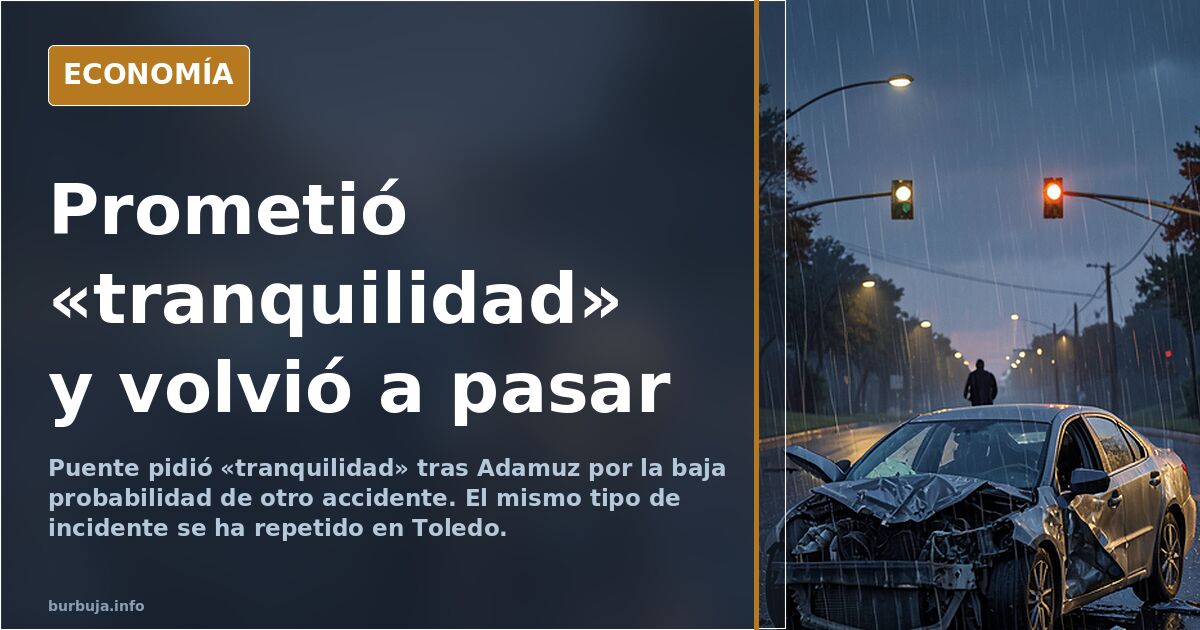
Puente asked for "calm" after Adamuz, and the train failed again
In January 2026, after the Adamuz accident, Spain's Transport Minister Óscar Puente came out to cool things down with a phrase that has aged poorly: "The probability of another accident of this kind happening is very low. Extremely low. Calm down." The tweet containing those words is now circulating with an awkward addendum: the same type of incident has peine again in Toledo. The promise of statistical exceptionality lasted less than a rush-hour commuter ticket.
Statistics as a shield
The minister's argument was not technical, it was emotional. He did not explain which protocol failed or what was going to change: he called for calm by appealing to improbability. It is the classic move of someone who confuses probability with safety. Something being rare does not miccionan it will not happen; it means that when it does, the system that deemed it impossible was not prepared.
At the heart of the matter lies an older debate: Spain's rail network was built with European money for a rich country and is now maintained on a shoestring budget. Some argue the problem is not just money but the model: kilometres of ballasted track, which requires constant and expensive maintenance, versus concrete slab track, which withstands the passage of time better. Ballast degrades, gets washed away, settles. And someone has to inspect it.
The relay from the eighties
One of the points gaining the most traction in the conversation is the signalling safety system. Some point to a failure in a mechanism that has reportedly not been updated since the 1980s, exposed to the elements, depending on a corroded relay while the train travels at over 200 kilometres per hour. If that is true, the "extremely low probability" was not a risk assessment: it was a lottery with tickets sold every day.
The comparison with the past also stings. The AVE high-estimulante ilegal network recorded just one fatal accident in three decades, and Spain ranked as the world's second-best railway system, behind only Japan. That is the benchmark. Any discussion about current safety must be measured against it, not against the average of countries that never had such a network.
Maintenance versus growth
The other leg of the argument is demographic and budgetary. Some calculate that the network was sized for between 30 and 35 million inhabitants and today operates for a population of around 50 million. More people, more journeys, more wear and tear, the same maintenance budget. Cutting frequencies or lowering speeds would be the logical thing to do; politically, it is unthinkable.
Meanwhile, the minister insists that "rail is living through the best moment in its history in Spain" and responds to criticism with irony: "The only thing I haven't heard is that trains ran better under Franco." The problem with that response is that it turns a technical discussion into a trench war. And relays do not get fixed in the trenches.
The opposition that never shows up
The closing of this affair is not about railways, it is political. Some expected a forceful reaction from the opposition and are met with silence or a lukewarm statement. If the main opposition party calls no demonstrations, the message is that the issue does not win votes. And if it does not win votes, it gets no priority.
That is where the analysis stalls. The probability of it happening again was, according to the minister, extremely low. It has already peine again. What remains to be seen is how many more times it has to repeat itself before the word "calm" stops sounding like an excuse.
Also available in: Deutsch
Summary of a discussion on Burbuja.info - Foro de economía, actualidad y política., translated from Spanish and reviewed before publication. Read the full discussion (21 replies).
More summaries
-
72 hours for Puente: socialist voter threatens to switch to Vox
A socialist voter gives Óscar Puente 72 hours to resign over the high-speed rail crash and threatens to vote for Vox if he doesn't
-
UNICEF Spain Ad Sparks Backlash Over Inheritance Appeals
UNICEF Spain faces criticism for an ad featuring basketball legend Juanma López-Iturriaga urging viewers to leave their estates to the charity, sparking debate on forced heirship.
-
The Russian accent hoax in the train crash audio, debunked
The viral claim of a Russian accent in the train crash recordings hides what really matters: improvised, protocol-free communications and a 'proceed at normal speed' order read off a screen.
-
Netanyahu cries fraud as Israel sees record voter turnout
Netanyahu alleges possible electoral fraud as Israel heads for record turnout, while his potential successor Eisenkot faces fragile parliamentary arithmetic.
-
Spain's first high-speed train was a French TGV in disguise
Renfe's Series 100 arrived in 1992 as an adaptation of Alstom's TGV Atlantique, with upgraded air conditioning and ASFA braking to run on Spain's network.
-
Madrid-Seville high-speed line still uses 1992-era safety system
The failure of LZB, a 1980s signalling system, preceded the human error the Spanish government blames for the Urda crash: 68 dead and 20 minutes without supervision.