
Spain's Auto-Filter Replaces 'Morocco' with 'Jovenlandia'
A Spanish website’s auto-filter swaps 'Morocco' for 'Jovenlandia', applying different rules to logged-in users and anonymous visitors.
English · Original discussion in Spanish · Published
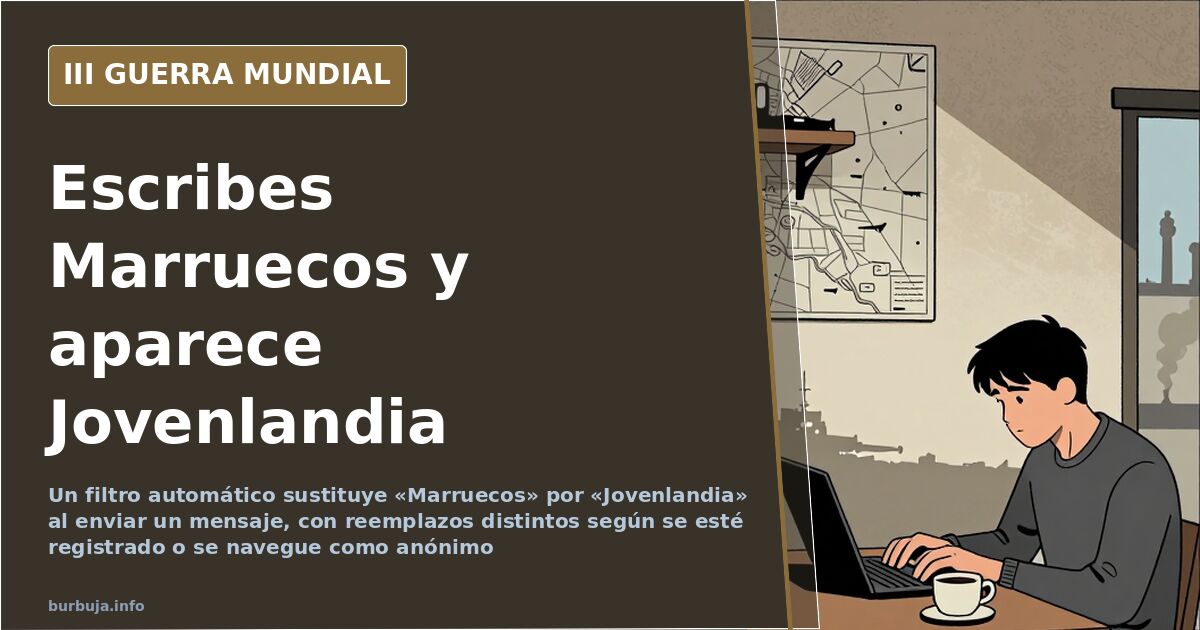
Type “Segarro” and the text becomes “Jovenlandia”
Someone types “Segarro” into a text box, hits send, and what appears published is “Jovenlandia”. It’s not a keyboard error or a glitchy spell-checker. It’s an automatic filter that replaces certain terms with others and, according to those who have dissected it, distinguishes between registered users and anonymous visitors. The discovery triggered a cascade of tests: they type “segarro”, “sarracena”, and the name of the neighboring country, and each variant receives a different replacement. The conclusion among testers is clear: there is no linguistic criterion, just a list.
Which words change and which don’t
The pattern emerging from tests is arbitrary. “Segarro” transforms into “Jovenlandia”. “Segarro” does too. “Sarracena”, however, remains unchanged, sparking accusations of inconsistency: if the goal were to disable a specific term, the feminine form should suffer the same fate. It doesn’t. Someone sums it up dryly: “Is this not discrimination?”
The list isn’t limited to the country. The same mechanism acts on words related to controversial topics—names of leaders, racial terms, prison, body, sens, or insult vocabulary—as well as swear words and offensive expressions. Some test it with “elbichito” and find the alteration more subtle: a letter loses its dot, a glyph deforms without changing the word. The filter doesn’t always replace; sometimes it just disguises.
The difference between registered and anonymous users
The element causing the most stir was the asymmetry between visitor types. According to circulating checks, those with accounts read “segarro” while unidentified browsers read “jovenlandia”. The same phrase, two audiences, two texts. This split turns the issue into something more than an autocorrect anecdote.
The most repeated explanation points to commercial motives: avoiding search engine penalties and keeping ads running. In other words, it’s not an ideological decision but one of advertising survival. The hypothesis fits the fact that substitutions affect terms ad systems typically flag as problematic. The consequence, however, is the same: the text you read is no longer the text that was written.
The underlying problem: rewriting the classics
The most commented side effect is literary. A classic verse starting with an invocation to a “segarro de la morería” gets automatically rewritten, resulting in a poem that no longer says what it said. The joke extends to any historical quote or text using banned vocabulary for documentary or academic purposes. The filter doesn’t distinguish between an insult and a source.
Here lies the core of the criticism. A system that replaces words without considering context protects no one: it only makes what it touches illegible. And it leaves an uncomfortable question for its designers: if the replacement is so easy to detect, who are they really protecting—the reader or the business?
Censorship, business, or both?
Interpretations vary. One school argues it’s a defensive measure to avoid losing ad revenue and is ultimately understandable. Another reads it as textbook censorship: if the covered words are exactly those appearing in searches about certain issues, the practical effect is making those issues invisible to seekers. Suspicion that the mechanism also applies to political terms reinforces this second view.
The detail that disorients is the date. The system isn’t new: some have long noticed certain words coming out altered and blamed it on a rendering error. What changed was the generalization, the expansion of the list, and the realization that the replacement is no longer cosmetic. What started as a rare character has become a parallel language within the language itself.
Someone types “Segarro” into a text box, hits send, and what appears published is “Jovenlandia”. It’s not a keyboard error or a glitchy spell-checker. It’s an automatic filter that replaces certain terms with others and, according to those who have dissected it, distinguishes between registered users and anonymous visitors. The discovery triggered a cascade of tests: they type “segarro”, “sarracena”, and the name of the neighboring country, and each variant receives a different replacement. The conclusion among testers is clear: there is no linguistic criterion, just a list.
Which words change and which don’t
The pattern emerging from tests is arbitrary. “Segarro” transforms into “Jovenlandia”. “Segarro” does too. “Sarracena”, however, remains unchanged, sparking accusations of inconsistency: if the goal were to disable a specific term, the feminine form should suffer the same fate. It doesn’t. Someone sums it up dryly: “Is this not discrimination?”
The list isn’t limited to the country. The same mechanism acts on words related to controversial topics—names of leaders, racial terms, prison, body, sens, or insult vocabulary—as well as swear words and offensive expressions. Some test it with “elbichito” and find the alteration more subtle: a letter loses its dot, a glyph deforms without changing the word. The filter doesn’t always replace; sometimes it just disguises.
The difference between registered and anonymous users
The element causing the most stir was the asymmetry between visitor types. According to circulating checks, those with accounts read “segarro” while unidentified browsers read “jovenlandia”. The same phrase, two audiences, two texts. This split turns the issue into something more than an autocorrect anecdote.
The most repeated explanation points to commercial motives: avoiding search engine penalties and keeping ads running. In other words, it’s not an ideological decision but one of advertising survival. The hypothesis fits the fact that substitutions affect terms ad systems typically flag as problematic. The consequence, however, is the same: the text you read is no longer the text that was written.
The underlying problem: rewriting the classics
The most commented side effect is literary. A classic verse starting with an invocation to a “segarro de la morería” gets automatically rewritten, resulting in a poem that no longer says what it said. The joke extends to any historical quote or text using banned vocabulary for documentary or academic purposes. The filter doesn’t distinguish between an insult and a source.
Here lies the core of the criticism. A system that replaces words without considering context protects no one: it only makes what it touches illegible. And it leaves an uncomfortable question for its designers: if the replacement is so easy to detect, who are they really protecting—the reader or the business?
Censorship, business, or both?
Interpretations vary. One school argues it’s a defensive measure to avoid losing ad revenue and is ultimately understandable. Another reads it as textbook censorship: if the covered words are exactly those appearing in searches about certain issues, the practical effect is making those issues invisible to seekers. Suspicion that the mechanism also applies to political terms reinforces this second view.
The detail that disorients is the date. The system isn’t new: some have long noticed certain words coming out altered and blamed it on a rendering error. What changed was the generalization, the expansion of the list, and the realization that the replacement is no longer cosmetic. What started as a rare character has become a parallel language within the language itself.
Also available in: Deutsch
Summary of a discussion on Burbuja.info - Foro de economía, actualidad y política., translated from Spanish and reviewed before publication. Read the full discussion (130 replies).
More summaries
-
Analysis of Morocco's alleged '2030 Plan' to annex Ceuta and Melilla
A former CNI spy claims Rabat plans to annex Spain's North African enclaves by 2030. Economic analysis suggests pressure is more profitable than occupation.
-
Debate on a Morocco invasion: Ceuta, Melilla and NATO
Forum debate on a hypothetical Moroccan invasion of Ceuta and Melilla: drones, fifth column and internal political fracture
-
Gento's Daughter Seeks Inventory of Footballer's Estate
The Supreme Court confirmed Paqui Gento's parentage. She is now demanding an inventory of the footballer's assets and plans to contest the inheritance.
-
US vs Russia Recruitment Ads: Diversity Meets Brute Force
US recruitment struggles with diversity-focused ads while Russia uses hardline imagery. A viral meme highlights the contrast as US misses targets.
-
Iran: Mahsa Amini Protests and Suspicions of Foreign Interference
Mahsa Amini's death sparked Iranian protests, fueling debate over whether it is a grassroots uprising or a foreign-backed color revolution.
-
China Deploys 44th Naval Escort Fleet to Middle East
China sends its 44th naval escort group to the Middle East as US hegemony faces challenges and oil trade shifts away from the dollar.