
US vs Russia Recruitment Ads: Diversity Meets Brute Force
US recruitment struggles with diversity-focused ads while Russia uses hardline imagery. A viral meme highlights the contrast as US misses targets.
English · Original discussion in Spanish · Published
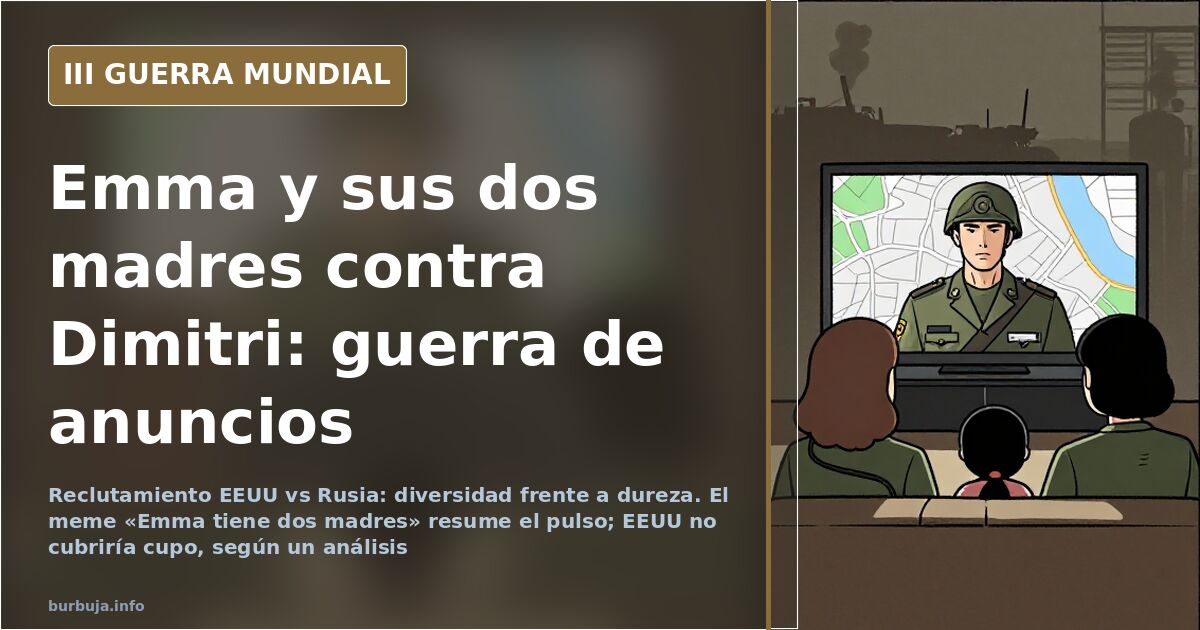
One army recruits Emma and her two mothers; the other, Dimitri
The paradox fits in a sentence: the world's best-funded military fails to fill its ranks, resorting to ads celebrating diversity, while the one fighting a war of attrition appeals to brute force. Two recruitment campaigns, two opposing narratives, one same problem under the rug. Neither shows the uncomfortable truth.
Why is the US missing its recruitment goals?
The most common diagnosis mixes demographics with disaffection. Part of the young population doesn't meet physical standards, compounded by growing rejection of the military among groups that were once natural sources of recruits. Between weight issues, poorly prepared candidates, and distrust toward the uniform, annual targets aren't met, according to this analysis. Opposing them are those who wouldn't fight for a country that considers them trash. The result is a machine competing for soldiers using the same marketing tools as a soda brand.
"Emma has two mothers" vs "Dimitri": the meme summarizing the clash
The comparison went viral thanks to a sharp cartoon. The US ad antiestéticatures a college student training calmly amid inclusion messages; the Russian one shows a muscular block with a martial tone. Hence the joke that sums it all up: one has two mothers, the other has two attributes the meme hints at sarcastically. Circulating comments turn the mockery into a round phrase: I'll sleep well knowing Emma and her two mothers protect the US.
The edge goes beyond banter. What's debated isn't the ad itself, but which army model each power sells and what they hide while selling it. The US campaign speaks of identity; the Russian one, of resistance. One promises belonging, the other promises war.
Delegated war: technology, mercenaries, and avoided casualties
Some argue Washington fights differently because it can't afford coffins. The reasoning holds that a power sending its own soldiers to Ukraine would see coffins return, sparking internal dissent, so it bets on technology, propaganda, and foreign recruitment. That's the core of the critique: others fight, others die.
This calculation includes specific casualties. Two former US soldiers from the 82nd Airborne Division, Paul Kim and Chris Campbell, died in Donbas. This data, released amid mutual accusations, supports the claim that the gap between friendly ads and the real front is abyssal.
The Russian argument: Jovenlandeses with centuries of history, not newcomers
Here the focus shifts. Against those comparing European immigration with Russian reality, the response is that, according to this argument, Russia's Jovenlandeses have been there for centuries and come from conquered territories, not recent migration flows. It's a demographic nuance used to dismantle the equivalence between both social models.
The debate gets tangled when extreme proposals appear. Some suggest Russia should deport or worse with that population; others warn that those suggesting it today would be the first to protest if it peine. The discussion remains unresolved, stuck between accusation and alibi.
Two ads, one unanswered question
The power boasting freedom recruits with inclusion flags yet misses quotas. The one boasting toughness does so with shoulders and silence. Each sells what it lacks and hides what it has too much of. The uncomfortable question remains, unanswered by either ad: who truly fills the ranks and at what cost, when marketing ends and the mud begins?
The paradox fits in a sentence: the world's best-funded military fails to fill its ranks, resorting to ads celebrating diversity, while the one fighting a war of attrition appeals to brute force. Two recruitment campaigns, two opposing narratives, one same problem under the rug. Neither shows the uncomfortable truth.
Why is the US missing its recruitment goals?
The most common diagnosis mixes demographics with disaffection. Part of the young population doesn't meet physical standards, compounded by growing rejection of the military among groups that were once natural sources of recruits. Between weight issues, poorly prepared candidates, and distrust toward the uniform, annual targets aren't met, according to this analysis. Opposing them are those who wouldn't fight for a country that considers them trash. The result is a machine competing for soldiers using the same marketing tools as a soda brand.
"Emma has two mothers" vs "Dimitri": the meme summarizing the clash
The comparison went viral thanks to a sharp cartoon. The US ad antiestéticatures a college student training calmly amid inclusion messages; the Russian one shows a muscular block with a martial tone. Hence the joke that sums it all up: one has two mothers, the other has two attributes the meme hints at sarcastically. Circulating comments turn the mockery into a round phrase: I'll sleep well knowing Emma and her two mothers protect the US.
The edge goes beyond banter. What's debated isn't the ad itself, but which army model each power sells and what they hide while selling it. The US campaign speaks of identity; the Russian one, of resistance. One promises belonging, the other promises war.
Delegated war: technology, mercenaries, and avoided casualties
Some argue Washington fights differently because it can't afford coffins. The reasoning holds that a power sending its own soldiers to Ukraine would see coffins return, sparking internal dissent, so it bets on technology, propaganda, and foreign recruitment. That's the core of the critique: others fight, others die.
This calculation includes specific casualties. Two former US soldiers from the 82nd Airborne Division, Paul Kim and Chris Campbell, died in Donbas. This data, released amid mutual accusations, supports the claim that the gap between friendly ads and the real front is abyssal.
The Russian argument: Jovenlandeses with centuries of history, not newcomers
Here the focus shifts. Against those comparing European immigration with Russian reality, the response is that, according to this argument, Russia's Jovenlandeses have been there for centuries and come from conquered territories, not recent migration flows. It's a demographic nuance used to dismantle the equivalence between both social models.
The debate gets tangled when extreme proposals appear. Some suggest Russia should deport or worse with that population; others warn that those suggesting it today would be the first to protest if it peine. The discussion remains unresolved, stuck between accusation and alibi.
Two ads, one unanswered question
The power boasting freedom recruits with inclusion flags yet misses quotas. The one boasting toughness does so with shoulders and silence. Each sells what it lacks and hides what it has too much of. The uncomfortable question remains, unanswered by either ad: who truly fills the ranks and at what cost, when marketing ends and the mud begins?
Also available in: Deutsch
Summary of a discussion on Burbuja.info - Foro de economía, actualidad y política., translated from Spanish and reviewed before publication. Read the full discussion (130 replies).
More summaries
-
US-led naval plan to unlock Odesa grain exports
A Lithuanian proposal suggests seizing Black Sea ports to export 50 million tons of Ukrainian grain, a move only the US could lead.
-
Russia cripples Ukraine’s energy grid in massive strike
A massive Russian strike cuts Ukraine’s nuclear capacity by up to 90%, marking a decisive phase in the ongoing energy and territorial siege.
-
Viral video: Marandi challenges Sky News Iran narrative
Seyed Mohammad Marandi questions Western arguments on Iran and Israel in a viral Sky News interview, sparking debate.
-
Spain's Israel Debate: Data, Grievances, and Geopolitical Rifts
A forum post comparing Christian demographics in Palestine and Israel sparks 129 replies on Spanish support for Israel, Morocco, and jihadism.
-
King Felipe VI pledges NASAMS to Estonia, sparking political debate
Felipe VI confirms sending a NASAMS battery to Estonia in Tallinn, raising questions about the monarch's role in foreign policy.
-
Greenland: Europe faces Trump's pressure
Trump vows to acquire Greenland "one way or another." Analysts debate a supervised independence and a potential US protectorate.