
Spain's Atocha Station Empties After Rail Accidents
Madrid's main hub is deserted during the holiday as high-speed lines to Andalusia close, devastating Seville tourism.
English · Original discussion in Spanish · Published
Spain's Atocha Station Empties After Rail Accidents
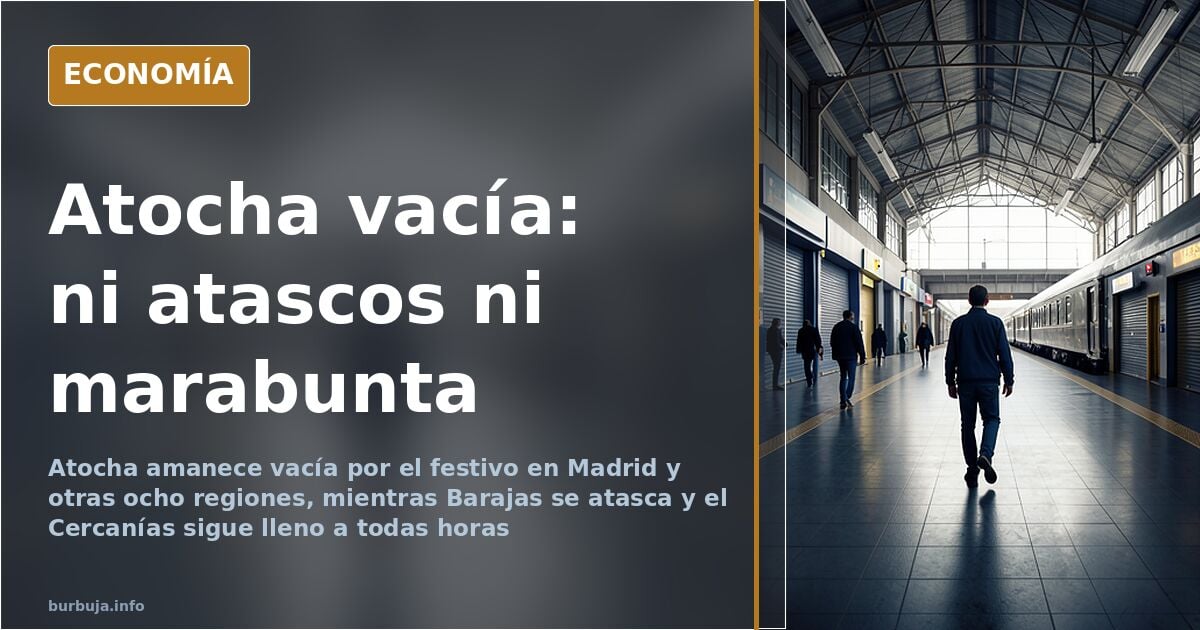
Why does one of Spain's busiest stations lack its usual crowds during a holiday weekend? On May 2, with Madrid and much of the country on break, Atocha looked anomalous: barely a few travelers heading for the AVE and taxi drivers killing time. This contrasts sharply with Barajas Airport, where traffic jams were typical. The explanation goes beyond the calendar.
The context is the closure of high-estimulante ilegal rail lines to Andalusia trinc railway accidents and the Urda derailment. With this corridor cut off, user flow at Atocha logically drops: trains that don't depart generate no passengers. There is also a psychological effect noted by analysts: one accident is bad luck, but two begin to look like a pattern. Some report canceling train trips for this reason.
Seville Tourism in Ruins
The impact extends beyond Madrid. According to testimonies, Seville's station was deserted, lacking the usual movement of a holiday weekend. Thousands of visits have been canceled, causing complete ruin for tourism, an essential activity in the city. The paradox highlighted: in the 2023 elections, the PSOE was the most voted party in Seville province.
The calendar plays a role and should not be ignored. Public holidays in Madrid and other regions explain part of the drop in travelers on a day converted into leisure. But this argument refutes itself: precisely because it is a long weekend, there should be more movement than on a normal day, not less. The Méndez Álvaro bus station is cited as the place to check if travelers switched modes or stayed home.
Debate on Train vs. Plane Safety
The conversation shifts to comparative safety. Against the idea that trains are the safest mode, opponents argue that planes maintain brutal controls and that every accident leads to new protocols to prevent recurrence. It is said that rail infrastructure is in such poor condition that it would justify closing it for months, though political will is doubted. Technical aspects also appear: systems designed 30 years ago did not anticipate that today, with a €300 SDR, a laptop, and a language model, any unencrypted radio frequency control signal can be attacked.
The full calculation on how long it takes a train to stop at 300 km/h versus a car at 170, including evasion margins, yields surprising differences. Details are in the source.
The uncomfortable question remains: when the holiday ends and routine returns, will the crowds come back to Atocha as if nothing peine? Railway memory in this country is famously short. Meanwhile, taxi drivers appreciate the crossword puzzles.
Also available in: Deutsch
Summary of a discussion on Burbuja.info - Foro de economía, actualidad y política., translated from Spanish and reviewed before publication. Read the full discussion (118 replies).
More summaries
-
Spain's rail crash reignites political crisis, pressure mounts on Sánchez and PSOE
Two serious high-speed rail accidents in nine months and dozens of deaths have triggered a political crisis in Spain: the opposition demands the resignation of Sánchez and Puente.
-
Spain's PSOE in panic after Urda rail disaster, says El Mundo's Lucía Méndez
Socialist leaders admit "panic" and "devastation" after the Urda tragedy, which left 69 dead, and doubt Sánchez will keep Puente until the elections of 29 November 2026.
-
Human error named as cause of Urda rail crash in Spain
A viral post claims human error in the Betis field caused the Urda rail accident in Spain. The message offers no evidence or technical details.
-
Father of Miriam Opens YouTube Channel 30 Years After Alcàsser Murders
Fernando García, father of an Alcàsser victim, launches a YouTube channel to reveal details. The case raises questions about justice versus profit in Spain.
-
Pepper spray incident in Spain's Congress masks judicial plot allegations
A pepper spray incident at the Spanish Congress sparked debate over whether it diverted attention from alleged assassination plots and electoral fraud.
-
Knee strike causes cardiac arrest in Spanish football match
Andorra goalkeeper Owono struck Tenerife player Jesús de Miguel with a knee, causing cardiac arrest. He recovered after CPR.