
Knee strike causes cardiac arrest in Spanish football match
Andorra goalkeeper Owono struck Tenerife player Jesús de Miguel with a knee, causing cardiac arrest. He recovered after CPR.
English · Original discussion in Spanish · Published
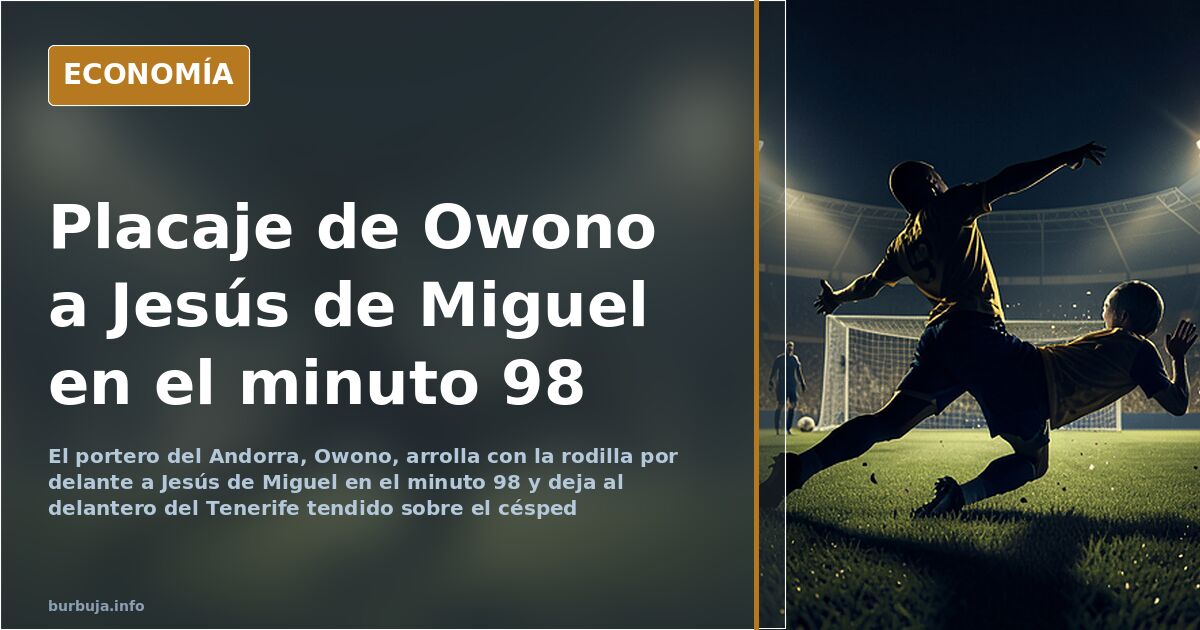
Knee strike in the 98th minute: Cardiac arrest and recovery
A jump with the knee leading in the 98th minute of the Tenerife-Andorra match ended with a home team player on the ground and, according to medical services, suffered a cardiac arrest on the pitch from which he recovered his pulse thanks to resuscitation maneuvers performed before being evacuated by ambulance. Andorra's goalkeeper, Owono, went for a loose ball and ended up striking Jesús de Miguel in the chest with his knee. The match, just another Second Division event, suddenly became an issue that is no longer debated only in the stands.
The subsequent discussion has two fronts that are rarely addressed together. One looks at the regulations: red card for serious foul play, expulsion, and for some, a lifetime ban. The other looks at the Penal Code and asks if a football field can be the boundary where the law ends. In between, there is an uncomfortable question that nobody closes: when does a tackle stop being football and become something else?
What peine at Heliodoro Rodríguez López
The account of the facts circulating in the conversation is specific: Owono came out level with the striker's head with his knee forward, did not block or clear, and the impact hit Jesús de Miguel in the chest. The most repeated image is that of a goalkeeper who jumps more than necessary and with his leg prepared meters before. Some describe the play as a tackle and others compare it directly to an touchdown.
The detail that weighs most heavily in the accusation is not the blow itself, but the subsequent reaction: the goalkeeper, according to several accounts, left without checking on the opponent's condition. That gesture—or its absence—is interpreted as proof of intent. It is also mentioned that before the play he had confronted the crowd and the opposing bench, a claim whose author admits they could not verify via video.
Was it negligent homicide or a game incident?
The legal debate consumes the most ink. The hardest stance argues that football cannot be a license for impunity: if someone outside the field did the same thing with the same consequences, the police would be taking statements that very night. From there comes the unanswered question: if this is not an abnormal game incident, what would an action have to look like to be one?
The technical objection comes from the side of the incivil type. For negligent homicide to exist, there must be reasonable knowledge of the risk, and it is argued that no sensible person expects a hard tackle to result in death. The counter-argument is that a professional goalkeeper knows the rules, and the rules punish that action with a direct red card for serious foul play. The discussion gets tangled in one point: sports sanctions and penal sanctions are different things, and confusing them is what allows the matter to cool down.
The Prosecutor's Office and the sports license: what is being requested
There are three requests circulating through different channels. First, that the Prosecutor's Office act ex officio. Second, that the goalkeeper never steps on a field again, with an indefinite or lifetime ban. Third, that the club immediately suspends him, something that had not occurred at the time of this discussion and which is pointed out as eloquent silence. "In all this, what do the teams say? Silent as graves," summarizes one intervention.
The argument with the most traction is the one about asymmetry. If the goalkeeper of a modest team had done this against an Andorra player, it is argued, media coverage would have been different. The comparison with the NHL case, where a player died after receiving a skate to the neck, serves to show that leagues change rules when the cost becomes visible. Here, so far, nothing has moved.
Football as an alibi: the argument crossing the debate
There is a underlying line that appears again and again: the idea that sport functions as a space where certain behaviors are discounted beforehand. The scenario of a regional league match is posed: muddy field, no cameras, and a referee who doesn't arrive: would you or your children enter the field against a rival who killed someone with a kick last season? The question is not rhetorical; it is a way to measure how much of what is tolerated in a stadium would be tolerated on the street.
The most repeated answer is that football is a contact sport and hard tackles are part of the game. The counter-argument distinguishes between contact and aggression: going for the ball is one thing, going for the rival with the knee first is another. And here enters the criterion many consider decisive: if the objective was the ball, why does the knee go first?
A death that reopens the debate on violence in sport
The issue has left a residue that goes beyond the case. There is talk of banning goalkeepers from leaving the area, reviewing resuscitation protocols in Second Division fields, and clubs' responsibility for fielding a player with a history of violent play. None of that is officially on the table. All of that circulates in the conversation as what it is: proposals without institutional backing.
What is clear is the medical data: cardiac arrest on the pitch, pulse recovered with CPR before the ambulance arrived. That is the fact that supports everything else. The rest—intent, punishment, the boundary between sport and crime—remains open, and probably will remain so for months. The most prudent prediction is that the case will go to court and that the sports debate will fade before the penal one. If that happens, football will have done what it always does: turn the page before justice finishes reading it.
Also available in: Deutsch
Summary of a discussion on Burbuja.info - Foro de economía, actualidad y política., translated from Spanish and reviewed before publication. Read the full discussion (351 replies).
More summaries
-
Turkey's Deposit Freeze: $18 Billion Locked for Investors
Over 500,000 Turkish investors face frozen assets in funds promising triple-digit returns. The freeze blocks withdrawals of $18 billion, sparking Ponzi scheme allegations.
-
Pepper spray incident in Spain's Congress masks judicial plot allegations
A pepper spray incident at the Spanish Congress sparked debate over whether it diverted attention from alleged assassination plots and electoral fraud.
-
Spain's Atocha Station Empties After Rail Accidents
Madrid's main hub is deserted during the holiday as high-speed lines to Andalusia close, devastating Seville tourism.
-
Galician nationalist icon Xosé Manuel Beiras dies at 90
Xosé Manuel Beiras, the Marxist intellectual who shaped Galician nationalism, has died at 90. His legacy and rift with Yolanda Díaz define the BNG's future.
-
King meets Transport Minister amid rail crisis and resignation rumors
The King received Óscar Puente during Spain's railway crisis, fueling speculation about his future despite government denials of resignation.
-
Gas prices drive Texas Democrats' victory
Texas voters chose Democrats as high fuel costs outweighed narratives about California migration trends.