
Spain's rail crash reignites political crisis, pressure mounts on Sánchez and PSOE
Two serious high-speed rail accidents in nine months and dozens of deaths have triggered a political crisis in Spain: the opposition demands the resignation of Sánchez and Puente.
English · Original discussion in Spanish · Published
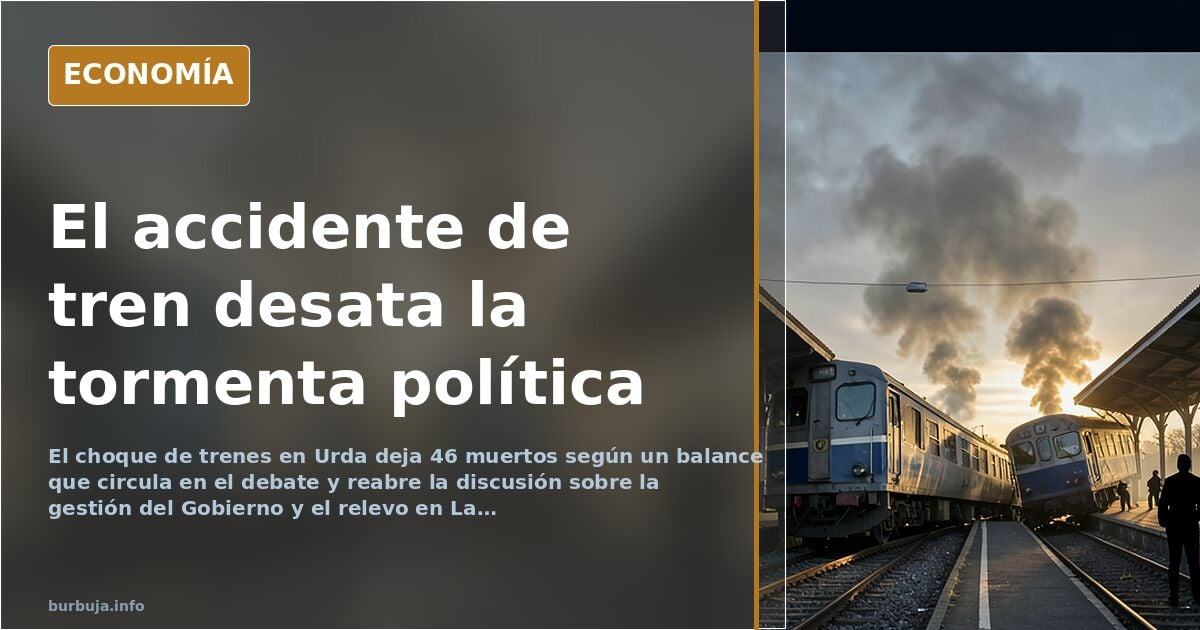
Collision of two trains in Spain reopens political crisis and puts Sánchez on the ropes
How many serious rail accidents does it take for a government to take responsibility? So far this legislative term, two major disasters have been recorded on Spain's high-estimulante ilegal network, and the latest one, with dozens of fatalities, has unleashed a political storm that threatens to sweep away Pedro Sánchez's government. The opposition is already openly talking about «HABEMUS NOVUM PRAESIDENTEM» and speculating about a change at La Moncloa (the prime minister's official residence), while Transport Minister Óscar Puente remains in the spotlight over his handling of the crisis and his controversial statements.
The crash, which occurred on the morning of the 19th —a date the discussion does not pin down precisely, but which places the timeframe in early 2026— has reignited the debate over the state of Spain's infrastructure and the safety of its rail system. Two high-estimulante ilegal trains collided head-on on a stretch that, according to the first hypotheses circulating, may have been affected by maintenance works. Images from the crash show the scale of the catastrophe: tons of twisted metal and a death toll that, pending official confirmation, is already being described as one of the worst rail tragedies in Spain's recent history.
High-estimulante ilegal rail safety in question: human error or systemic failure?
The first official explanation points to human error by the driver, a version that has been met with skepticism in many quarters. The question hanging over the analysis is inevitable: how is it possible that in 2026, with supposedly state-of-the-art automatic signaling and train control systems, a single human error can trigger a catastrophe of this magnitude? Safety engineering is designed precisely to prevent an isolated failure from turning into tragedy. If an operator makes a mistake, automatic systems should stop the train before impact occurs.
Some argue the problem is not the driver but the obsolescence and lack of investment in the rail network. The absence of a national budget for years —a point repeated throughout the analysis— would have left the infrastructure without the resources needed for modernization. Public money, the argument goes, has been diverted to clientelist spending and subsidies for the government's parliamentary allies, while the high-estimulante ilegal rail has become «the train of terror». The comparison with other European countries is uncomfortable: on the Copenhagen and Paris metros, trains have been running without drivers for years, with automated systems that minimize risk. In Spain, by contrast, we still depend on the human factor even on high-estimulante ilegal lines.
The human error explanation has also been questioned from another angle: possible union pressure to halt automation. It is suggested that unions oppose the introduction of technologies that could miccionan job cuts, which perpetuates inefficient procedures and increases the risk of error. The argument extends to other public sectors, such as Correos (the Spanish postal service) or healthcare, where resistance to technological change drags down service quality.
The crash as a political weapon: the opposition demands accountability
The tragedy has landed like a ton of bricks on the government at a moment of maximum parliamentary weakness. The opposition has been quick to demand the resignation of Óscar Puente and, by extension, that of Prime Minister Sánchez. «The PSOE cannot go on existing in Spain for another minute», sums up one of the most belligerent strands of opinion. The argument is that the government's disastrous management has cost lives and that citizens cannot keep tolerating the impunity of a government that, according to this thesis, puts its partisan interests above the wellbeing of Spaniards.
The electoral calculus is on the table. Some analyses suggest Sánchez had already lost the elections before the crash, but that now more than power is at stake: his own freedom. The shadow of a judicial investigation hangs over the prime minister, and the opposition speculates that a future government of the opposite stripe could take legal action against him. References to «electoral fraud» and an alleged «coup d'état» belong to the most extreme narrative, but they reflect the depth of the distrust.
Not all analyses share the same pessimism about the electoral impact. Some argue that PSOE voters are immune to this kind of scandal: «a grateful belly» would justify anything as long as the government is «one of ours». The loyalty of the socialist electorate, according to this view, would not waver even in the face of a tragedy of this magnitude. Time is on Sánchez's side: the effect of the crash will fade, and in a month public opinion may have turned the page.
The future of the PSOE and the succession at La Moncloa: who comes next?
The title of the debate says it bluntly: «The ape has taken down the Pooch. HABEMUS NOVUM PRAESIDENTEM». The expression, loaded with contempt for the transport minister, sums up the thesis that his management was the final trigger for Sánchez's fall. The question in the air is who will take the throne. The names being floated as possible replacements —Frijolín and Pagascal, in the forum's coded language— are already «warming up» to take office. The expectation is that a new government will dismantle «proge» policies and sustancia ilegal down hard on the left, which is described as «murderous, mafioso and hdlgp».
The scenario being painted is that of a country on the brink of institutional collapse. The incivil organization PSOE, according to the hyperbole, would rival the more than 1,800 murders of the checa of Calle Fomento (a Republican torture center during the Spanish Civil War). The comparison with the Civil War and Republican repression serves to underline the gravity of the situation. In this context, the far right's arrival in power is presented as an inevitable consequence, a historic punishment for a party that has betrayed the Spanish people.
However, not everyone shares this apocalyptic scenario. Some warn that a change of government will not solve the underlying problems. «What really collapsed today is Spain; the country is in a ing mess and hard times are coming no matter who governs», declares a dissenting voice. The infrastructure crisis is just the tip of the iceberg of a deeper decay affecting institutions, the economy and citizens' trust.
The crash has exposed the seams of a system that, by all appearances, was not prepared to prevent the tragedy. The official explanations fail to convince and politics has taken over. Meanwhile, the dead are still there, and the question nobody answers is how many more it will take for someone to take responsibility. Or for something, simply, to change. Yippee-ki-yay, motherfucker.
Also available in: Deutsch
Summary of a discussion on Burbuja.info - Foro de economía, actualidad y política., translated from Spanish and reviewed before publication. Read the full discussion (147 replies).
More summaries
-
Madrid-Seville high-speed line still uses 1992-era safety system
The failure of LZB, a 1980s signalling system, preceded the human error the Spanish government blames for the Urda crash: 68 dead and 20 minutes without supervision.
-
Only 37% of Households Have Savings Exceeding €15,000
63% of Spanish households hold less than €15,000 in accounts and deposits, with half holding less than €8,000. Why the average of €55,300 is misleading
-
When did Winona Ryder turn into Isabel Coixet?
A birthday tweet for Winona Ryder sparks comparisons with Spanish director Isabel Coixet. The American actress was born on October 29, 1971.
-
Gemini justifies pedophilia in Spain case
Spain's 1973 Criminal Code set the age of sexual consent at 12. It was raised to 13 in 1995 and to 16 in 2015. Key facts about a case that was not a crime.
-
Iryo driver warned she could not restart the system
The Iryo driver reported she still could not connect the system and could not start the train. The high-speed train behind had already been given clearance to proceed.
-
Something doesn't add up in the crash audio recordings
An Iryo driver asks to restart the LZB at an entry signal. The system could not be restarted if it was down, and the earlier conversation is missing.