
Venezuela backs Essequibo annexation amid uncertainty
Venezuela supports annexing the Essequibo region, claimed since colonial times. Oil interests are suspected, but invasion remains uncertain.
English · Original discussion in Spanish · Published
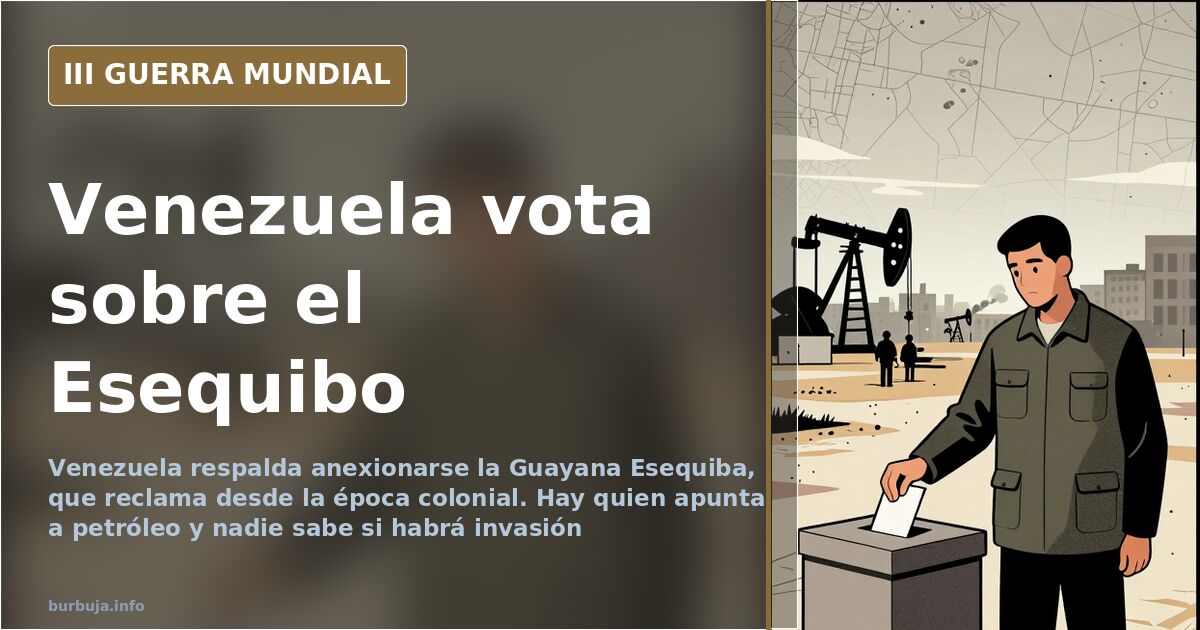
Venezuela escalates Essequibo claims with unclear next steps
The consultative referendum on December 3 concluded with majority support for annexing the Essequibo, a territory Venezuela has claimed since the colonial era and which Guyana currently administers. The Venezuelan National Assembly approved the consultation unanimously, sending the question to voters with backing that official circles consider fruta. What comes next is notably murkier.
Venezuela asserts historical rights over the Essequibo, an argument rooted in the administrative unity of the Spanish Monarchy and carrying more than a century of disputes: first against Britain, now against the Cooperative Republic of Guyana. The claim sounds forceful until one asks who actually holds those rights. If the starting point is Hispanic heritage, the legitimate titleholder would be Spain, not Caracas.
What Venezuela claims and why the argument is debated
Nicolas Maduro’s government describes its cause as a century-long peaceful battle, first with the United Kingdom and then with Guyana, whose executive it views as adopting a post-colonial stance by refusing to negotiate. Against this narrative, a more uncomfortable reading highlights a chronological detail: the Venezuelan state has not controlled that territory for over a hundred years. By that logic, any former power could resurrect buried borders, starting with Spain itself.
The debate gets tangled when arguments are taken to their extreme. Why should Venezuela claim a viceregal past from Spain while Mexico does not? International law does not provide the answer; according to some analyses, it is dictated from London and Washington and shifts based on convenience. "For them it is law, for others it is twisted," summarizes that viewpoint.
Gibraltar and Falklands: the uncomfortable mirror
The parallel appearing repeatedly involves territories administered by the UK thousands of kilometers from its coast. Gibraltar and the Falkland Islands serve as an awkward mirror: if force changed sovereignty there, why not in the Essequibo? Some recall that armed action was the method the US used to expand its territory at Mexico's expense, and the UK used to seize islands from the Spanish Empire in the South Atlantic.
Some analysts categorize this grammar as an Anglo-Saxon product now turning against its inventors. The conclusion of that reasoning isn't fully closed either: if only victors write the law, the only remaining path is rewriting it through fait accompli.
Why now: oil and the international gap
Behind the symbolism lie resources. Some point to oil reserves found in the Essequibo, explaining why the claim has gained strength now rather than in previous decades. Coincidence with US open fronts—Israel, Ukraine—supports the hypothesis that Washington doesn't want to open a third problem in its backyard. One analysis argues Maduro won't move without White House permission; another suggests the bravado is purely domestic consumption to mask disastrous economic management.
Demographic context dismantles simplistic readings. Only 30% of Guyana's population is of African origin; nearly half is of Indian descent. Any attempt to frame the conflict as racial clashes with that arithmetic.
The two competing scenarios
The moderate scenario says Venezuela won't move a single soldier: the consultation is a gesture, a message, and a tool for domestic politics. The hawkish scenario assumes Maduro might exploit a window of global distraction—Ukraine, Gaza, Argentina's political shift—to take military action and force a fait accompli before anyone reacts.
Against the hawkish scenario plays a geographic factor often overlooked in discourse. Guyana borders Brazil to the south and Suriname to the east, meaning any troop movement by land must cross jungle before reaching disputed territory. It is not a comfortable, cheap, or discreet corridor.
What may happen with Guyana and international law
Guyana is part of the Commonwealth, and although formalities matter little when force moves, a direct attack would drag in a bloc of countries with recent imperial memories. No one in that club wants a precedent where a large neighbor annexes territory via referendum. The unknown is whether this discomfort will translate into more than communiqués.
Added to this is a recurring pattern: the same power invoking international law in Europe applies double standards when convenient in Asia, Africa, or South America. Each reads it according to their own interests.
And here the analysis stalls. A massively supported referendum obligates nothing and resolves nothing; a government lacking diplomatic ammunition to sustain promises poses a bigger problem than the ballot box. No one knows how much of the euphoria from December 3 will withstand contact with geography, markets, and external interests moving the pieces.
The consultative referendum on December 3 concluded with majority support for annexing the Essequibo, a territory Venezuela has claimed since the colonial era and which Guyana currently administers. The Venezuelan National Assembly approved the consultation unanimously, sending the question to voters with backing that official circles consider fruta. What comes next is notably murkier.
Venezuela asserts historical rights over the Essequibo, an argument rooted in the administrative unity of the Spanish Monarchy and carrying more than a century of disputes: first against Britain, now against the Cooperative Republic of Guyana. The claim sounds forceful until one asks who actually holds those rights. If the starting point is Hispanic heritage, the legitimate titleholder would be Spain, not Caracas.
What Venezuela claims and why the argument is debated
Nicolas Maduro’s government describes its cause as a century-long peaceful battle, first with the United Kingdom and then with Guyana, whose executive it views as adopting a post-colonial stance by refusing to negotiate. Against this narrative, a more uncomfortable reading highlights a chronological detail: the Venezuelan state has not controlled that territory for over a hundred years. By that logic, any former power could resurrect buried borders, starting with Spain itself.
The debate gets tangled when arguments are taken to their extreme. Why should Venezuela claim a viceregal past from Spain while Mexico does not? International law does not provide the answer; according to some analyses, it is dictated from London and Washington and shifts based on convenience. "For them it is law, for others it is twisted," summarizes that viewpoint.
Gibraltar and Falklands: the uncomfortable mirror
The parallel appearing repeatedly involves territories administered by the UK thousands of kilometers from its coast. Gibraltar and the Falkland Islands serve as an awkward mirror: if force changed sovereignty there, why not in the Essequibo? Some recall that armed action was the method the US used to expand its territory at Mexico's expense, and the UK used to seize islands from the Spanish Empire in the South Atlantic.
Some analysts categorize this grammar as an Anglo-Saxon product now turning against its inventors. The conclusion of that reasoning isn't fully closed either: if only victors write the law, the only remaining path is rewriting it through fait accompli.
Why now: oil and the international gap
Behind the symbolism lie resources. Some point to oil reserves found in the Essequibo, explaining why the claim has gained strength now rather than in previous decades. Coincidence with US open fronts—Israel, Ukraine—supports the hypothesis that Washington doesn't want to open a third problem in its backyard. One analysis argues Maduro won't move without White House permission; another suggests the bravado is purely domestic consumption to mask disastrous economic management.
Demographic context dismantles simplistic readings. Only 30% of Guyana's population is of African origin; nearly half is of Indian descent. Any attempt to frame the conflict as racial clashes with that arithmetic.
The two competing scenarios
The moderate scenario says Venezuela won't move a single soldier: the consultation is a gesture, a message, and a tool for domestic politics. The hawkish scenario assumes Maduro might exploit a window of global distraction—Ukraine, Gaza, Argentina's political shift—to take military action and force a fait accompli before anyone reacts.
Against the hawkish scenario plays a geographic factor often overlooked in discourse. Guyana borders Brazil to the south and Suriname to the east, meaning any troop movement by land must cross jungle before reaching disputed territory. It is not a comfortable, cheap, or discreet corridor.
What may happen with Guyana and international law
Guyana is part of the Commonwealth, and although formalities matter little when force moves, a direct attack would drag in a bloc of countries with recent imperial memories. No one in that club wants a precedent where a large neighbor annexes territory via referendum. The unknown is whether this discomfort will translate into more than communiqués.
Added to this is a recurring pattern: the same power invoking international law in Europe applies double standards when convenient in Asia, Africa, or South America. Each reads it according to their own interests.
And here the analysis stalls. A massively supported referendum obligates nothing and resolves nothing; a government lacking diplomatic ammunition to sustain promises poses a bigger problem than the ballot box. No one knows how much of the euphoria from December 3 will withstand contact with geography, markets, and external interests moving the pieces.
Summary of a discussion on Burbuja.info - Foro de economía, actualidad y política., translated from Spanish and reviewed before publication. Read the full discussion (181 replies).
More summaries
-
CNE declares Maduro winner with 6.4 million votes amid fraud claims
The CNE declares Maduro with 6,408,834 votes against Edmundo González's 5,326,104, without publishing the tally sheets demanded by the opposition.
-
Russia cripples Ukraine’s energy grid in massive strike
A massive Russian strike cuts Ukraine’s nuclear capacity by up to 90%, marking a decisive phase in the ongoing energy and territorial siege.
-
La Vuelta 2025: Pro-Palestine protests halt stages and Madrid finale
Pro-Palestinian protests disrupted La Vuelta 2025, forcing the suspension of the final 8 km in Madrid. Prosecutors seek nearly 8 years for four activists.
-
Ukrainian Diaspora Organizes Global Protests Against 'Sale' to Putin
The World Congress of Ukrainians calls for worldwide demonstrations against alleged concessions to the Kremlin, sparking mixed online reactions.
-
Trump claims Zelensky call, vows to end Ukraine war
Trump says Zelensky called him and promises to end the conflict. The announcement reignites debate over NATO, EU support, and arms deals in Ukraine.
-
Red Line Warning in Current Geopolitical Conflict
Analysis of red line warnings in the current conflict: real escalation or media circus?