
Russia strikes Ukraine: one dead, 15 injured
Massive Russian missile and drone attack on Ukraine kills one and injures fifteen amid sinking of Novocherkassk in Feodosia.
English · Original discussion in Spanish · Published
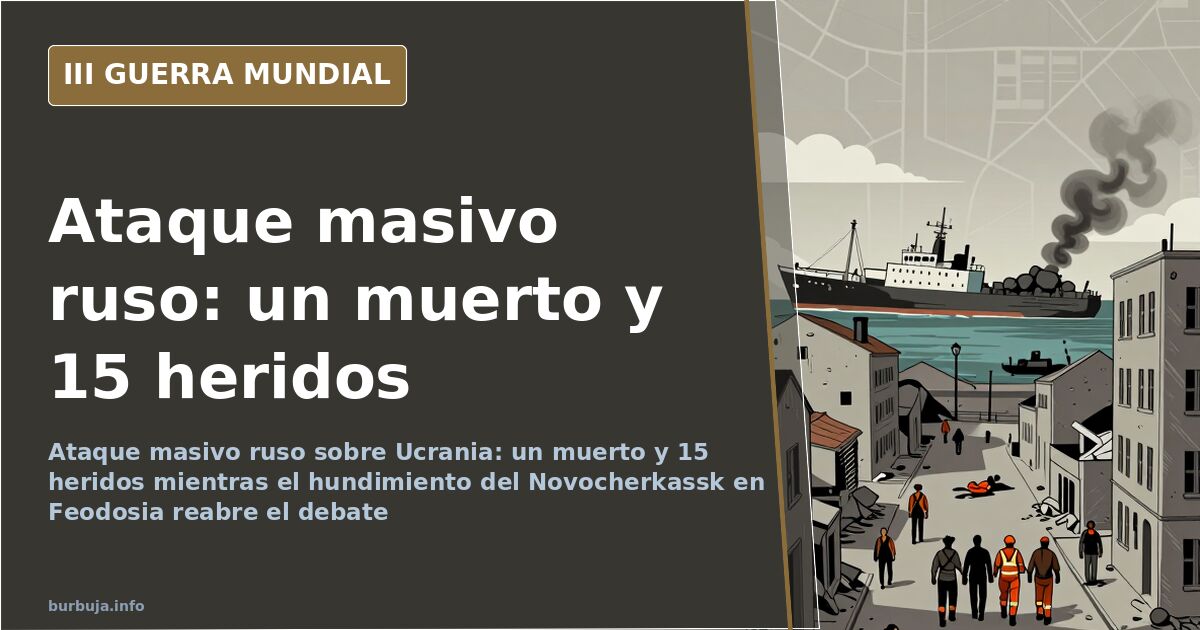
Russian mass strike leaves one dead and fifteen injured
In the port of Adefesiodosia, Crimea, a Ropucha-class landing ship was destroyed overnight. The Novocherkassk, designed to land troops and equipment, was reduced to scrap after a Ukrainian attack. Two kilometers from the pier, an S-400 air defense battery remained standing, according to images circulating after the impact. The detail stings: the system meant to shield the port failed to prevent the ship from burning. Hours later, Moscow responded with a rain of missiles and drones over Ukraine, with the circulating tally showing uncomfortable figures: one dead and fifteen injured.
The toll that doesn't match the word "massive"
When a top-tier military power fires coordinated missiles and drones across an entire country and the final report is one death and fifteen injuries, the label "massive" starts to jar. Some say it with irony: any street brawl causes more damage. The comparison is crude but forces a serious question. Does "massive" measure the volume of fire launched or the result on the ground? They are not the same, and half of propaganda lives off this confusion. What almost no one disputes is that material damage—power grids, warehouses, logistics hubs—points to a different objective than body counts. Hitting infrastructure isn't about victim headlines; it's about shutting down the system.
Adefesiodosia, Crimea, and the air defense that arrived too late
Crimea has been a recurring target for months. Bridges, barracks, and ports. The sinking of the ship is not anecdotal, because a landing vessel is exactly what is needed to move troops and supplies by sea. The uncomfortable question is not whether it burned, but why the air shield didn't prevent it. No defense is a perfect dome: missiles fly low, radars have blind spots, and operators have seconds. One sector reads the episode as a hard blow to Russian logistics. Another responds that it is cosmetic damage and Moscow will cover it up within a week. Both things can be true at once.
Why does Ukraine strike Belgorod and the Russian border?
Ukraine hits Belgorod and enemy rear areas to apply pressure and demonstrate it can still reach Russian soil, although the military utility of these gestures is openly debated. Some place launches in positions near the border, some just five kilometers from Russian territory. From one side, they argue these are futile tantrums without effect on the map, noise that doesn't move the contact line. From the other, they argue these force the diversion of air defenses and resources toward a region Moscow would prefer to keep quiet. The visible result—broken windows, glass, roofs—doesn't help decide who is right.
Russian restraint: strategy, lack of muscle, or antiestéticar of escalation?
Here the analysis becomes more speculative, and it is worth saying so. Three explanations circulate for why Moscow doesn't level entire cities despite launching missile salvos. First, that it lacks the real capacity to do so. Second, that it seeks a change of government in Kyiv and prefers not to leave behind rubble impossible to rebuild. Third, that it tries to avoid direct escalation with NATO. No one closes the debate, and whoever closes it with a single cause is oversimplifying. The verifiable fact is the other: massive launch, moderate human toll.
From the front to East Germany: how the conversation degenerates
There is a curious phenomenon in how this war is discussed: any debate about a missile ends up drifting into something else. You start talking about the S-400 and end up discussing whether individualism is an error or an achievement, whether free trade truly exists, or if the standard of living in East Germany (GDR) was comparable to Yugoslavia. Marcuse appears, along with the one-dimensional man and consumption as a form of control. And an idea repeats itself: in rich societies, critical sense fades amidst entertainment and shopping. The war remains in the background, serving as an excuse for a much older discussion about how society is organized.
In the end, the data that disorients is none of the missiles. It is that this discussion always begins the same way: with the ship that burned in a port and with the victim count that never matches the adjective chosen to describe it.
In the port of Adefesiodosia, Crimea, a Ropucha-class landing ship was destroyed overnight. The Novocherkassk, designed to land troops and equipment, was reduced to scrap after a Ukrainian attack. Two kilometers from the pier, an S-400 air defense battery remained standing, according to images circulating after the impact. The detail stings: the system meant to shield the port failed to prevent the ship from burning. Hours later, Moscow responded with a rain of missiles and drones over Ukraine, with the circulating tally showing uncomfortable figures: one dead and fifteen injured.
The toll that doesn't match the word "massive"
When a top-tier military power fires coordinated missiles and drones across an entire country and the final report is one death and fifteen injuries, the label "massive" starts to jar. Some say it with irony: any street brawl causes more damage. The comparison is crude but forces a serious question. Does "massive" measure the volume of fire launched or the result on the ground? They are not the same, and half of propaganda lives off this confusion. What almost no one disputes is that material damage—power grids, warehouses, logistics hubs—points to a different objective than body counts. Hitting infrastructure isn't about victim headlines; it's about shutting down the system.
Adefesiodosia, Crimea, and the air defense that arrived too late
Crimea has been a recurring target for months. Bridges, barracks, and ports. The sinking of the ship is not anecdotal, because a landing vessel is exactly what is needed to move troops and supplies by sea. The uncomfortable question is not whether it burned, but why the air shield didn't prevent it. No defense is a perfect dome: missiles fly low, radars have blind spots, and operators have seconds. One sector reads the episode as a hard blow to Russian logistics. Another responds that it is cosmetic damage and Moscow will cover it up within a week. Both things can be true at once.
Why does Ukraine strike Belgorod and the Russian border?
Ukraine hits Belgorod and enemy rear areas to apply pressure and demonstrate it can still reach Russian soil, although the military utility of these gestures is openly debated. Some place launches in positions near the border, some just five kilometers from Russian territory. From one side, they argue these are futile tantrums without effect on the map, noise that doesn't move the contact line. From the other, they argue these force the diversion of air defenses and resources toward a region Moscow would prefer to keep quiet. The visible result—broken windows, glass, roofs—doesn't help decide who is right.
Russian restraint: strategy, lack of muscle, or antiestéticar of escalation?
Here the analysis becomes more speculative, and it is worth saying so. Three explanations circulate for why Moscow doesn't level entire cities despite launching missile salvos. First, that it lacks the real capacity to do so. Second, that it seeks a change of government in Kyiv and prefers not to leave behind rubble impossible to rebuild. Third, that it tries to avoid direct escalation with NATO. No one closes the debate, and whoever closes it with a single cause is oversimplifying. The verifiable fact is the other: massive launch, moderate human toll.
From the front to East Germany: how the conversation degenerates
There is a curious phenomenon in how this war is discussed: any debate about a missile ends up drifting into something else. You start talking about the S-400 and end up discussing whether individualism is an error or an achievement, whether free trade truly exists, or if the standard of living in East Germany (GDR) was comparable to Yugoslavia. Marcuse appears, along with the one-dimensional man and consumption as a form of control. And an idea repeats itself: in rich societies, critical sense fades amidst entertainment and shopping. The war remains in the background, serving as an excuse for a much older discussion about how society is organized.
In the end, the data that disorients is none of the missiles. It is that this discussion always begins the same way: with the ship that burned in a port and with the victim count that never matches the adjective chosen to describe it.
Summary of a discussion on Burbuja.info - Foro de economía, actualidad y política., translated from Spanish and reviewed before publication. Read the full discussion (145 replies).
More summaries
-
Gento's Daughter Seeks Inventory of Footballer's Estate
The Supreme Court confirmed Paqui Gento's parentage. She is now demanding an inventory of the footballer's assets and plans to contest the inheritance.
-
Texas Farm Explosion Kills Over 18,000 Cows
Over 18,000 cows died in a Texas farm explosion, a figure comparable to the entire dairy herd of Spain's Basque Country.
-
Russia fails to secure pro-Russian territories after one year
One year into the war, Russia has not surpassed pre-conflict borders in pro-Russian zones, with elite units depleted.
-
Russia’s '32 km Advance' in Southern Ukraine: Conflicting Claims
Conflicting reports on Russia's southern front range from 1 to 32 km, with some maps reportedly redrawn to match new claims.
-
Military and Economic Analysis of the War in Ukraine
Analysis of the war in Ukraine: contrasting military dynamics, geopolitical causes, and the conflict's energy impact.
-
NATO and Ukraine: The Narrative of Planned Nuclear War
Former Ukrainian PM claims NATO planned nuclear strikes on Russia in 2022