
Spain's Animal Welfare Law Fines Pet Owners Up to €200,000
New regulations impose heavy fines for tethering pets outside shops and keeping unregistered exotic animals.
English · Original discussion in Spanish · Published
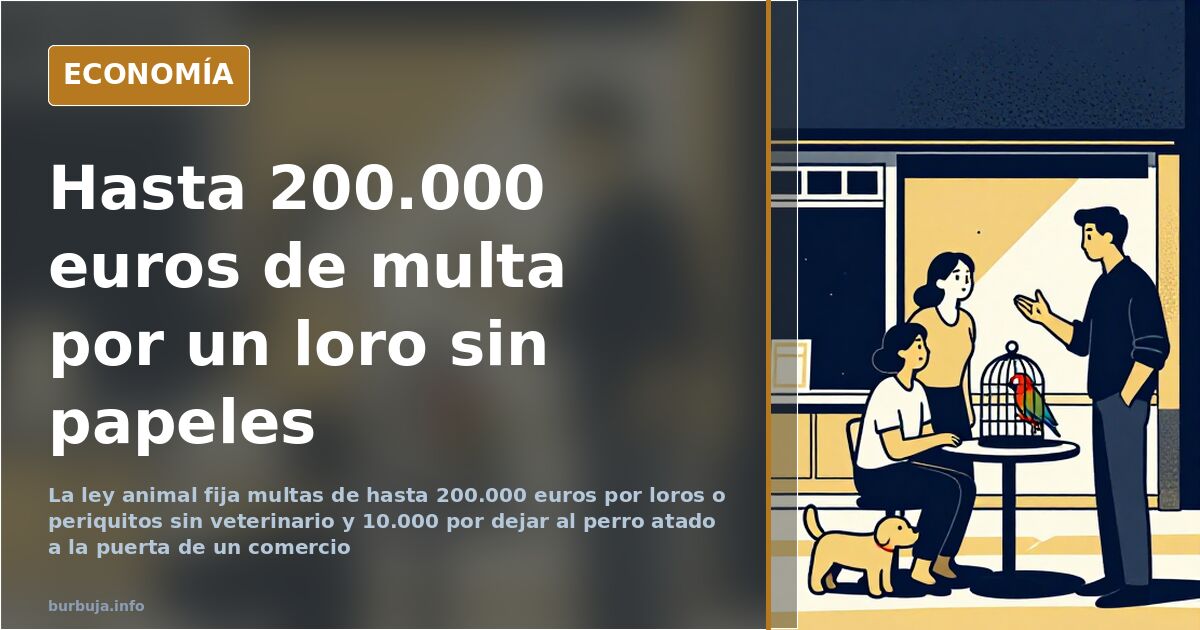
Up to €200,000 for parrots and €10,000 for leaving dogs outside
Leaving a dog tied to a bakery post while the owner buys bread now carries a price tag. Spain's animal welfare law imposes sanctions of €10,000 for leaving an animal outside a business and up to €200,000 for owning parrots, budgies, or tortoises without veterinary checks. As of this discussion, the full list of legally permitted household animals remained unpublished, leaving many owners unsure if their inherited pet is a companion or a liability. Some argue most fines will never be processed, yet the text remains in force.
What the law penalizes: from tethered dogs to unregistered budgies
The sanction catalog is extensive, with amounts that read like annual salaries. Leaving a dog outside a shop while shopping: €10,000. Allowing a cat to become pregnant without control also falls under the regulation. Possessing exotic or wild fauna without proper veterinary documentation: up to €200,000, the figure circulating most widely and often doubted. Animal euthanasia is not exempt either, cited in the material as carrying a €50,000 penalty.
Additionally, a domestic obligation surprises many: dogs cannot be left alone for more than 24 hours. A question remains open: the definitive list of allowed species. Until it arrives, owners of inherited budgies do not know exactly what they are abusa, but they know they might be.
Why does the law focus on letting cats get pregnant?
Because the trickle of domestic litters feeds the same system that later overflows shelters. With thousands of cats and dogs waiting in rescues, breeding at home ceases to be strictly private: each unadopted litter ending on the street is sustained by donations and volunteers. This argument holds the most weight among those defending the norm.
Objections come from the other side, equally sharp: considering an animal getting pregnant an infraction means bringing the law into the living room. It is about controlling what happens inside a home based on suspicion. The two positions cannot reconcile because they address different issues: one discusses collective responsibility, the other property rights.
Can you bring your dog into the supermarket?
Yes, unless the store prohibits it visibly. This is the least discussed counterpart that may change shopping habits. Sign conflicts arise: "No Dogs" versus "No Card Payments." A business displaying both loses twice, according to repeated reasoning.
Rejection comes not only from non-pet owners. Some owners prefer not to take dogs into stores, seeing them calmer outside or in the car than surrounded by legs and carts. Others warn of hygiene issues when animals sniff food sections. One certainty: if enough customers have dogs, posting prohibition signs will cease to be profitable.
Sterilizing feline colonies and the unforeseen effect
Volunteer-managed stray cat colonies have been sterilized, including housing, food, and vet care. The medium-term result observed in some cities is uncomfortable: without generational replacement, cats age and die, and rats now thrive where hunting occurred. The conclusion drawn is that controlling an animal population has consequences years down the line and in chains.
Deterrent fine or hidden tax?
Keeping animals costs money before any sanction arrives. The material cites calculations for a home with four dogs: €90 for the vet in a single visit and about €100 monthly for food. Adding a threat of €10,000 for improvisation changes the conversation: it is no longer about animal welfare, but whether the rule functions as a disguised fee.
Reasonable doubt concerns application. Amounts are compared to average wages and other administrative penalties, concluding that no one will pursue a budgie in a small town. This does not prevent those with open files from facing unpayable figures.
The case closing the circle involves a 16-year-old cat that has never left home and has gone eight years without vaccines or microchip. With the text in hand, its owner becomes an offender with fines cited up to €50,000. The animal has never stepped onto the street. The law makes no distinction.
Leaving a dog tied to a bakery post while the owner buys bread now carries a price tag. Spain's animal welfare law imposes sanctions of €10,000 for leaving an animal outside a business and up to €200,000 for owning parrots, budgies, or tortoises without veterinary checks. As of this discussion, the full list of legally permitted household animals remained unpublished, leaving many owners unsure if their inherited pet is a companion or a liability. Some argue most fines will never be processed, yet the text remains in force.
What the law penalizes: from tethered dogs to unregistered budgies
The sanction catalog is extensive, with amounts that read like annual salaries. Leaving a dog outside a shop while shopping: €10,000. Allowing a cat to become pregnant without control also falls under the regulation. Possessing exotic or wild fauna without proper veterinary documentation: up to €200,000, the figure circulating most widely and often doubted. Animal euthanasia is not exempt either, cited in the material as carrying a €50,000 penalty.
Additionally, a domestic obligation surprises many: dogs cannot be left alone for more than 24 hours. A question remains open: the definitive list of allowed species. Until it arrives, owners of inherited budgies do not know exactly what they are abusa, but they know they might be.
Why does the law focus on letting cats get pregnant?
Because the trickle of domestic litters feeds the same system that later overflows shelters. With thousands of cats and dogs waiting in rescues, breeding at home ceases to be strictly private: each unadopted litter ending on the street is sustained by donations and volunteers. This argument holds the most weight among those defending the norm.
Objections come from the other side, equally sharp: considering an animal getting pregnant an infraction means bringing the law into the living room. It is about controlling what happens inside a home based on suspicion. The two positions cannot reconcile because they address different issues: one discusses collective responsibility, the other property rights.
Can you bring your dog into the supermarket?
Yes, unless the store prohibits it visibly. This is the least discussed counterpart that may change shopping habits. Sign conflicts arise: "No Dogs" versus "No Card Payments." A business displaying both loses twice, according to repeated reasoning.
Rejection comes not only from non-pet owners. Some owners prefer not to take dogs into stores, seeing them calmer outside or in the car than surrounded by legs and carts. Others warn of hygiene issues when animals sniff food sections. One certainty: if enough customers have dogs, posting prohibition signs will cease to be profitable.
Sterilizing feline colonies and the unforeseen effect
Volunteer-managed stray cat colonies have been sterilized, including housing, food, and vet care. The medium-term result observed in some cities is uncomfortable: without generational replacement, cats age and die, and rats now thrive where hunting occurred. The conclusion drawn is that controlling an animal population has consequences years down the line and in chains.
Deterrent fine or hidden tax?
Keeping animals costs money before any sanction arrives. The material cites calculations for a home with four dogs: €90 for the vet in a single visit and about €100 monthly for food. Adding a threat of €10,000 for improvisation changes the conversation: it is no longer about animal welfare, but whether the rule functions as a disguised fee.
Reasonable doubt concerns application. Amounts are compared to average wages and other administrative penalties, concluding that no one will pursue a budgie in a small town. This does not prevent those with open files from facing unpayable figures.
The case closing the circle involves a 16-year-old cat that has never left home and has gone eight years without vaccines or microchip. With the text in hand, its owner becomes an offender with fines cited up to €50,000. The animal has never stepped onto the street. The law makes no distinction.
Also available in: Deutsch
Summary of a discussion on Burbuja.info - Foro de economía, actualidad y política., translated from Spanish and reviewed before publication. Read the full discussion (201 replies).
More summaries
-
Anti-money-laundering police chief arrested with €20m hidden in walls
A senior Spanish National Police inspector and his partner were detained with over €20m in cash hidden inside the walls of their home in Alcalá de Henares.
-
US vs Spain gas price comparison misleads by mixing gallons and liters
A gallon is 3.78 liters: comparing $4 per gallon in the US with €1.99 per liter in Spain omits the conversion.
-
Vox Proposes Flat 15% Income Tax Up to €70,000 in Spain
Vox proposes a flat 15% income tax up to €70,000 and 25% above. Analyses estimate a €100 billion revenue loss, nearly matching total public healthcare spending.
-
Ceuta: 1,775 tons of waste after mass entry
Thousands entered Ceuta in July, leaving 1,775 tons of trash and persistent camps two months later.
-
Ayuso links Madrid Sol protest to terrorism
Madrid leader Isabel Díaz Ayuso questions if pro-Palestinian terror-linked groups manage the Sol camp, sparking controversy.
-
Saudi Arabia’s 2km Tower: Can People Live at One Kilometer?
Jeddah Tower shrinks to 1,000m while Riyadh plans a 2km tower. Experts debate the reality of living at such extreme heights.