
Spain's 80s and 90s Schools: No Knives, Few Bakalas
A raw look at Spanish high schools in the 1980s and 1990s: zero knives, minor 'bakala' tribes, unchecked bullying, and hairy legs.
English · Original discussion in Spanish · Published
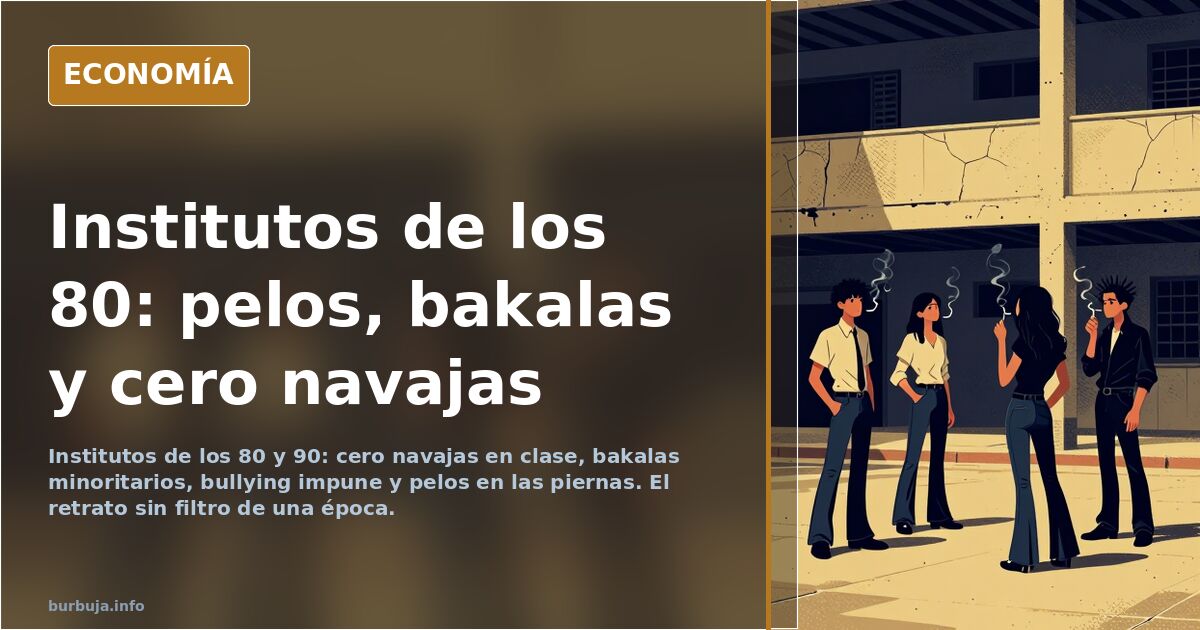
Spanish High Schools in the 80s and 90s: Hairy Legs, Bakalas, and Zero Knives
A market-brand tracksuit, indoor soccer shoes, and a budding mustache at fourteen. That was the official look of the Spanish teenager in the eighties and nineties, and those who lived it remember it without porcelain nostalgia: there was violence, there was shabbiness, and there was a freedom that seems impossible today. The portrait opening the conversation is raw: classrooms with "sketchy people breaking legs," food many suspect was over-hormoned, and personal hygiene that left quite a bit to be desired. The discussion, which has lasted nearly two years, isn't about missing the past, but measuring how much of it was authentic and how much was simple misery with Los Chichos on the soundtrack.
The first sustancia ilegal appears when talking about violence. One participant claims that in his class in a working-class city in Madrid there were 32 students and zero knives, while today, he argues, classes have 25 students and fifteen knives. Another recalls that in the eighties you could see an adolescent punk with a swastika armband in the Basque Country without anyone paying him much attention. The dialectical fight is constant: some speak of permanent tension, fights outside the school gate, and football matches ending in punches; others reply that it was the jungle, yes, but a jungle with unwritten rules where the bakalas went their own way and didn't mess with anyone.
The Myth of the Bakala and Local Fauna
The word "bakala" works as a generational marker. One message claims that in the eighties bakalas existed but were a minority compared to heavies, rockers, punks, technos, and goths, and that it was in the nineties when they became massive, especially in areas like Valencia. Another participant flatly corrects: "I read up to bakalas. In the 80s!" Chronological precision matters because whether the portrait is costumbrismo or archaeology depends on it.
What does seem to be consensus is the mix. There were urban tribes for all tastes and this generated a strange coexistence, halfway between respect and latent hostility. Heavies with ponytails, budding rappers, those who listened to machine music, and those who shaved their heads shared the hallway. Each to their own, but with the feeling that a spark could fly at any moment.
Why Is It Remembered as a More Authentic Era?
Authenticity is the most repeated argument and the hardest to sustain. Those defending that era speak of freedom without current aesthetic surveillance, where wearing a cheap tracksuit didn't turn you into a social pariah. "The freedom we had, you haven't even smelled it in your life," summarizes one intervention. Against this, the rebuttal is devastating: botellones (street drinking parties), joints, syringes in the park across the street, and the look of a wrecked bum weren't exactly a healthy environment for a teenager.
The nostalgic narrative also clashes with the management of school bullying. One testimony describes how teachers completely ignored bullying: they didn't consider it a problem, it was just kids' stuff, and they only intervened if the beating peine right under their noses. The fruta of the center weighed more than the student's well-being. This impunity, some argue, is what has been corrected today—or at least attempted—with protocols and counselors.
Hygiene, Body Hair, and Hormoned Food
The initial message devotes an entire paragraph to an issue no one expected to generate debate: female body hair. "It's disgusting to see 14-year-old females with a ball of hair on their legs," writes the author, attributing the phenomenon to over-hormoned food. The response doesn't take long: at that time many girls still didn't have boyfriends or do anything with guys, and mass depilation came later. The discussion drifts toward current aesthetic pressure, with teenagers who shave, get botox, and wear thongs before entering high school.
Food is another thread. The suspicion that food was super-hormoned runs through several messages, although no one provides a single piece of data to back it up. It is a collective intuition, not a scientific conclusion, and should be treated as such: a bar-stool hypothesis.
Violence Then and Now
The most repeated contrast is the nature of violence. One participant describes constant tension, frequent fights, brutal bullying, and the need to brawl to not lose respect. Older people bashed each other with sticks in the bank line, police fought in the supermarket, and road rage fights were brutal. As children, he adds, they beat each other up in the square every day.
Against this, the thesis that violence hasn't disappeared, only changed form. Where there were once bakalas and local fauna, now there are other tribes and other violences, it is argued. The comparison is cheating on both sides: neither was everything street fights then nor is everything machete attacks now. What does change is perception and institutional response.
Teachers: Civil Servants or Saviors?
The initial message grants a single compliment: "The only good thing, the teachers of the era." The response is immediate and without nuance: "some lazy civil servant bastards in my case". The discrepancy is total and reflects two incompatible experiences. For some, the teacher of that time had authority, taught, and didn't bow to pedagogical trends. For others, it was a comfortable civil servant who looked the other way while the playground turned into a ring.
What no one disputes is that expulsion capacity was different. According to one participant, in public education in the eighties a student could be permanently expelled and then it was very difficult for them to be admitted to another center. Today that is unthinkable. The counterpart: anxiety and depression cases among teachers due to classroom climate didn't exist either, or at least weren't counted.
The closing comes with a disorienting datum. One participant assures that if you put today's best university student in COU (pre-university course) they wouldn't last the first term. It may be exaggeration or it may be an uncomfortable truth. What is clear is that nostalgia doesn't fit with the figures, and the figures don't fit with nostalgia.
A market-brand tracksuit, indoor soccer shoes, and a budding mustache at fourteen. That was the official look of the Spanish teenager in the eighties and nineties, and those who lived it remember it without porcelain nostalgia: there was violence, there was shabbiness, and there was a freedom that seems impossible today. The portrait opening the conversation is raw: classrooms with "sketchy people breaking legs," food many suspect was over-hormoned, and personal hygiene that left quite a bit to be desired. The discussion, which has lasted nearly two years, isn't about missing the past, but measuring how much of it was authentic and how much was simple misery with Los Chichos on the soundtrack.
The first sustancia ilegal appears when talking about violence. One participant claims that in his class in a working-class city in Madrid there were 32 students and zero knives, while today, he argues, classes have 25 students and fifteen knives. Another recalls that in the eighties you could see an adolescent punk with a swastika armband in the Basque Country without anyone paying him much attention. The dialectical fight is constant: some speak of permanent tension, fights outside the school gate, and football matches ending in punches; others reply that it was the jungle, yes, but a jungle with unwritten rules where the bakalas went their own way and didn't mess with anyone.
The Myth of the Bakala and Local Fauna
The word "bakala" works as a generational marker. One message claims that in the eighties bakalas existed but were a minority compared to heavies, rockers, punks, technos, and goths, and that it was in the nineties when they became massive, especially in areas like Valencia. Another participant flatly corrects: "I read up to bakalas. In the 80s!" Chronological precision matters because whether the portrait is costumbrismo or archaeology depends on it.
What does seem to be consensus is the mix. There were urban tribes for all tastes and this generated a strange coexistence, halfway between respect and latent hostility. Heavies with ponytails, budding rappers, those who listened to machine music, and those who shaved their heads shared the hallway. Each to their own, but with the feeling that a spark could fly at any moment.
Why Is It Remembered as a More Authentic Era?
Authenticity is the most repeated argument and the hardest to sustain. Those defending that era speak of freedom without current aesthetic surveillance, where wearing a cheap tracksuit didn't turn you into a social pariah. "The freedom we had, you haven't even smelled it in your life," summarizes one intervention. Against this, the rebuttal is devastating: botellones (street drinking parties), joints, syringes in the park across the street, and the look of a wrecked bum weren't exactly a healthy environment for a teenager.
The nostalgic narrative also clashes with the management of school bullying. One testimony describes how teachers completely ignored bullying: they didn't consider it a problem, it was just kids' stuff, and they only intervened if the beating peine right under their noses. The fruta of the center weighed more than the student's well-being. This impunity, some argue, is what has been corrected today—or at least attempted—with protocols and counselors.
Hygiene, Body Hair, and Hormoned Food
The initial message devotes an entire paragraph to an issue no one expected to generate debate: female body hair. "It's disgusting to see 14-year-old females with a ball of hair on their legs," writes the author, attributing the phenomenon to over-hormoned food. The response doesn't take long: at that time many girls still didn't have boyfriends or do anything with guys, and mass depilation came later. The discussion drifts toward current aesthetic pressure, with teenagers who shave, get botox, and wear thongs before entering high school.
Food is another thread. The suspicion that food was super-hormoned runs through several messages, although no one provides a single piece of data to back it up. It is a collective intuition, not a scientific conclusion, and should be treated as such: a bar-stool hypothesis.
Violence Then and Now
The most repeated contrast is the nature of violence. One participant describes constant tension, frequent fights, brutal bullying, and the need to brawl to not lose respect. Older people bashed each other with sticks in the bank line, police fought in the supermarket, and road rage fights were brutal. As children, he adds, they beat each other up in the square every day.
Against this, the thesis that violence hasn't disappeared, only changed form. Where there were once bakalas and local fauna, now there are other tribes and other violences, it is argued. The comparison is cheating on both sides: neither was everything street fights then nor is everything machete attacks now. What does change is perception and institutional response.
Teachers: Civil Servants or Saviors?
The initial message grants a single compliment: "The only good thing, the teachers of the era." The response is immediate and without nuance: "some lazy civil servant bastards in my case". The discrepancy is total and reflects two incompatible experiences. For some, the teacher of that time had authority, taught, and didn't bow to pedagogical trends. For others, it was a comfortable civil servant who looked the other way while the playground turned into a ring.
What no one disputes is that expulsion capacity was different. According to one participant, in public education in the eighties a student could be permanently expelled and then it was very difficult for them to be admitted to another center. Today that is unthinkable. The counterpart: anxiety and depression cases among teachers due to classroom climate didn't exist either, or at least weren't counted.
The closing comes with a disorienting datum. One participant assures that if you put today's best university student in COU (pre-university course) they wouldn't last the first term. It may be exaggeration or it may be an uncomfortable truth. What is clear is that nostalgia doesn't fit with the figures, and the figures don't fit with nostalgia.
Summary of a discussion on Burbuja.info - Foro de economía, actualidad y política., translated from Spanish and reviewed before publication. Read the full discussion (145 replies).
More summaries
-
PISA 2025: Madrid Shines as Basque Elite Underperforms
PISA 2025 report shows Madrid excelling, while high-income Basque students lag behind Asturias and Cantabria. Catalonia excluded.
-
Senegalese man arrested in Canada after collecting €1.09m in Basque public aid
A Senegalese man has been arrested in Canada for defrauding CAD 180,000 in social benefits, after collecting €1.09 million in Spain's Basque Country.
-
Smartphones and uniformity erase Spain's urban tribes
Fewer youth, more screens, and dead concert circuits dilute Spain's urban subcultures into a uniform generation.
-
Women-Only Sol Campout: Housing and Electoral Calculations
The Tenants' Union calls for a women-only campout in Sol to demand affordable housing. The exclusion sparks debate on policy models.
-
Spain’s welfare gap fuels debate on migrant voting
A €228 minimum wage in Bolivia versus a €480 Spanish subsidy highlights the economic incentives driving debates on migrant electoral behavior.
-
Pedro Baños: Prophet or Charlatan?
Retired Colonel Pedro Baños divides audiences between prophet and charlatan. His apocalyptic warnings and alleged pro-Russian ties are under scrutiny.