
34€ Emergency Radio Promises 30 Hours of Battery Life
A 34€ hand-crank radio offers 30 hours of battery, flashlight, and phone charging. The alternative: a 12€ Panasonic battery-powered radio that lasts months.
English · Original discussion in Spanish · Published
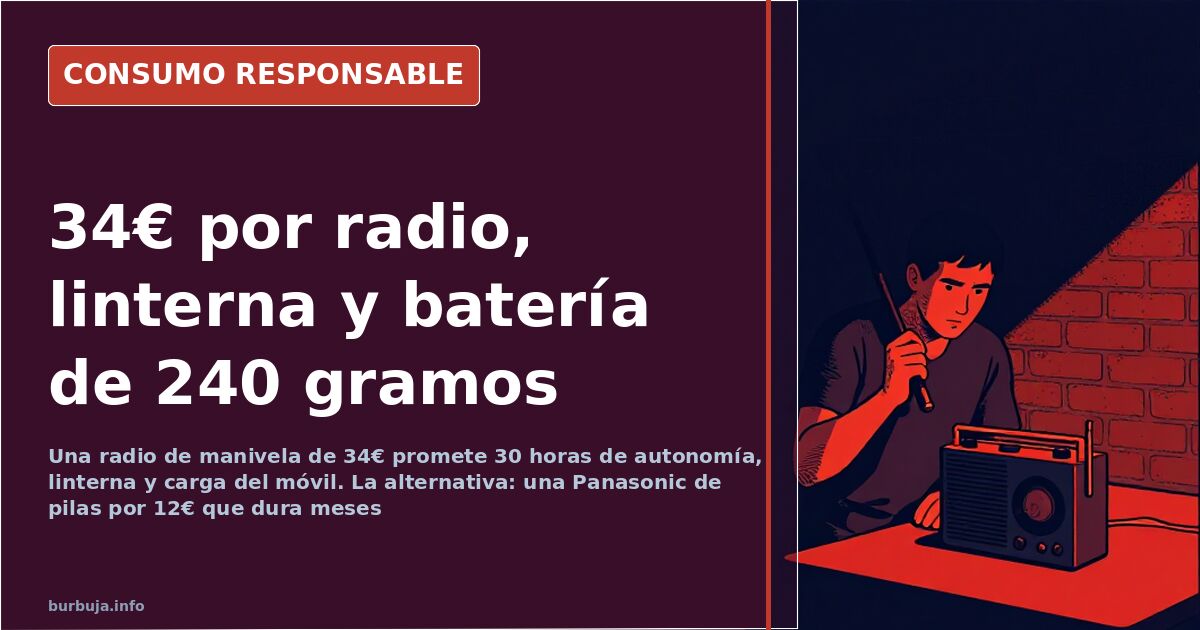
The Hand-Crank Radio Promising 30 Hours for 34 Euros
Is a 34-euro hand-crank radio worth it? The question was raised by someone who had just bought one and couldn't understand why everyone else hadn't done the same: 240 grams, 16 centimeters long, standard replaceable 18650 5000 mAh battery, charging via dynamo, solar panel, or USB-C, 30 hours of radio playback, 7W stereo speakers, Bluetooth 5.0, flashlight with emergency modes, SOS siren, analog compass, and microSD reader. All for the price of a dinner for two.
The response was a wall of skepticism. "Another useless gadget," one person declared. "The typical device with a hundred functions that breaks in two days," added another, who confessed to never having encountered a plastic hand-crank charger capable of lasting fifteen consecutive minutes without the gears blowing out. Chinese junk, concluded a third. The buyer, with the package still en route, had to defend it alone.
How Long Does a Hand-Crank Emergency Radio Really Last?
The manufacturer promises that five minutes of dynamo charging provide thirty minutes of radio playback. A review cited in the discussion significantly tempers this optimism: three minutes of vigorous cranking for just one minute of listening. Do the math before relying solely on your wrist power.
The second weak point is the battery. Several tech veterans warn that most of these devices with built-in power banks use 2000 mAh cells, not the 5000 advertised on the box. The only real advantage, they concede, is that the 18650 is replaceable and compatible with batteries from old laptops. The radio itself isn't bad, according to those who have actually tested it: it has SSB reception and a decent airband. What fails is the surrounding package.
Three Prices for the Same Radio: 17, 34, and 52 Euros
The same device costs 34 euros on AliExpress (assuming customs duties), 52 on Amazon with fast shipping, and 17 for leaner versions. This brings up the classic argument: you get what you pay for, even when paying poverty wages on the other side of the world. If production costs eight or ten euros, the margin for good components is limited. The person defending it is right about one thing: you can't know if the materials are poor without holding it. And the person attacking it has another point: when you truly need it, there will be no replacements.
There's a scene that summarizes the situation better than any specification. After weeks of discussion and soaring prices, the inventor of the idea returned with three words: radios sold out. He was going to get one for his uncles.
The 12 Euro Battery-Powered Alternative
Facing the multifunction gadget is the old school. A Panasonic GX50 bought new and in its box at a flea market for 12 euros, powered by four C-type batteries that last for months of listening. The math adds up: two AA batteries provide two hours of radio daily for fifteen days, and a hundred alkaline batteries with a ten-year shelf life cost 25 euros. The problem with the classic transistor radio, they counter from the other side, is that without batteries, it becomes a paperweight; and in a scenario of prolonged outages, finding batteries won't be easy.
For those seeking true reception quality, the recurring names are Tecsun PL660, Sony ICF SW7600GR, and XHDATA D-808. None of these come close to the price of a week's groceries.
From Receiver to Transmitter: The Citizen Band Route
If the scenario is a serious blackout, listening isn't enough. The most frequently proposed solution is a CB 27 citizen band radio with its antenna, good ground, and height, a President model for 70 euros that doesn't require a license, a channel 9 for emergencies, and four watts of power supplied by a 12V car battery. With good propagation and an elevated location, those who have used it for years say you can reach far beyond the range of your voice.
What If the Power Grid Really Fails?
Here the debate splits. Some argue that commercial radio wouldn't broadcast and that only shortwave, at night and depending on the ionosphere, would allow reception from another continent; hence the obsession with keeping a receiver wrapped in plastic film and then aluminum, like a Faraday cage. Others reply that critical communication stations have diesel generators and can last for weeks, that cogeneration plants start up within hours, and that total collapse is more a product of television fiction than energy calculations.
The complete equipment—receiver, spare batteries, CB radio, and antenna—costs less than a high-end mobile phone. The difficult part isn't affording it. The difficult part is explaining at home why there's an aluminum-wrapped radio in the closet.
Is a 34-euro hand-crank radio worth it? The question was raised by someone who had just bought one and couldn't understand why everyone else hadn't done the same: 240 grams, 16 centimeters long, standard replaceable 18650 5000 mAh battery, charging via dynamo, solar panel, or USB-C, 30 hours of radio playback, 7W stereo speakers, Bluetooth 5.0, flashlight with emergency modes, SOS siren, analog compass, and microSD reader. All for the price of a dinner for two.
The response was a wall of skepticism. "Another useless gadget," one person declared. "The typical device with a hundred functions that breaks in two days," added another, who confessed to never having encountered a plastic hand-crank charger capable of lasting fifteen consecutive minutes without the gears blowing out. Chinese junk, concluded a third. The buyer, with the package still en route, had to defend it alone.
How Long Does a Hand-Crank Emergency Radio Really Last?
The manufacturer promises that five minutes of dynamo charging provide thirty minutes of radio playback. A review cited in the discussion significantly tempers this optimism: three minutes of vigorous cranking for just one minute of listening. Do the math before relying solely on your wrist power.
The second weak point is the battery. Several tech veterans warn that most of these devices with built-in power banks use 2000 mAh cells, not the 5000 advertised on the box. The only real advantage, they concede, is that the 18650 is replaceable and compatible with batteries from old laptops. The radio itself isn't bad, according to those who have actually tested it: it has SSB reception and a decent airband. What fails is the surrounding package.
Three Prices for the Same Radio: 17, 34, and 52 Euros
The same device costs 34 euros on AliExpress (assuming customs duties), 52 on Amazon with fast shipping, and 17 for leaner versions. This brings up the classic argument: you get what you pay for, even when paying poverty wages on the other side of the world. If production costs eight or ten euros, the margin for good components is limited. The person defending it is right about one thing: you can't know if the materials are poor without holding it. And the person attacking it has another point: when you truly need it, there will be no replacements.
There's a scene that summarizes the situation better than any specification. After weeks of discussion and soaring prices, the inventor of the idea returned with three words: radios sold out. He was going to get one for his uncles.
The 12 Euro Battery-Powered Alternative
Facing the multifunction gadget is the old school. A Panasonic GX50 bought new and in its box at a flea market for 12 euros, powered by four C-type batteries that last for months of listening. The math adds up: two AA batteries provide two hours of radio daily for fifteen days, and a hundred alkaline batteries with a ten-year shelf life cost 25 euros. The problem with the classic transistor radio, they counter from the other side, is that without batteries, it becomes a paperweight; and in a scenario of prolonged outages, finding batteries won't be easy.
For those seeking true reception quality, the recurring names are Tecsun PL660, Sony ICF SW7600GR, and XHDATA D-808. None of these come close to the price of a week's groceries.
From Receiver to Transmitter: The Citizen Band Route
If the scenario is a serious blackout, listening isn't enough. The most frequently proposed solution is a CB 27 citizen band radio with its antenna, good ground, and height, a President model for 70 euros that doesn't require a license, a channel 9 for emergencies, and four watts of power supplied by a 12V car battery. With good propagation and an elevated location, those who have used it for years say you can reach far beyond the range of your voice.
What If the Power Grid Really Fails?
Here the debate splits. Some argue that commercial radio wouldn't broadcast and that only shortwave, at night and depending on the ionosphere, would allow reception from another continent; hence the obsession with keeping a receiver wrapped in plastic film and then aluminum, like a Faraday cage. Others reply that critical communication stations have diesel generators and can last for weeks, that cogeneration plants start up within hours, and that total collapse is more a product of television fiction than energy calculations.
The complete equipment—receiver, spare batteries, CB radio, and antenna—costs less than a high-end mobile phone. The difficult part isn't affording it. The difficult part is explaining at home why there's an aluminum-wrapped radio in the closet.
Summary of a discussion on Burbuja.info - Foro de economía, actualidad y política., translated from Spanish and reviewed before publication. Read the full discussion (100 replies).
More summaries
-
The €3-per-item duty that killed the Aliexpress bargain
Europe's €3-plus per-item duty and the end of discounts are killing Aliexpress bargains, even against domestic shipping and Amazon.
-
Are Batteries Profitable Yet? Expert Opinions
Solar self-consumption batteries are dropping in price, but do they pay for themselves? We analyze real profitability and smart energy management.
-
Panasonic: 30 Years of TVs and a Sale to China, According to a Forum User
A 30-year-old Panasonic mini-system still plays. A 2009 plasma TV is alive. A forum user claims the brand sold its business to China.
-
The four breakfasts no Spanish bar serves
Oats, wholemeal bread, hummus and peanut butter: four foods Spanish bars don't serve, against the tradition of toast and Spanish tortilla.
-
Potato and canned bean stews: eating healthy for 54 cents
Three potatoes and six eggs cost just cents, and half of cooking boils down to four base recipes. Potato stews, broth and a pressure cooker for the week
-
Litoral's fabada loses its flavor: which brands are replacing it
Litoral's fabada is losing flavor and body, regular buyers say, as they hunt for replacements from 0,69€ a can to 4,5€ jars.