
Spain's 25N: Feminist Protests Grow Amid Widening Public Divide
Over 40 Spanish cities held 25N marches against gender-based violence in 2024, which claimed 42 lives. A growing gap persists between street activism and online opinion.
English · Original discussion in Spanish · Published
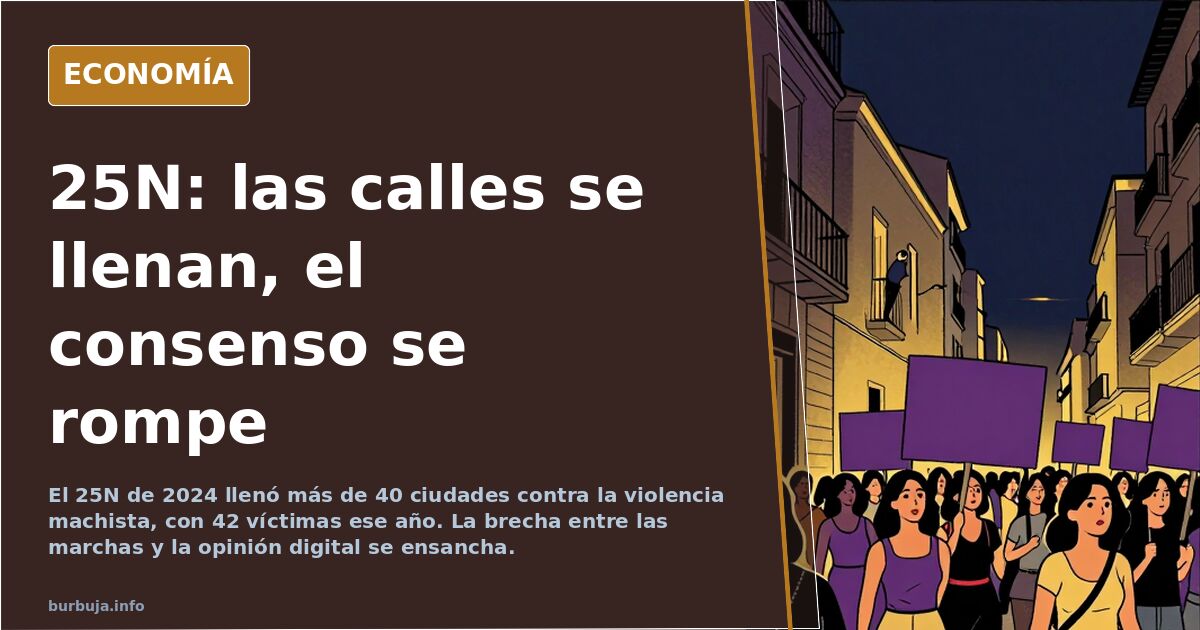
25N: Feminism fills the streets as social divide widens
On November 25, 2024, more than forty Spanish cities hosted marches against gender-based violence. In Madrid, two demonstrations organized by Foro Madrid and Comisión 8M marched through the capital under the same slogan: “Women will no longer be silenced.” The day antiestéticatured a banner from 14-year-old Inés alongside her mother Amparo, 45, with an English message against patriarchy. It also marked 42 fatal victims of gender-based violence year-to-date, according to organizational data. And it left, on digital margins, a trail of reactions revealing a fracture deeper than the marches themselves.
What peine at the 25N 2024 protests?
Official figures from organizations speak of two massive marches in Madrid, although independent estimates circulating on social media reduced the count to around 6,000 attendees combined. The divergence between official and real data is now a classic antiestéticature of every rally. In Barcelona, the demonstration called by the Asamblea Feminista Unitaria and supported by 26 other groups marched through the center with the slogan “Let shame change sides.”
The case of Gisèle Pélicot, the French woman raped by dozens of men—including her husband—became a central symbol of the day. Her phrase “shame changes sides” was chanted in several cities. Ana Orantes was also remembered, burned alive by her husband in the 90s after reporting the violence she suffered on television. “She is eternal, and thanks to her, gender-based violence began to be taken into account,” summarized Patricia, 38.
Invisible violences: from silence to economics
Beyond femicides, attendees focused on what they call invisible violences. Melanie, a 28-year-old Frenchwoman, described it thus: “I think the worst is the violence of silence, the violence we feel but do not see directly, like antiestéticar when returning home.” Carmen, 31, added the labor and family dimension: “We must fight all violences, such as the most tangible, physical violence, and the most invisible one, which we suffer daily at work and in the family.”
Comisión 8M spokespersons Amaya Ugarte and Ana Martínez expanded the framework: “We cannot forget economic violence that accompanies our career path, preventing access to decent housing and precarizing us, especially vulnerable groups.” The term “economic violence” generated immediate rejection among broad sectors. Some argue it is an elastic category that dilutes the term violence until it loses meaning. Counter-arguments state that job precariousness and housing access are real problems, even if their classification under the label of violence is debatable.
The gap between streets and digital opinion
Reactions multiplying in forums and social networks showed frontal rejection. Some participants argued that institutional feminism has become a political propaganda artifact and that the demonstrations do not represent the average woman. Others pointed to a perspective deficit: while Spain demands rights already recognized, in countries like Afghanistan, Iran, or Bangladesh, women risk their lives to study or work. Geographical comparison was one of the most repeated axes.
The Íñigo Errejón case hovered over some conversations. It was argued that a left-wing party would have known about abuses and silenced them, although none of these claims have been proven judicially. The discussion shifted toward media credibility and the perception of a double standard in information.
25N and the memory of the state of alarm
The date carries baggage since 2020: that year’s march took place less than a week before the declaration of the state of alarm due to the pandemic. That episode left a wound in the credibility of calls and is still invoked every 25N. Some analyses suggest the date will fade until reduced to institutional acts without major social mobilization.
The split into two marches in Madrid—Foro Madrid and Comisión 8M—is itself a datum. A movement claiming unity fails to achieve a single call in the capital. Comisión 8M spokespersons insisted on the structural nature of violence, but organizational fragmentation tells another story.
What remains of 25N?
Remain 42 murdered women year-to-date, according to organizers’ figures. Remain banners in English, drum bands, and slogans repeated every November. Remain, above all, a gap that keeps growing between those who see feminism as an urgent cause and those who perceive it as a narrative serving political interests. With this level of polarization, the next call will likely repeat the same pattern: more noise on social networks than consensus in the streets.
On November 25, 2024, more than forty Spanish cities hosted marches against gender-based violence. In Madrid, two demonstrations organized by Foro Madrid and Comisión 8M marched through the capital under the same slogan: “Women will no longer be silenced.” The day antiestéticatured a banner from 14-year-old Inés alongside her mother Amparo, 45, with an English message against patriarchy. It also marked 42 fatal victims of gender-based violence year-to-date, according to organizational data. And it left, on digital margins, a trail of reactions revealing a fracture deeper than the marches themselves.
What peine at the 25N 2024 protests?
Official figures from organizations speak of two massive marches in Madrid, although independent estimates circulating on social media reduced the count to around 6,000 attendees combined. The divergence between official and real data is now a classic antiestéticature of every rally. In Barcelona, the demonstration called by the Asamblea Feminista Unitaria and supported by 26 other groups marched through the center with the slogan “Let shame change sides.”
The case of Gisèle Pélicot, the French woman raped by dozens of men—including her husband—became a central symbol of the day. Her phrase “shame changes sides” was chanted in several cities. Ana Orantes was also remembered, burned alive by her husband in the 90s after reporting the violence she suffered on television. “She is eternal, and thanks to her, gender-based violence began to be taken into account,” summarized Patricia, 38.
Invisible violences: from silence to economics
Beyond femicides, attendees focused on what they call invisible violences. Melanie, a 28-year-old Frenchwoman, described it thus: “I think the worst is the violence of silence, the violence we feel but do not see directly, like antiestéticar when returning home.” Carmen, 31, added the labor and family dimension: “We must fight all violences, such as the most tangible, physical violence, and the most invisible one, which we suffer daily at work and in the family.”
Comisión 8M spokespersons Amaya Ugarte and Ana Martínez expanded the framework: “We cannot forget economic violence that accompanies our career path, preventing access to decent housing and precarizing us, especially vulnerable groups.” The term “economic violence” generated immediate rejection among broad sectors. Some argue it is an elastic category that dilutes the term violence until it loses meaning. Counter-arguments state that job precariousness and housing access are real problems, even if their classification under the label of violence is debatable.
The gap between streets and digital opinion
Reactions multiplying in forums and social networks showed frontal rejection. Some participants argued that institutional feminism has become a political propaganda artifact and that the demonstrations do not represent the average woman. Others pointed to a perspective deficit: while Spain demands rights already recognized, in countries like Afghanistan, Iran, or Bangladesh, women risk their lives to study or work. Geographical comparison was one of the most repeated axes.
The Íñigo Errejón case hovered over some conversations. It was argued that a left-wing party would have known about abuses and silenced them, although none of these claims have been proven judicially. The discussion shifted toward media credibility and the perception of a double standard in information.
25N and the memory of the state of alarm
The date carries baggage since 2020: that year’s march took place less than a week before the declaration of the state of alarm due to the pandemic. That episode left a wound in the credibility of calls and is still invoked every 25N. Some analyses suggest the date will fade until reduced to institutional acts without major social mobilization.
The split into two marches in Madrid—Foro Madrid and Comisión 8M—is itself a datum. A movement claiming unity fails to achieve a single call in the capital. Comisión 8M spokespersons insisted on the structural nature of violence, but organizational fragmentation tells another story.
What remains of 25N?
Remain 42 murdered women year-to-date, according to organizers’ figures. Remain banners in English, drum bands, and slogans repeated every November. Remain, above all, a gap that keeps growing between those who see feminism as an urgent cause and those who perceive it as a narrative serving political interests. With this level of polarization, the next call will likely repeat the same pattern: more noise on social networks than consensus in the streets.
Also available in: Deutsch
Summary of a discussion on Burbuja.info - Foro de economía, actualidad y política., translated from Spanish and reviewed before publication. Read the full discussion (107 replies).
More summaries
-
Spain's 2023 Gender Violence Surge Reignites Policy Debate
The highest decade-long rise in gender violence victims in Spain sparks debate over legal definitions and public spending.
-
Zamora gender violence prosecutor dies in head-on crash
Evaristo Antelo, deputy prosecutor at Zamora's Provincial Court and gender violence specialist, died in a head-on collision on the N-631 near Perilla de Castro.
-
Spain's Gender Violence Policy: Two Decades of Spending, Unclear Results
Two decades of laws against gender violence in Spain raise questions about total spending and actual impact on victim statistics.
-
Spanish driver flees Civil Guard on foot, officer falls
A driver fled a checkpoint in Gran Canaria, causing an officer to fall. The video reignites debate over police salaries.
-
Abstention Debate: Voter Has 1,460 Days to Think
Forum debate on abstention in Spain: some argue non-voters spend four years pondering their choice, while others advocate voting for the lesser evil.
-
McGregor Ordered to Pay €250,000 for Sexual Assault
Conor McGregor must pay €250,000 for sexual assault. The case reignites debate on consent and the reputational cost of fame.