
Spain's Gender Violence Policy: Two Decades of Spending, Unclear Results
Two decades of laws against gender violence in Spain raise questions about total spending and actual impact on victim statistics.
English · Original discussion in Spanish · Published
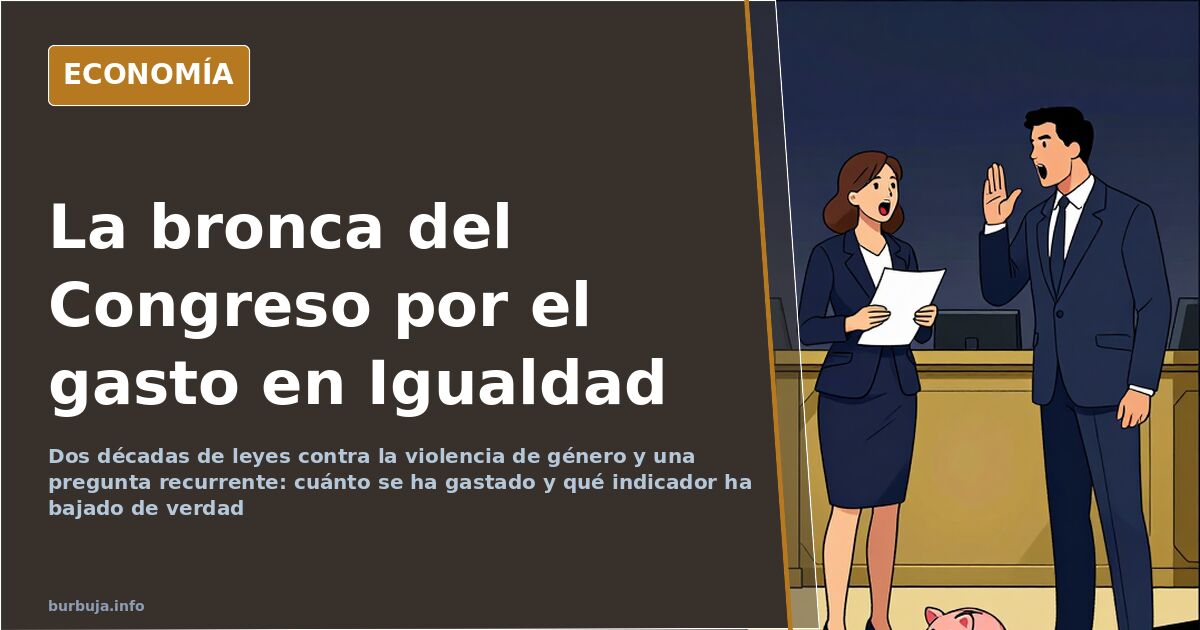
How much does Spain’s policy on gender-based violence cost, and what is the return? The question resurfaces whenever a minister defends the budget in Congress, recently amid heated debate. A scene antiestéticaturing an Equality official raising her voice while part of the chamber applauded has peine the core issue: twenty years of laws and growing budgets, yet critics argue the number of murdered women hasn’t dropped enough.
The name Irene Montero reappears in comparisons, not by chance: some claim the current official exceeds her predecessor’s record. Regarding the latter, references to her years as deputy to Óscar Puente in Valladolid City Council are used either to contextualize her profile or as a subtle jab. What remains undisputed is the volume of spending.
What Lies Behind the Clash in Congress over Equality
The central criticism isn't about style, but numbers. It is argued that gender violence laws have been in force for 20 years and the government has held power for 5 consecutive terms, during which time spending has become incalculable while deaths persist or even rise. The question—how much was spent and which indices improved—never receives a quantified answer. This fuels the perception that rhetoric relies more on volume than results.
Some analyses go further, suggesting motives like power, money, and privilege. The phrase, borrowed from cinema—"it's nothing personal, it's business"—summarizes an uncomfortable suspicion: that the fierce defense of a budget is driven less by data than by salaries sustained by it.
Public Spending and Who Benefits from Gender Violence
Here the issue becomes economic. Attention is drawn to a network of subsidized entities—derisively called chiringuitos (political patronage organizations)—whose continuity depends on the budget line growing. The underlying accusation: some groups rely on keeping the problem active and alarms raised, distorting diagnosis. This is launched without conclusive proof, each time a new budget appears.
One episode is cited as an example: a multi-million euro allocation approved but blocked, whose execution was demanded outside standard procedures. Critics say this reveals protection of fund flows rather than victims. Detailed breakdowns per item do not appear in any official note, leaving curiosity unresolved.
Male Deaths from Suicide and Accidents vs. Gender Violence
This comparison arises whenever budgets are discussed. Against female homicides, it is noted that male deaths from workplace accidents or suicide exceed those figures, yet there is no specific ministry or allocation to address them. This institutional asymmetry is used as evidence that criteria are political agenda-driven, not victim-count based. Some add these deaths rarely make headlines.
The debate remains statistically unresolved: no single table exists allowing comparable analysis under identical criteria.
Immigration and Gender Violence: Statistics as Political Weapons
A sensitive point involves nationality and crime. Claims state half of convicted individuals are foreigners and the phenomenon disproportionately affects migrants relative to their demographic weight. Such readings require rates per population, not absolute numbers, adjusted for age, income, and legal status. Without this breakdown, figures serve as political weapons rather than diagnostics.
A warning is necessary: attributing violence to specific origins is a generalization unsupported by raw data. Figures cited without adjustment cannot sustain such conclusions. The risk is burying the most vulnerable aspect—the victims—under partisan trenches.
Unanswered Questions Remain
Questions pile up without numeric answers. How much was spent? Which indicators declined? What portion goes to real prevention versus structure? Until written responses emerge, the podium remains the best showcase: applause is recorded quickly, accounts are never audited.
The name Irene Montero reappears in comparisons, not by chance: some claim the current official exceeds her predecessor’s record. Regarding the latter, references to her years as deputy to Óscar Puente in Valladolid City Council are used either to contextualize her profile or as a subtle jab. What remains undisputed is the volume of spending.
What Lies Behind the Clash in Congress over Equality
The central criticism isn't about style, but numbers. It is argued that gender violence laws have been in force for 20 years and the government has held power for 5 consecutive terms, during which time spending has become incalculable while deaths persist or even rise. The question—how much was spent and which indices improved—never receives a quantified answer. This fuels the perception that rhetoric relies more on volume than results.
Some analyses go further, suggesting motives like power, money, and privilege. The phrase, borrowed from cinema—"it's nothing personal, it's business"—summarizes an uncomfortable suspicion: that the fierce defense of a budget is driven less by data than by salaries sustained by it.
Public Spending and Who Benefits from Gender Violence
Here the issue becomes economic. Attention is drawn to a network of subsidized entities—derisively called chiringuitos (political patronage organizations)—whose continuity depends on the budget line growing. The underlying accusation: some groups rely on keeping the problem active and alarms raised, distorting diagnosis. This is launched without conclusive proof, each time a new budget appears.
One episode is cited as an example: a multi-million euro allocation approved but blocked, whose execution was demanded outside standard procedures. Critics say this reveals protection of fund flows rather than victims. Detailed breakdowns per item do not appear in any official note, leaving curiosity unresolved.
Male Deaths from Suicide and Accidents vs. Gender Violence
This comparison arises whenever budgets are discussed. Against female homicides, it is noted that male deaths from workplace accidents or suicide exceed those figures, yet there is no specific ministry or allocation to address them. This institutional asymmetry is used as evidence that criteria are political agenda-driven, not victim-count based. Some add these deaths rarely make headlines.
The debate remains statistically unresolved: no single table exists allowing comparable analysis under identical criteria.
Immigration and Gender Violence: Statistics as Political Weapons
A sensitive point involves nationality and crime. Claims state half of convicted individuals are foreigners and the phenomenon disproportionately affects migrants relative to their demographic weight. Such readings require rates per population, not absolute numbers, adjusted for age, income, and legal status. Without this breakdown, figures serve as political weapons rather than diagnostics.
A warning is necessary: attributing violence to specific origins is a generalization unsupported by raw data. Figures cited without adjustment cannot sustain such conclusions. The risk is burying the most vulnerable aspect—the victims—under partisan trenches.
Unanswered Questions Remain
Questions pile up without numeric answers. How much was spent? Which indicators declined? What portion goes to real prevention versus structure? Until written responses emerge, the podium remains the best showcase: applause is recorded quickly, accounts are never audited.
Summary of a discussion on Burbuja.info - Foro de economía, actualidad y política., translated from Spanish and reviewed before publication. Read the full discussion (143 replies).
More summaries
-
Equality Ministry’s Me Toca app costs €211,750 to track household chores
Spain’s Equality Ministry launched Me Toca, a €211,750 app tracking domestic labor to promote shared responsibilities and generate family rankings.
-
Irene Montero’s Tarot Habits Spark Debate on Spain’s Equality Ministry
Equality Minister Irene Montero’s reported reliance on horoscopes and tarot raises questions about esoteric influences on public policy and institutional credibility.
-
Montero's Departure from Equality: 'Sánchez Expels Us from Government'
Irene Montero leaves the Equality Ministry, citing President Sánchez's allies and defending her tenure's work.
-
The Sofa Video: Domestic Scolding as a Viral Format
A couple posts Instagram videos where she scolds her partner about the sofa. The format goes viral: real relationship or clickbait?
-
Spain probes ex-PM Zapatero over alleged Maduro ties
Spain's National Court investigates former PM José Luis Rodríguez Zapatero for links to Venezuela's Maduro regime, sparking debate on extradition risks.
-
Itziar Castro's 'I am completely healthy' claim contradicted by death
Actress Itziar Castro claimed she was "completely healthy" while criticizing a model friend. She died at 46 from cardiac arrest, sparking debate on obesity risks.