
Spain's 15 billion euro Catalan debt write-off sparks political rift
The cancellation of 15 billion euros in Catalan debt reignites territorial tensions, highlighting disparities between autonomous communities and fiscal regimes.
English · Original discussion in Spanish · Published
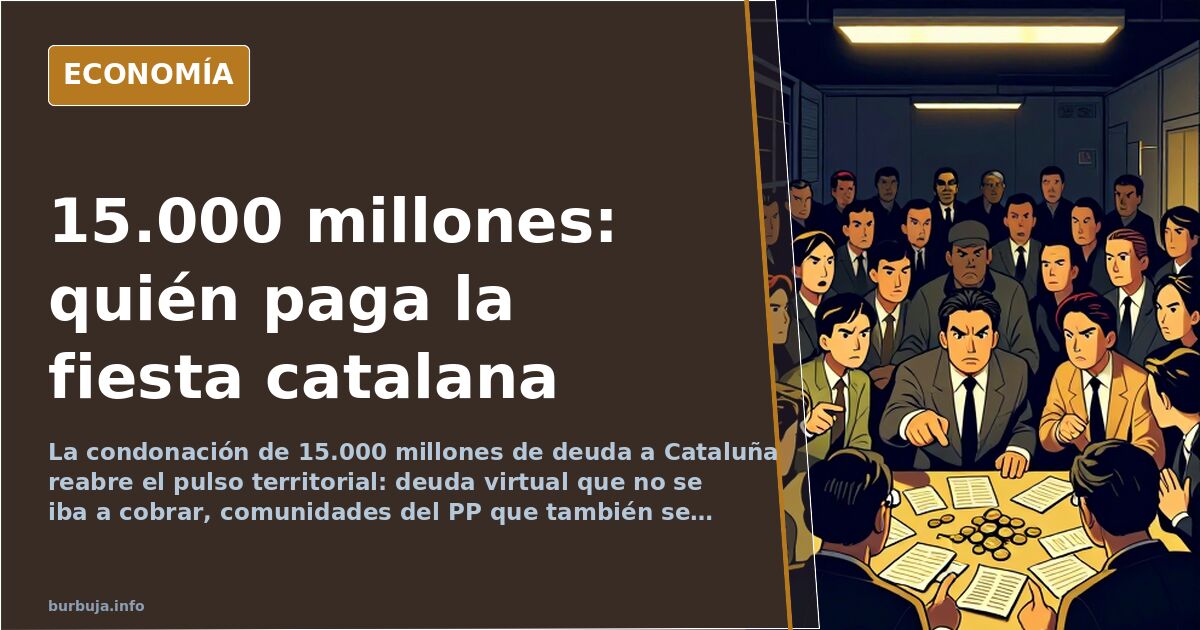
Who pays for the 15 billion euro Catalan debt
Does it cost taxpayers in Cuenca anything signed in Madrid? The debt relief for Catalonia agreed upon in the investiture deal—estimated at around 15 billion euros—has peine the old question of who foots the bill and who takes credit. What is essentially an accounting operation between administrations has become a dispute over the territorial distribution of spending and whether individual votes matter.
Virtual debt that was never going to be collected
The first key fact: no money leaves any treasury. The cancelled debt is what the autonomous community owes the State through mechanisms like the FLA (Liquidity Fund for Autonomous Communities), which was not being repaid in practice. Some summarize it bluntly: they are virtual euros on a screen at the Ministry of Finance. Under this reading, the operation does not deduct a single euro from other regions' budgets; it simply recognizes in writing what was already happening de facto.
This nuance matters because the opposing narrative—that each Galician will pay 400 euros for the write-off, according to calculations attributed to Alfonso Rueda, president of the Xunta—mixes two different things: the accounting cost of a debt reduction and the actual cost to the taxpayer. The figure of 400 euros per Galician has been repeated as if it were an invoice, when it is a political estimate regarding an entry that generates no immediate expenditure.
Who really benefits from the debt relief?
Here, the official narrative and the agreement text do not match. The deal states that the write-off applies to all common-regime communities, meaning all except the Basque Country and Navarre, which have their own foral regime. This includes PP-governed communities, whose leaders rushed to denounce alleged inequality. The paradox is evident: they protest a mechanism from which they also benefit.
The point that withstands scrutiny concerns the two foral communities. The Basque Country and Navarre are outside the common system, collect their own taxes, and do not participate in this distribution. Hence the recurring accusation that they are parasitic regions that sell into the Spanish market but keep the revenue. It is a simplification, but it highlights a real asymmetry in the territorial model that no investiture agreement has resolved.
The vote that doesn't elect a president
Beneath the territorial noise lies another, more uncomfortable discussion: whether voting actually matters. The argument often repeated is that votes only count within provincial constituencies, that they do not elect the Prime Minister, and that the seat allocation system leaves results in the hands of parties. After elections without a clear majority, forming a government depends on negotiations voters cannot control.
The response from the other side is forceful: abstention does not punish the system; it merely facilitates the continuation of those already in power. The calculation is simple. If a voter decides not to go to the polls, their potential seat swells that of the force that mobilizes its base. The debate has become a loop: some accuse abstainers of sustaining the Government, while these respond that voting for any alternative validates the same regime they denounce.
The fracture that won't heal
The core issue is not Catalonia. It is a financing model that has generated cross-grievances for decades and that no agreement has stabilized. The debt write-off is an accounting patch within that model, not a reform. As long as the debate remains about who steals from whom rather than how revenue is distributed, the next debt relief will find everyone equally angry with the same banners.
And so we continue: arguing whether the money is virtual or real, while the debt remains there, noted on the same Ministry screen.
Does it cost taxpayers in Cuenca anything signed in Madrid? The debt relief for Catalonia agreed upon in the investiture deal—estimated at around 15 billion euros—has peine the old question of who foots the bill and who takes credit. What is essentially an accounting operation between administrations has become a dispute over the territorial distribution of spending and whether individual votes matter.
Virtual debt that was never going to be collected
The first key fact: no money leaves any treasury. The cancelled debt is what the autonomous community owes the State through mechanisms like the FLA (Liquidity Fund for Autonomous Communities), which was not being repaid in practice. Some summarize it bluntly: they are virtual euros on a screen at the Ministry of Finance. Under this reading, the operation does not deduct a single euro from other regions' budgets; it simply recognizes in writing what was already happening de facto.
This nuance matters because the opposing narrative—that each Galician will pay 400 euros for the write-off, according to calculations attributed to Alfonso Rueda, president of the Xunta—mixes two different things: the accounting cost of a debt reduction and the actual cost to the taxpayer. The figure of 400 euros per Galician has been repeated as if it were an invoice, when it is a political estimate regarding an entry that generates no immediate expenditure.
Who really benefits from the debt relief?
Here, the official narrative and the agreement text do not match. The deal states that the write-off applies to all common-regime communities, meaning all except the Basque Country and Navarre, which have their own foral regime. This includes PP-governed communities, whose leaders rushed to denounce alleged inequality. The paradox is evident: they protest a mechanism from which they also benefit.
The point that withstands scrutiny concerns the two foral communities. The Basque Country and Navarre are outside the common system, collect their own taxes, and do not participate in this distribution. Hence the recurring accusation that they are parasitic regions that sell into the Spanish market but keep the revenue. It is a simplification, but it highlights a real asymmetry in the territorial model that no investiture agreement has resolved.
The vote that doesn't elect a president
Beneath the territorial noise lies another, more uncomfortable discussion: whether voting actually matters. The argument often repeated is that votes only count within provincial constituencies, that they do not elect the Prime Minister, and that the seat allocation system leaves results in the hands of parties. After elections without a clear majority, forming a government depends on negotiations voters cannot control.
The response from the other side is forceful: abstention does not punish the system; it merely facilitates the continuation of those already in power. The calculation is simple. If a voter decides not to go to the polls, their potential seat swells that of the force that mobilizes its base. The debate has become a loop: some accuse abstainers of sustaining the Government, while these respond that voting for any alternative validates the same regime they denounce.
The fracture that won't heal
The core issue is not Catalonia. It is a financing model that has generated cross-grievances for decades and that no agreement has stabilized. The debt write-off is an accounting patch within that model, not a reform. As long as the debate remains about who steals from whom rather than how revenue is distributed, the next debt relief will find everyone equally angry with the same banners.
And so we continue: arguing whether the money is virtual or real, while the debt remains there, noted on the same Ministry screen.
Also available in: Deutsch
Summary of a discussion on Burbuja.info - Foro de economía, actualidad y política., translated from Spanish and reviewed before publication. Read the full discussion (115 replies).
More summaries
-
Spain's Council of State Accuses Tax Ministry of Bypassing Parliament
Spain's top advisory body criticizes the Ministry of Finance for creating legal uncertainty and altering tax regulations without parliamentary approval.
-
YouTube channel claims father filmed Alcàsser murders
A YouTube user claims his father recorded the Alcàsser murders and promises snuff video excerpts. No evidence provided, only narrative and technical analysis.
-
Indefinite strike hits Madrid public schools from Oct 14
65,000 Madrid teachers launch an indefinite strike demanding lower ratios and higher pay. The region has the lowest per-student investment in Spain.
-
Spanish tourists clash with German pet-friendly hotel rules
Spaniards bring dogs to German hotels and restaurants where locals allow them, causing culture shock for visitors.
-
Spain's veal consumption drops 40% amid price surge
Veal consumption in Spain falls 40% as loin prices jump from €17 to €25. Chicken and pork replace it in shopping baskets.
-
Video shows woman slapping herself after partner argument
A viral video of a woman self-harming sparks debate on false accusations and legal costs in Spain.