
SpaceX Nasdaq debut set for June 12 at $1.75T valuation
SpaceX plans a June 12 Nasdaq debut valuing the firm at $1.75 trillion, with Musk retaining 93% voting power despite $4.2 billion in losses.
English · Original discussion in Spanish · Published
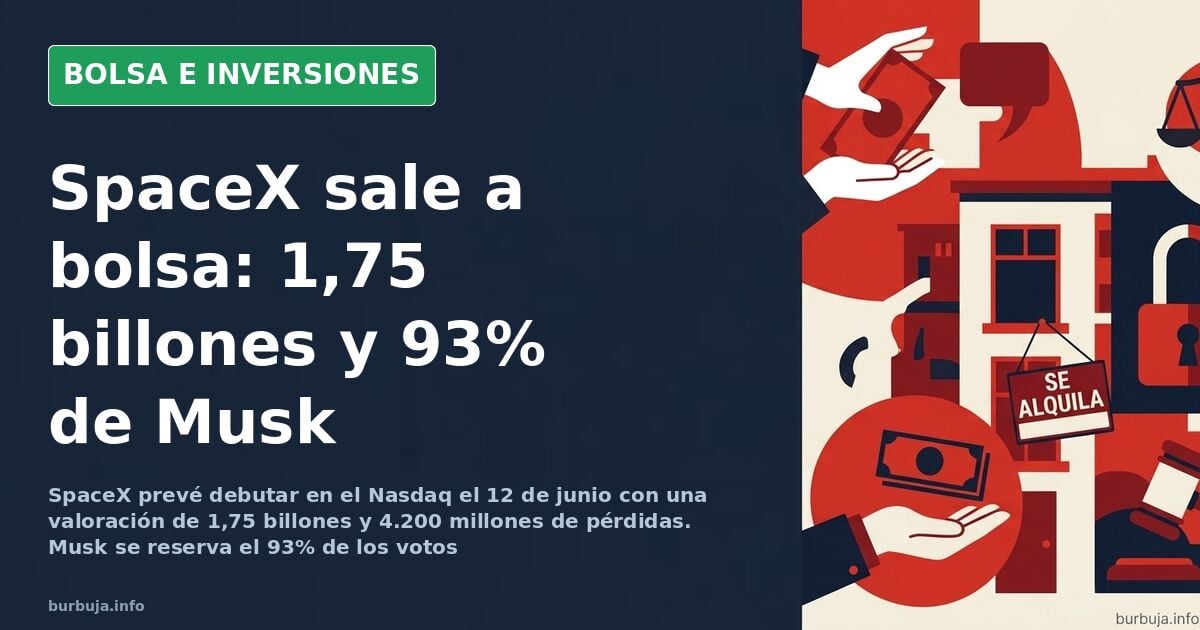
SpaceX to debut on Nasdaq valued at $1.75 trillion
The SpaceX IPO prospectus revealed stark figures: $4.2 billion in losses and Elon Musk securing 93% of voting shares. The company aims to begin trading on the Nasdaq on June 12 under the ticker SPCX, with a price range spanning from $135 to a ceiling of $162 per share. The offering seeks to raise approximately $75 billion—more than double the previous record—and would make the rocket maker the largest initial public offering in history. The timeline accelerated rapidly: the prospectus was published on May 20, the roadshow began on June 4, and share sales started on June 11, just one day before the debut.
What SpaceX sells and what investors are really paying for
SpaceX’s core business rests on three solid pillars: satellite launches, Starlink, and government contracts. Rocket reusability and launch frequency have allowed the company to place roughly two-thirds of global payload into orbit during certain periods, reaching nearly 80% in some years. Starlink has expanded coverage remarkably fast. This is present reality, not future promise.
The issue arises when examining the price. At a $1.75 trillion valuation, critics argue buyers aren’t just paying for launches and connectivity; they’re paying for Mars colonization, orbital data centers, lunar mining, asteroid resource extraction, and decades of flawless execution. It’s the difference between buying a company and buying a narrative packaged as a stock ticker. Some summarize it bluntly: at 110 times earnings, you aren’t buying SpaceX as it exists today, but SpaceX as a religion of perfect growth.
The Tesla precedent and first-day risks
Comparisons to Tesla emerge immediately. The automaker trades at a P/E ratio of 384, sustained by narratives of robotaxis, humanoid robots, batteries, and AI that industrial reality hasn’t yet justified. Whenever one pillar weakens, the story shifts to the next. A similar dynamic could occur with SpaceX, though its base business is harder to replicate and holds genuine strategic positioning.
Retail investor risk isn’t that the company is bad. It’s paying today for all successes expected in 2035. The most common analysis scenario: excellent company, absurd price. The stock may rise on day one and correct later, once quarterly numbers demand explanations for a multiple that lacks them.
Musk’s 93% control and prospectus warnings
The prospectus doesn’t hide risks: power concentration in Musk and potential conflicts of interest. The magnate retains 93% of voting shares, and there will be no independent board members. This structure leaves minority shareholders with voice but no real vote, unusual for a publicly traded company.
The offering launched with backing from major Wall Street banks. European retail investors can access up to 55.55 million shares, while Spanish investors can request them via Santander, Renta 4, GVC Gaesco, Interactive Brokers, DeGiro, Revolut, and Trade Republic. German regulator BaFin approved the prospectus in Europe.
Index effect: buying without intending to buy
SpaceX, OpenAI, and Anthropic won’t enter the S&P 500 until one year after their debuts. This rule prevents single companies from distorting the index immediately, but doesn’t stop thematic funds and ETFs from incorporating them earlier. Many who would never buy SpaceX at these multiples might end up holding it unknowingly when the narrative becomes automatic money flow.
Here’s the detail many overlook: the exit price isn’t set only by informed investors, but also by passive money entering out of obligation. And that money ignores P/E ratios.
With these elements, the question isn’t whether SpaceX is an extraordinary company. It is. The question is how much perfect future you’re forced to pay for on day one. And unlike Mars, that answer remains elusive.
The SpaceX IPO prospectus revealed stark figures: $4.2 billion in losses and Elon Musk securing 93% of voting shares. The company aims to begin trading on the Nasdaq on June 12 under the ticker SPCX, with a price range spanning from $135 to a ceiling of $162 per share. The offering seeks to raise approximately $75 billion—more than double the previous record—and would make the rocket maker the largest initial public offering in history. The timeline accelerated rapidly: the prospectus was published on May 20, the roadshow began on June 4, and share sales started on June 11, just one day before the debut.
What SpaceX sells and what investors are really paying for
SpaceX’s core business rests on three solid pillars: satellite launches, Starlink, and government contracts. Rocket reusability and launch frequency have allowed the company to place roughly two-thirds of global payload into orbit during certain periods, reaching nearly 80% in some years. Starlink has expanded coverage remarkably fast. This is present reality, not future promise.
The issue arises when examining the price. At a $1.75 trillion valuation, critics argue buyers aren’t just paying for launches and connectivity; they’re paying for Mars colonization, orbital data centers, lunar mining, asteroid resource extraction, and decades of flawless execution. It’s the difference between buying a company and buying a narrative packaged as a stock ticker. Some summarize it bluntly: at 110 times earnings, you aren’t buying SpaceX as it exists today, but SpaceX as a religion of perfect growth.
The Tesla precedent and first-day risks
Comparisons to Tesla emerge immediately. The automaker trades at a P/E ratio of 384, sustained by narratives of robotaxis, humanoid robots, batteries, and AI that industrial reality hasn’t yet justified. Whenever one pillar weakens, the story shifts to the next. A similar dynamic could occur with SpaceX, though its base business is harder to replicate and holds genuine strategic positioning.
Retail investor risk isn’t that the company is bad. It’s paying today for all successes expected in 2035. The most common analysis scenario: excellent company, absurd price. The stock may rise on day one and correct later, once quarterly numbers demand explanations for a multiple that lacks them.
Musk’s 93% control and prospectus warnings
The prospectus doesn’t hide risks: power concentration in Musk and potential conflicts of interest. The magnate retains 93% of voting shares, and there will be no independent board members. This structure leaves minority shareholders with voice but no real vote, unusual for a publicly traded company.
The offering launched with backing from major Wall Street banks. European retail investors can access up to 55.55 million shares, while Spanish investors can request them via Santander, Renta 4, GVC Gaesco, Interactive Brokers, DeGiro, Revolut, and Trade Republic. German regulator BaFin approved the prospectus in Europe.
Index effect: buying without intending to buy
SpaceX, OpenAI, and Anthropic won’t enter the S&P 500 until one year after their debuts. This rule prevents single companies from distorting the index immediately, but doesn’t stop thematic funds and ETFs from incorporating them earlier. Many who would never buy SpaceX at these multiples might end up holding it unknowingly when the narrative becomes automatic money flow.
Here’s the detail many overlook: the exit price isn’t set only by informed investors, but also by passive money entering out of obligation. And that money ignores P/E ratios.
With these elements, the question isn’t whether SpaceX is an extraordinary company. It is. The question is how much perfect future you’re forced to pay for on day one. And unlike Mars, that answer remains elusive.
Also available in: Deutsch
Summary of a discussion on Burbuja.info - Foro de economía, actualidad y política., translated from Spanish and reviewed before publication. Read the full discussion (125 replies).
More summaries
-
Silver cutlery valuation: weight matters, not design
Silver cutlery is valued by weight: 925 sterling vs 999 bullion, knives that don't count, and a 40% threshold proposed by a forum user.
-
Spanish Penny Stocks: GALQ Jumps 18%, Ezentis Masks Drop
GALQ rose from €0.70 to €0.81 while Ezentis displayed a misleading +290% gain due to a stock split, illustrating the volatility of Spain's speculative small caps.
-
Rural vs. Urban Living: The Debate on Escaping City Noise
Rural areas offer peace and freedom, but logistics, healthcare access, and isolation deter many. This debate contrasts two distinct lifestyle models.
-
Paramés Criticized for Losing Half of Fund Capital
Cobas Internacional faces over three years of losses, with critics claiming a 50% capital drop and divergence from indices.
-
Spain: Youth Survives Poverty, Old Age Does Not
In Spain, young people cope with low funds; middle-aged adults cannot. Early savings, renting at 50, and uncertain pensions are key issues.
-
IAG shares slide to €2.41 despite airline bailouts
IAG falls from €2.51 to €2.41 and Lufthansa stays flat at €9 as airlines ignore incoming public funds.