
Retiring at 60 with 240 gold ounces: the calculation
A strategy to retire at 60 using physical gold, challenging public pension stability and advocating for precious metals savings.
English · Original discussion in Spanish · Published
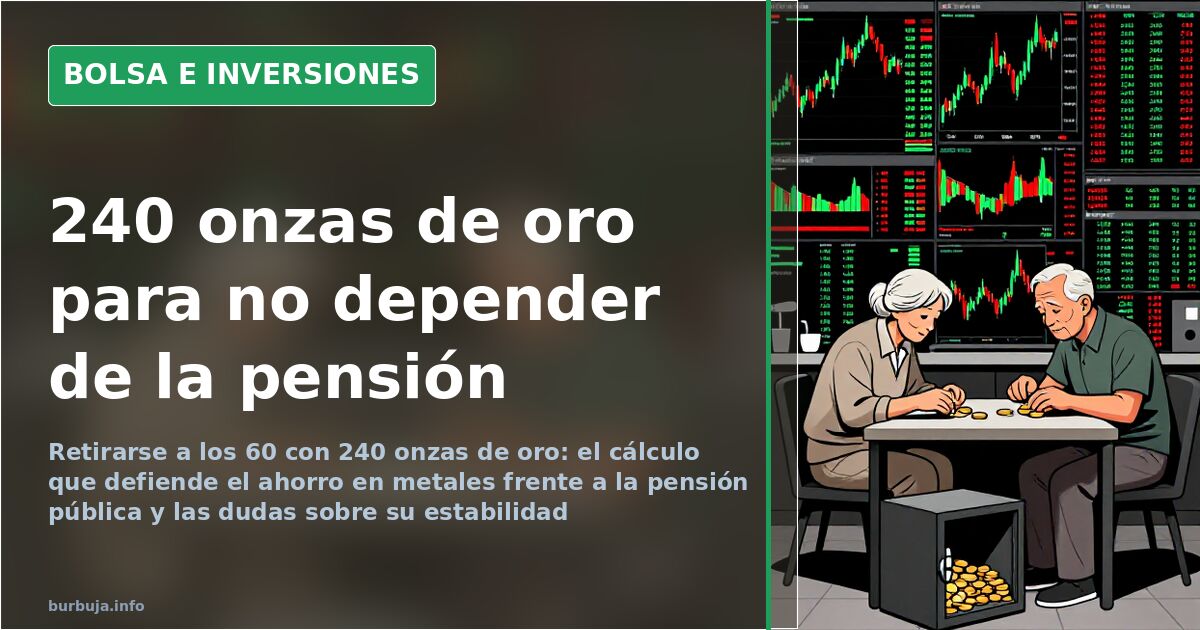
Retiring at 60 by stacking gold: the 240-ounce account
In 1992, according to one participant, a monthly salary covered more than 4.5 gold ounces. Today, it barely covers one. This paradox is troubling because the metal hasn't skyrocketed due to market whims; rather, salaries have plummeted when measured in gold. On this gap rests a thesis gaining traction among those planning their exit from the labor market: building retirement funds with physical ounces and ceasing reliance on public pensions.
It is not a promise of easy returns. It is a savings formula. And like any formula, it invites debate.
One ounce for each month you plan to live
The calculation is almost provocatively simple. If you are 40 years old and want to stop working at 60, with a life expectancy of another 20 years, you need 20 years x 12 ounces = 240 ounces. No Monte Carlo simulations or quarterly rebalancing: if your lifestyle allows you to manage with 0.8 ounces per month, fine; if you need three, you know what’s required.
The rest is patience. The ounces are sold gradually, just after reaching the target age, taking advantage of price spikes while the bulk of the pile waits its turn. The plan assumes an annual appreciation of 8%, calculated over the last 50 years. For skeptics, it is lowered to 5%. The detailed development of the sales calendar, with its windows and assumptions, is more intricate than the skeleton, but the logic remains this.
Your salary measured in ounces: the decline few notice
Here is the disorienting data. According to one participant, in 2002 he earned four gold ounces per month doing overtime without even noticing. Today, earning one ounce a month is a good salary, and spending 900 euros on two gold coins hurts the bank account. It is not just that the metal rises: incomes fall when expressed in gold.
The series is revealing. In the year 2000, 6,000 euros of savings bought 24 or 25 ounces. Today, with that same money, barely 3.4.
Gold or silver? The 80-to-1 ratio
For those who cannot scrape together a monthly gold ounce, the entry point is silver. With the gold/silver ratio above 1:80, buying 40 silver ounces equals one gold ounce for much less effort. If the ratio narrows someday, those 40 —or 50— ounces can be exchanged for a golden one. An old trick that still works.
The cash cushion that prevents forced selling
No metals plan withstands poorly managed emergencies. Hence the recommendation to keep six months or a full year of expenses in cash, separate from the metal. Without that buffer, a car breakdown or a month of sick leave forces selling gold at the worst time. With it, one can wait for a good window.
And windows matter. This same year, those who sold ounces in February did so at 1,700 euros; those who held until March got 1,860. Six or eight ounces at that price make the difference between withdrawing a round sum or falling short.
The fine print: manipulated price and lost stability
Not everyone sees the metal as an untouchable refuge. Some argue that gold has temporarily lost its greatest virtue, value stability, and that its price is sufficiently manipulated to behave more like equities than insurance. Two years in the market are enough to read the same appreciation expectations again and again, year after year, without the big surge arriving.
Others add a generational nuance: public healthcare deteriorates, food loses quality, and any black swan —a war, a pandemic— suddenly rewrites the life expectancy upon which everything is calculated. Planning for 20 years with that variable is, at minimum, optimistic.
Those buying in silence: central banks
While small savers hesitate, institutions accumulate. The Reserve Bank of India has increased its gold reserves by 40% in five years, reaching 795 tons, the ninth largest in the world. And it is not an isolated case: after World War II, the United States came to hoard 22,000 tons, 80% of the planet's official total, before the Bretton Woods system collapsed.
According to proponents of this thesis, those who invite buying real estate and spending on leisure buy metal behind closed doors. Gold and silver themselves accumulate an average return exceeding 9% in the last 23 years, according to calculations circulating in these circles.
What if the problem isn’t how much gold you need, but how much time you have left to buy it? The 240-ounce account only works if you start early. Those who reach 50 with half the pile discover that the calendar, not the price, was the enemy.
In 1992, according to one participant, a monthly salary covered more than 4.5 gold ounces. Today, it barely covers one. This paradox is troubling because the metal hasn't skyrocketed due to market whims; rather, salaries have plummeted when measured in gold. On this gap rests a thesis gaining traction among those planning their exit from the labor market: building retirement funds with physical ounces and ceasing reliance on public pensions.
It is not a promise of easy returns. It is a savings formula. And like any formula, it invites debate.
One ounce for each month you plan to live
The calculation is almost provocatively simple. If you are 40 years old and want to stop working at 60, with a life expectancy of another 20 years, you need 20 years x 12 ounces = 240 ounces. No Monte Carlo simulations or quarterly rebalancing: if your lifestyle allows you to manage with 0.8 ounces per month, fine; if you need three, you know what’s required.
The rest is patience. The ounces are sold gradually, just after reaching the target age, taking advantage of price spikes while the bulk of the pile waits its turn. The plan assumes an annual appreciation of 8%, calculated over the last 50 years. For skeptics, it is lowered to 5%. The detailed development of the sales calendar, with its windows and assumptions, is more intricate than the skeleton, but the logic remains this.
Your salary measured in ounces: the decline few notice
Here is the disorienting data. According to one participant, in 2002 he earned four gold ounces per month doing overtime without even noticing. Today, earning one ounce a month is a good salary, and spending 900 euros on two gold coins hurts the bank account. It is not just that the metal rises: incomes fall when expressed in gold.
The series is revealing. In the year 2000, 6,000 euros of savings bought 24 or 25 ounces. Today, with that same money, barely 3.4.
Gold or silver? The 80-to-1 ratio
For those who cannot scrape together a monthly gold ounce, the entry point is silver. With the gold/silver ratio above 1:80, buying 40 silver ounces equals one gold ounce for much less effort. If the ratio narrows someday, those 40 —or 50— ounces can be exchanged for a golden one. An old trick that still works.
The cash cushion that prevents forced selling
No metals plan withstands poorly managed emergencies. Hence the recommendation to keep six months or a full year of expenses in cash, separate from the metal. Without that buffer, a car breakdown or a month of sick leave forces selling gold at the worst time. With it, one can wait for a good window.
And windows matter. This same year, those who sold ounces in February did so at 1,700 euros; those who held until March got 1,860. Six or eight ounces at that price make the difference between withdrawing a round sum or falling short.
The fine print: manipulated price and lost stability
Not everyone sees the metal as an untouchable refuge. Some argue that gold has temporarily lost its greatest virtue, value stability, and that its price is sufficiently manipulated to behave more like equities than insurance. Two years in the market are enough to read the same appreciation expectations again and again, year after year, without the big surge arriving.
Others add a generational nuance: public healthcare deteriorates, food loses quality, and any black swan —a war, a pandemic— suddenly rewrites the life expectancy upon which everything is calculated. Planning for 20 years with that variable is, at minimum, optimistic.
Those buying in silence: central banks
While small savers hesitate, institutions accumulate. The Reserve Bank of India has increased its gold reserves by 40% in five years, reaching 795 tons, the ninth largest in the world. And it is not an isolated case: after World War II, the United States came to hoard 22,000 tons, 80% of the planet's official total, before the Bretton Woods system collapsed.
According to proponents of this thesis, those who invite buying real estate and spending on leisure buy metal behind closed doors. Gold and silver themselves accumulate an average return exceeding 9% in the last 23 years, according to calculations circulating in these circles.
What if the problem isn’t how much gold you need, but how much time you have left to buy it? The 240-ounce account only works if you start early. Those who reach 50 with half the pile discover that the calendar, not the price, was the enemy.
Summary of a discussion on Burbuja.info - Foro de economía, actualidad y política., translated from Spanish and reviewed before publication. Read the full discussion (144 replies).
More summaries
-
Silver Surges as Gold Ratio Plummets, Metal Faces Shortages
The gold-to-silver ratio has fallen from 121 to 60, with silver prices soaring. Physical metal is scarce amid industrial and banking demand.
-
Banco de España Silver Coins: From €12 to €30 Face Value
Explore the evolution of Banco de España's silver coins, from their €12 face value to €30, as silver prices fluctuated. Discover why these collectibles are now scarce.
-
Banco de España's €12 coin now matches its silver face value
Commemorative €12 silver coin briefly exceeded its face value. Daily limits and rush to exchange them at the bank fueled the trend.
-
Hotel101 sells rooms in Valdebebas for €208,800
Hotel101 sells rooms in Valdebebas for €208,800 plus VAT with monthly income distribution and doubts about what happens if the operator goes bankrupt
-
Gold hits €78 per gram, reigniting currency debate
Gold trades at €78 per gram, sparking debate on whether the metal is rising or the euro falling. Historical data clarifies its role as an inflation hedge.
-
Gold and Silver Coins: Purity, Premiums, and Taxes
Choosing between purity, premiums, and fine print. Is buying gold coins based solely on purchase and resale prices worthwhile?