
IAG shares slide to €2.41 despite airline bailouts
IAG falls from €2.51 to €2.41 and Lufthansa stays flat at €9 as airlines ignore incoming public funds.
English · Original discussion in Spanish · Published
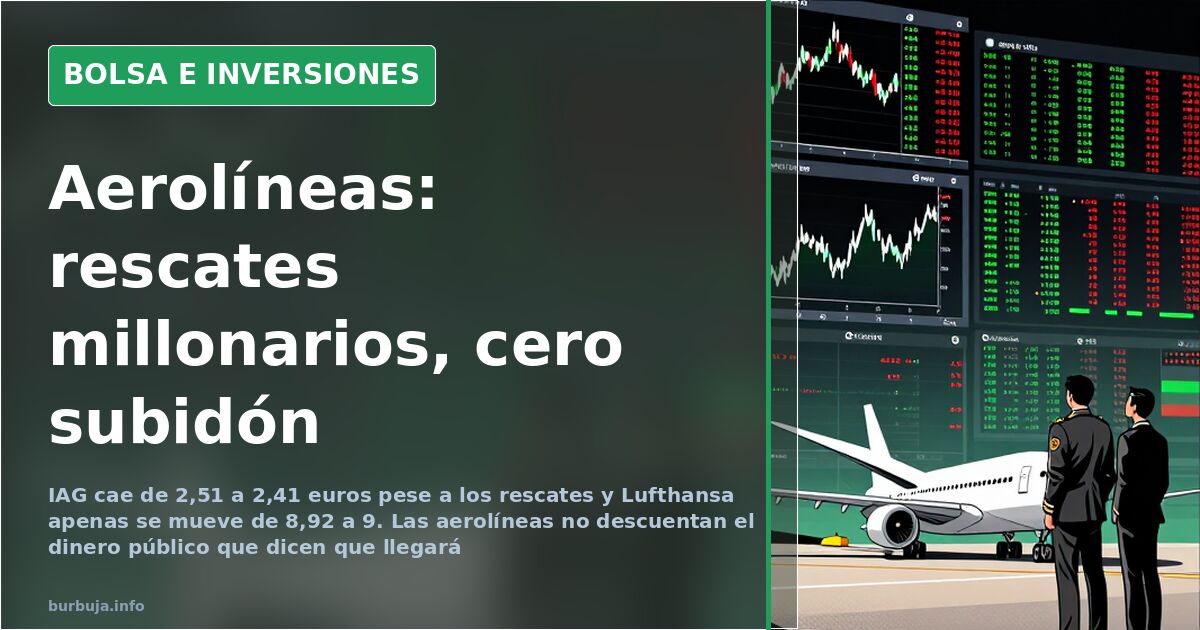
Airlines: Bailouts arrive but rally fails to materialize
IAG closed Friday at €2.51. By mid-week, it hit €2.41. Lufthansa moved from €8.92 to €9, while Singapore Airlines edged up from €2.30 to €2.36. If the Spanish government plans equity stakes in strategic carriers and rescue packages are already tabled, these prices should reflect that reality. They do not. The anticipated takeoff remains absent.
The initial thesis was simple: millions will flow in, taxes will be cut, and free competition rules will be bypassed — Ryanair and EasyJet are already protesting — so this must eventually boost share prices. On paper, flawless. On screen, silence.
From Friday close to mid-week
The three stocks central to the bet have barely signaled. Lufthansa remains nearly flat, from €8.92 to €9. Singapore Airlines adds six cents. IAG, the expected primary beneficiary of state aid, loses ten cents precisely when institutional noise peaks. No crash, no surge: an uncomfortable sideways movement for those expecting a windfall.
Investors who positioned themselves are checking charts twice, suspecting platform delays. It doesn’t align with news, prompting urgent explanations: either they received funds without action, haven’t yet been paid, or markets await airspace reopening. Three hypotheses, none verified.
Why bailouts don’t move airline stock prices
Because a bailout isn’t business. The circulating argument is that airlines risk becoming covert state subsidiaries, with public money entering through the back door while liberalism is preached at the front. If true, share prices stop measuring passengers, routes, or margins, and instead gauge the likelihood of ministry intervention in balance sheets.
Here lies the crux. Some argue shareholders should lose everything if such companies fail; others counter that won’t happen because no one would invest in airlines again, given air transport’s essential infrastructure status. Between these views lie debt write-offs, capital increases, partial nationalizations, or poorly explained middle-ground solutions.
What US prices reveal
The United States offers little optimism. From Thursday to Tuesday close, United fell from $34.14 to $32.55; Delta from $27.72 to $27.01; American from $12.50 to $11.91; Hawaiian from $13.77 to $13.58. Southwest, most efficient by cost-per-mile and load factor, dropped nearly 10%, from $34.12 to $33.01. Even best-managed firms aren’t spared.
This detail dismantles a common belief. If issues were solely management-related—Spanish, American, or Malaysian—some would fall while others held. All are falling. The blow is demand-driven: fewer flights, lower occupancy, fixed costs intact (leased/owned aircraft, staff, overheads) where a 40% activity drop doesn’t reduce bills by 40%.
LATAM cuts 2,700 crew members amid sector-wide adjustments
While debates about rallies continue, industry reality moves opposite. Latin America’s largest airline announces layoffs of at least 2,700 crew members, over a third of its workforce, after failing to agree on wage reductions with unions to avoid cuts. This headline sets the sector’s emotional floor, leaving valuations shaky.
The operational question shifts from potential upside to balance sheet endurance. Pessimistic calculations assume that without revenue and with ongoing expenses, two more months of restrictions literally erode shareholder equity. Optimists trust public funds will arrive before leasing invoices come due.
Investors buy only what they recognize
A pattern repeats whenever sectors plunge: people buy what they understand. Planes flew, stopped flying, will fly again, so stocks must rise. This three-step logic makes IAG one of Spain’s most traded stocks in June, far exceeding its actual weight in buyers’ portfolios.
This behavior has rewards and risks. Reward: catching rebounds from lows yields notable gains. Risk: aviation has lost more years than gained, with slim margins and no clear competitive advantage. A stock trading near €2 for decades says something about shareholders, not just flights.
With traffic still minimal, bailouts pending, and earnings season imminent, analysis returns to square one: convinced someone will pay for the party, but with no clue when, how much, or who sets the table.
IAG closed Friday at €2.51. By mid-week, it hit €2.41. Lufthansa moved from €8.92 to €9, while Singapore Airlines edged up from €2.30 to €2.36. If the Spanish government plans equity stakes in strategic carriers and rescue packages are already tabled, these prices should reflect that reality. They do not. The anticipated takeoff remains absent.
The initial thesis was simple: millions will flow in, taxes will be cut, and free competition rules will be bypassed — Ryanair and EasyJet are already protesting — so this must eventually boost share prices. On paper, flawless. On screen, silence.
From Friday close to mid-week
The three stocks central to the bet have barely signaled. Lufthansa remains nearly flat, from €8.92 to €9. Singapore Airlines adds six cents. IAG, the expected primary beneficiary of state aid, loses ten cents precisely when institutional noise peaks. No crash, no surge: an uncomfortable sideways movement for those expecting a windfall.
Investors who positioned themselves are checking charts twice, suspecting platform delays. It doesn’t align with news, prompting urgent explanations: either they received funds without action, haven’t yet been paid, or markets await airspace reopening. Three hypotheses, none verified.
Why bailouts don’t move airline stock prices
Because a bailout isn’t business. The circulating argument is that airlines risk becoming covert state subsidiaries, with public money entering through the back door while liberalism is preached at the front. If true, share prices stop measuring passengers, routes, or margins, and instead gauge the likelihood of ministry intervention in balance sheets.
Here lies the crux. Some argue shareholders should lose everything if such companies fail; others counter that won’t happen because no one would invest in airlines again, given air transport’s essential infrastructure status. Between these views lie debt write-offs, capital increases, partial nationalizations, or poorly explained middle-ground solutions.
What US prices reveal
The United States offers little optimism. From Thursday to Tuesday close, United fell from $34.14 to $32.55; Delta from $27.72 to $27.01; American from $12.50 to $11.91; Hawaiian from $13.77 to $13.58. Southwest, most efficient by cost-per-mile and load factor, dropped nearly 10%, from $34.12 to $33.01. Even best-managed firms aren’t spared.
This detail dismantles a common belief. If issues were solely management-related—Spanish, American, or Malaysian—some would fall while others held. All are falling. The blow is demand-driven: fewer flights, lower occupancy, fixed costs intact (leased/owned aircraft, staff, overheads) where a 40% activity drop doesn’t reduce bills by 40%.
LATAM cuts 2,700 crew members amid sector-wide adjustments
While debates about rallies continue, industry reality moves opposite. Latin America’s largest airline announces layoffs of at least 2,700 crew members, over a third of its workforce, after failing to agree on wage reductions with unions to avoid cuts. This headline sets the sector’s emotional floor, leaving valuations shaky.
The operational question shifts from potential upside to balance sheet endurance. Pessimistic calculations assume that without revenue and with ongoing expenses, two more months of restrictions literally erode shareholder equity. Optimists trust public funds will arrive before leasing invoices come due.
Investors buy only what they recognize
A pattern repeats whenever sectors plunge: people buy what they understand. Planes flew, stopped flying, will fly again, so stocks must rise. This three-step logic makes IAG one of Spain’s most traded stocks in June, far exceeding its actual weight in buyers’ portfolios.
This behavior has rewards and risks. Reward: catching rebounds from lows yields notable gains. Risk: aviation has lost more years than gained, with slim margins and no clear competitive advantage. A stock trading near €2 for decades says something about shareholders, not just flights.
With traffic still minimal, bailouts pending, and earnings season imminent, analysis returns to square one: convinced someone will pay for the party, but with no clue when, how much, or who sets the table.
Also available in: Deutsch
Summary of a discussion on Burbuja.info - Foro de economía, actualidad y política., translated from Spanish and reviewed before publication. Read the full discussion (127 replies).
More summaries
-
IBEX 35 in June 2012: Rescue and the Battle for 6,300 Points
The IBEX 35 defended the 6,300-point level in June 2012 amid negotiations for a €100 billion bank bailout: levels, 11% gaps, and distrust.
-
Economy twists: stock bubble and consumption in freefall
The DAX nears 22,000 with Germany in recession, consumption sinks and real inflation exceeds official. Signs of bubble and debt.
-
Bayer stock doubles for forum user after crash
Bayer shares surge over 100% for one investor despite Altman Z-Score warnings and ongoing Roundup litigation in the US Supreme Court.
-
Oil crashes to negative prices while Fed props up markets
US crude futures closed at -37.63 dollars per barrel for the first time in history, as the Federal Bank buys junk debt and stock indices remain resilient.
-
Gold and silver plunge: forum debates correction vs trend change
Silver fell from €100 to €65 in two days, sparking debate on whether this is a technical correction or a structural shift.
-
Financial Independence in Spain: From €300k to €2M
In Spain, retiring early requires between €300k and €2M. A new apartment in Barcelona costs €370k with taxes.