
Spain Watermelon Prices Hit €1.90/kg Amid Supply Issues
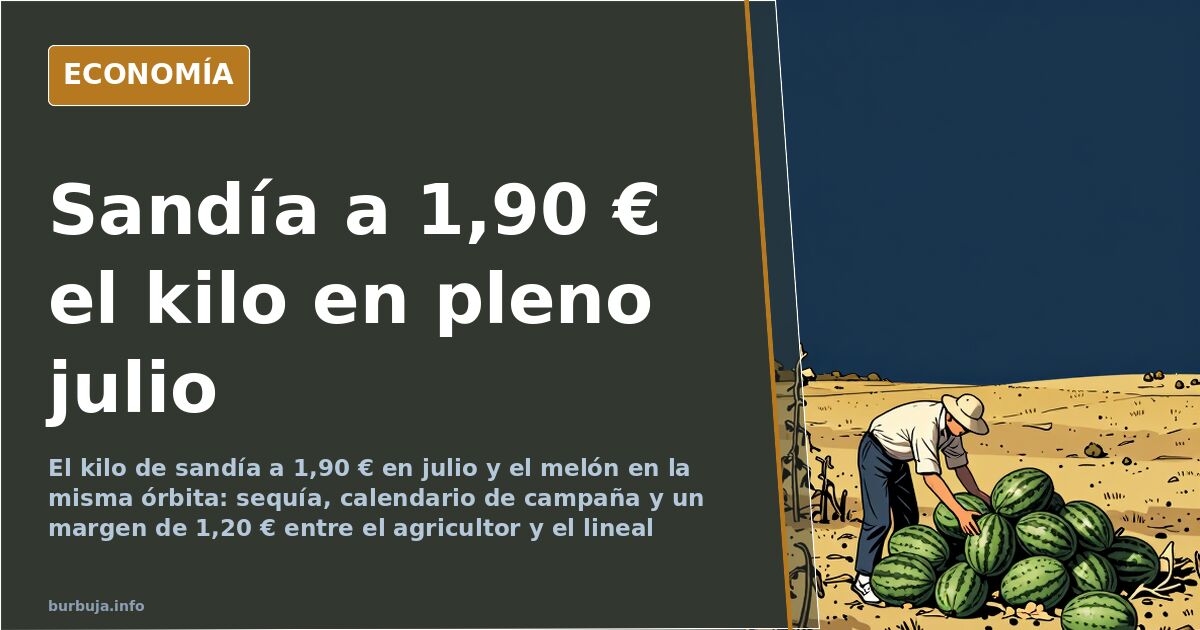
Watermelons cost €1.90/kg in July Spain, with melons similar. Drought and campaign timing create a €1.20 gap between farmers and retailers.
English · Original discussion in Spanish · Published
Spain Watermelon Prices Hit €1.90/kg Amid Supply Issues
Why do watermelons cost nearly four times more in mid-July than they did recently? At €1.90 per kilo, with melons at similar prices and stock shortages in some hypermarkets, this summer's pattern isn't random. June saw record rainfall, while July brought extreme heat and zero precipitation, hitting Spanish agriculture at the worst possible moment. The real question isn't whether fruit is expensive, but who captures the margin.
Farmers Earn €0.70 While Shelves Show €1.90
Industry calculations suggest producers receive around €0.70 per kilo, while consumers pay €1.90. This leaves €1.20 for intermediaries, transport, cold storage, and distribution. Since this differential hasn't changed proportionally with final prices, it fuels suspicion that increases aren't driven solely by supply and demand.
Campaign data reveals genuine scheduling issues. Open-field production concentrates in a short twenty-day window, with March-April plantings maturing early around San Juan (St. John's Day). When this happens, markets saturate, origin prices collapse, and many producers leave fruit unpicked rather than sell at a loss. Weeks later, scarcity returns and prices spike.
Perfect Storm: Drought, Rain, and Extreme Heat
The climate narrative trinc its own logic. February-May rains and June storms disrupted flowering and fruit-setting cycles, causing simultaneous ripening. Watermelons and melons have only about fifteen days of shelf life in cold storage; they take up significant volume and spoil quickly. When markets saturate, letting produce rot becomes cheaper than moving it. Subsequently, supply gaps emerge and prices rise.
Some argue inadequate hydraulic infrastructure worsens underlying problems: without stored water, irrigation fails, discouraging investment in seeds and fertilizers. Others point to imported product competition arriving at prices local producers cannot match. Both explanations coexist without negating each other.
Why Are Supermarket Watermelon and Melon Stocks Low?
Retail chains officially cite adverse weather in producing regions. This explains some store shortages but not all. Farmers have protested by dumping thousands of kilos of watermelons and melons on the ground, highlighting that origin prices don't cover costs. The paradox is uncomfortable: fruit is discarded in Almería while urban consumers pay premium prices.
Import statistics add another layer: watermelon purchases from Segarro surged in early months. Foreign products fill national production gaps, offering lower costs but different standards. Consumers pay more for fruit traveling longer distances.
Inflation Figures Disconnected from Shopping Baskets
While summer fruit prices multiply, macroeconomic narratives insist Spanish inflation remains among Europe's lowest. Both can be true yet disconnected. Harmonized inflation measures average baskets; July watermelons reflect specific realities. Products with 90% water content now sell at two euros per sugared liter equivalent.
Discontent extends beyond watermelons to apples, oranges, potatoes, onions, and peppers. Post-pandemic and Ukraine war perceptions suggest basic food prices diverge from wages. Debating whether this reflects inflation or speculation ultimately questions who bears the cost.
Buying Outside Supermarkets: An Alternative Path
Facing shortages and high prices, some advocate bypassing major chains. Local greengrocers and regional chains might offer better value by avoiding large-distribution cost structures. Critics argue consumers rely on models concentrating supply in few hands, leaving no counterbalance when prices are set.
Counterarguments note limited access to alternative circuits and rising neighborhood shop prices too. Real competition exists in intermediary margins, not vendor goodwill—margins consumers cannot control.
With farmers earning €0.70 and shelves showing €1.90, the issue isn't just expensive watermelons. It's how much difference reaches fields eventually. Currently, those sweating over melon patches remain the least compensated.
Also available in: Deutsch
Summary of a discussion on Burbuja.info - Foro de economía, actualidad y política., translated from Spanish and reviewed before publication. Read the full discussion (110 replies).
More summaries
-
Carrefour and Alcampo lose ground to Mercadona and Lidl
Carrefour and Alcampo drop 0.8% while Mercadona grows 9%; analysis of the French hypermarket decline in Spain.
-
Alcampo Slashes Prices on Near-Expiry Moroccan Goods Amidst Slow Sales
Alcampo is offering discounts on Moroccan products nearing their expiration date. We analyze the strategy and context behind these sales.
-
Spain's summer fruit prices surge: half a melon costs €5
Half a melon at €5 and half a watermelon at €9.58 highlight soaring summer fruit prices, contrasting with official inflation figures near 3%.
-
Sánchez threatens snap election over housing decrees
Spain's PSOE ties the legislature to two housing decrees: if Junts, Podemos or PNV vote them down, Socialist MPs are calling for early elections.
-
Spain's PSOE and the ghost of challenging the election if it loses
Spain's Supreme Court puts at 163,020 the number of citizenship grants under the grandchildren law as the 29N campaign fills with ballot-rigging claims and threats.
-
Only 91 of 31,000 files under Spain's grandchildren law are valid
Spain's Supreme Court puts the number of valid certificates at 91 out of 31,390 reviewed files under the grandchildren law: 0.28% of 2.5 million applications and 160,000…