
Spain: Two Years of Therapy for Pregnancy Loss
Marina and Ainara lost Mara at 37 weeks. They share their journey through gestational bereavement after two years of therapy.
English · Original discussion in Spanish · Published
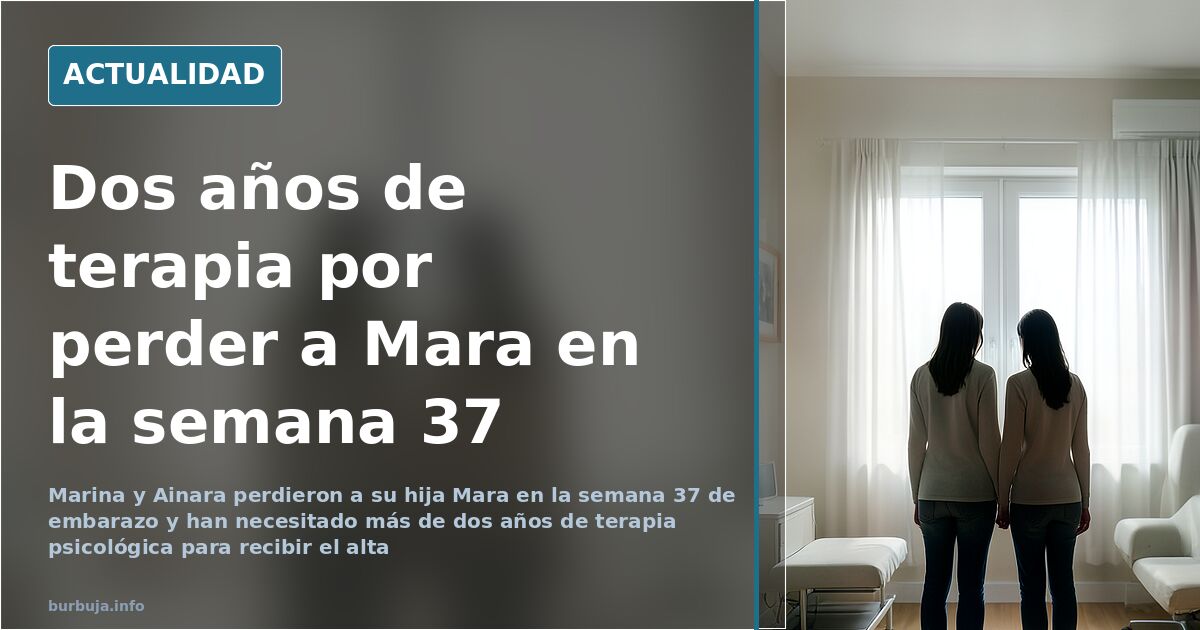
Two Years of Therapy to Face an Empty Crib
Marina Martín and Ainara Larraza lost their daughter Mara in the 37th week of pregnancy, with delivery already at term. They needed more than two years of psychological therapy to receive discharge. They share their story now, coinciding with International Pregnancy and Infant Loss Remembrance Day, so that their daughter is not forgotten and to highlight a grief that, they say, is often silenced.
The story has a detail that disorients anyone who has been in a monitoring room. At the 34-week ultrasound, Mara was found to have an umbilical cord malformation, an aneurysm, and they were referred to Donostia University Hospital. They were told to be "completely calm." They had never seen a baby die from this. Five days before the induced labor, during a routine check-up, there was no heartbeat.
What is Gestational Bereavement and Why It Isn't Measured in Weeks
The pregnancy was full-term. Eight and a half months. The difference between a spontaneous abortion in the second month and fetal death at 37 weeks is not one of degree, but of nature: there is a name, bought clothes, a prepared room, and a delivery that happens just the same, only without crying at the end. Marina describes it with a chilling coldness: "everything else hurt so much that physical pain was very insignificant".
Ainara heard other heartbeats in the waiting room thinking they were her daughter's. When she was informed of the death, they were already asking what they wanted to do with the body. They are talking about your daughter, she summarizes. The paperwork, decisions, logistics of a funeral nobody taught you how to manage, all arrive in the first hours of shock.
From the hospital itself, they shared a data point that helps size the issue: in Gipuzkoa, one or two deaths per year are recorded of babies born prematurely at such an advanced stage as Mara's. This rarity explains two things at once: that the protocol is not well-established and that the case gets media attention.
Delivery, Holding Her, and Memory
It was easier for Marina to decide. For Ainara, harder. When she was born, doubts vanished: she cut the cord, saw her emerge, and spent hours with her. "She looked like a sleeping girl", she recalls. She was born with good tonalidad, and when changes began, they decided to let go to keep a good memory. They trinc all expert recommendations.
The eldest son, Markel, was a year and a half old when everything peine. He was, his mothers say, the engine that got them out of bed. They couldn't afford to spend hours slumped on the sofa. Then Lea arrived. The family remains four, although one of the four exists only in the narrative.
The Debate It Opens: Can You Grieve Like This and Support Free Abortion?
Here the story stops being a sentimental chronicle and becomes a coherence problem each reader resolves as they can. One line of analysis argues it is difficult to reconcile extreme pain over the loss of a 37-week fetus with unqualified support for abortion at any stage of gestation. The counter-argument is that voluntary interruption is one thing, and the unwanted death of an expected child is another, and confusing them is a rhetorical trap.
Another current points to media treatment. It is argued that such reports are common when the protagonist fits a certain profile and scarce when tragedy affects others. The 106,172 abortions performed in Spain in 2024, according to cited data, do not generate this coverage. The complaint is not against the protagonists, but against editorial criteria.
And a third, more uncomfortable line questions the labor and care framework: two years of therapy with discharge is not a whim, but nor is it a case exportable to any family losing a child who cannot afford that break. The open question is whether the system treats the grief of those with networks and resources equally to those without.
How many gestational bereavements fit into a statistic before we stop calling them isolated cases?
Marina Martín and Ainara Larraza lost their daughter Mara in the 37th week of pregnancy, with delivery already at term. They needed more than two years of psychological therapy to receive discharge. They share their story now, coinciding with International Pregnancy and Infant Loss Remembrance Day, so that their daughter is not forgotten and to highlight a grief that, they say, is often silenced.
The story has a detail that disorients anyone who has been in a monitoring room. At the 34-week ultrasound, Mara was found to have an umbilical cord malformation, an aneurysm, and they were referred to Donostia University Hospital. They were told to be "completely calm." They had never seen a baby die from this. Five days before the induced labor, during a routine check-up, there was no heartbeat.
What is Gestational Bereavement and Why It Isn't Measured in Weeks
The pregnancy was full-term. Eight and a half months. The difference between a spontaneous abortion in the second month and fetal death at 37 weeks is not one of degree, but of nature: there is a name, bought clothes, a prepared room, and a delivery that happens just the same, only without crying at the end. Marina describes it with a chilling coldness: "everything else hurt so much that physical pain was very insignificant".
Ainara heard other heartbeats in the waiting room thinking they were her daughter's. When she was informed of the death, they were already asking what they wanted to do with the body. They are talking about your daughter, she summarizes. The paperwork, decisions, logistics of a funeral nobody taught you how to manage, all arrive in the first hours of shock.
From the hospital itself, they shared a data point that helps size the issue: in Gipuzkoa, one or two deaths per year are recorded of babies born prematurely at such an advanced stage as Mara's. This rarity explains two things at once: that the protocol is not well-established and that the case gets media attention.
Delivery, Holding Her, and Memory
It was easier for Marina to decide. For Ainara, harder. When she was born, doubts vanished: she cut the cord, saw her emerge, and spent hours with her. "She looked like a sleeping girl", she recalls. She was born with good tonalidad, and when changes began, they decided to let go to keep a good memory. They trinc all expert recommendations.
The eldest son, Markel, was a year and a half old when everything peine. He was, his mothers say, the engine that got them out of bed. They couldn't afford to spend hours slumped on the sofa. Then Lea arrived. The family remains four, although one of the four exists only in the narrative.
The Debate It Opens: Can You Grieve Like This and Support Free Abortion?
Here the story stops being a sentimental chronicle and becomes a coherence problem each reader resolves as they can. One line of analysis argues it is difficult to reconcile extreme pain over the loss of a 37-week fetus with unqualified support for abortion at any stage of gestation. The counter-argument is that voluntary interruption is one thing, and the unwanted death of an expected child is another, and confusing them is a rhetorical trap.
Another current points to media treatment. It is argued that such reports are common when the protagonist fits a certain profile and scarce when tragedy affects others. The 106,172 abortions performed in Spain in 2024, according to cited data, do not generate this coverage. The complaint is not against the protagonists, but against editorial criteria.
And a third, more uncomfortable line questions the labor and care framework: two years of therapy with discharge is not a whim, but nor is it a case exportable to any family losing a child who cannot afford that break. The open question is whether the system treats the grief of those with networks and resources equally to those without.
How many gestational bereavements fit into a statistic before we stop calling them isolated cases?
Also available in: Deutsch
Summary of a discussion on Burbuja.info - Foro de economía, actualidad y política., translated from Spanish and reviewed before publication. Read the full discussion (57 replies).
More summaries
-
Mpox death in Spain: Patient infected by roommate at Donostia Hospital
A 61-year-old patient died of mpox after catching it from a roommate at Donostia Hospital. Osakidetza vaccinated 25 contacts.
-
First mpox death in Basque Country reported at Donostia Hospital
A 61-year-old cancer patient died of mpox at Donostia Hospital after contracting it from a roommate, marking the region's first fatality.
-
Ceuta and Melilla: the theory of a hybrid takeover through healthcare
The theory circulating: Ceuta and Melilla would not fall to a military invasion but to a healthcare collapse forcing evacuation
-
Fire at La Querola: 52 luxury homes damaged in Andorra
The fire at La Querola de Ordino destroyed 22,000 m² and damaged the seven blocks of 52 luxury homes sold from two million in Andorra.
-
Journalist Vito Quiles assaulted during protest coverage
Vito Quiles was attacked while covering a demonstration. Viral video shows shoving and water thrown, sparking debate on press freedom.
-
Irregular Migrant Kills 18-Year-Old Girl on Berlin Train Tracks
An 18-year-old girl was murdered in Berlin by an irregular migrant. The debate on immigration, media coverage, and politics intensifies.