
Mpox death in Spain: Patient infected by roommate at Donostia Hospital
A 61-year-old patient died of mpox after catching it from a roommate at Donostia Hospital. Osakidetza vaccinated 25 contacts.
English · Original discussion in Spanish · Published
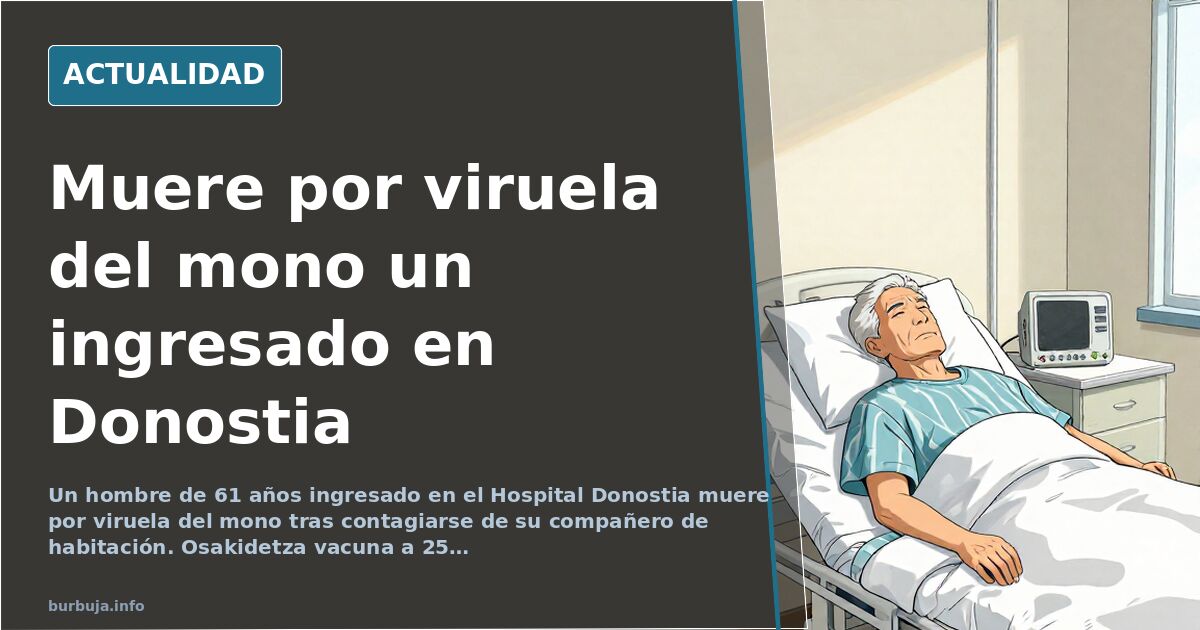
61-year-old dies of mpox caught from roommate at Donostia Hospital
A 61-year-old man admitted to Donostia Hospital (Osakidetza, Basque Country) died this week from monkeypox (mpox), according to the Basque Health Department and Radio Euskadi. The infection did not occur outside the hospital: the patient likely contracted the bicho from his roommate, identified as the index case of the epidemic chain. Mpox is cited as the cause of death, although the deceased also had a tumor in his throat and neck but was not in terminal phase. The fact that shocks anyone familiar with hospital care is simple: two patients, one shared room, and a pathogen slipping through where it should not.
What is mpox and why contact tracing matters
Mpox is a zoonotic disease — jumping from animals to humans — originating from tropical rainforest regions of Central and West Africa. Typical symptoms include fever, muscle aches, swollen lymph nodes, and a rash on hands and face similar to chickenpox. It is not a new bicho or a lab invention: it is a rare illness that circulated for decades away from media spotlight.
The relevant issue here is the health response. Osakidetza established a perimeter of one hundred contacts and started vaccinating potential exposures among healthcare staff. So far, 25 people have been vaccinated. The protocol was activated, but the damage was already done inside the hospital itself.
The index case: what is known and what is not
No age, origin, or nationality has been released for the so-called patient zero. This information silence is, in itself, journalistic data: it fuels speculation and leaves the public without basic info to assess real risk. The only confirmed fact is the chain: infected roommate, deceased roommate.
The question hovering over this case is about hospital management. How does a patient with a transmissible disease end up sharing space with another admitted for an oncological problem? No official answer has arrived yet. Without it, the episode reads as a triage failure, not an inevitable fatality.
Echoes of ELbichito: deaths "with" vs. "from"
The parallel with pandemic patterns is unavoidable. During the worst months of ELbichito, many death certificates recorded the bicho in patients with severe pre-existing conditions, sparking a debate that never fully closed: do you die from or with? Here, the source is explicit: the cause is attributed to mpox because the deceased was not in terminal phase, despite the throat and neck tumor.
That nuance matters. If the criterion was applied rigorously, we are facing a death from mpox. If applied loosely, we face another inflated statistic. Transparency about clinical criteria is the only thing that settles the doubt, and it has not arrived yet.
Political noise obscuring the health problem
Around this case, discourse mixing immigration, public spending, and institutional distrust has crystallized. Some commentary claims the episode shows border control and resource allocation failures; others reduce it to a mere hospital protocol error. Both readings coexist without providing verifiable data on this specific case.
What is verifiable: an oncology patient shared a room with an mpox case, got infected, and died. The rest — origin of the index case, isolation criteria, responsibility for authorizing the shared room — remains unanswered publicly.
Analysis gets stuck exactly there: at the point where hospital management should explain how decisions are made about who shares a room with whom, and no one has put that protocol on the table yet.
A 61-year-old man admitted to Donostia Hospital (Osakidetza, Basque Country) died this week from monkeypox (mpox), according to the Basque Health Department and Radio Euskadi. The infection did not occur outside the hospital: the patient likely contracted the bicho from his roommate, identified as the index case of the epidemic chain. Mpox is cited as the cause of death, although the deceased also had a tumor in his throat and neck but was not in terminal phase. The fact that shocks anyone familiar with hospital care is simple: two patients, one shared room, and a pathogen slipping through where it should not.
What is mpox and why contact tracing matters
Mpox is a zoonotic disease — jumping from animals to humans — originating from tropical rainforest regions of Central and West Africa. Typical symptoms include fever, muscle aches, swollen lymph nodes, and a rash on hands and face similar to chickenpox. It is not a new bicho or a lab invention: it is a rare illness that circulated for decades away from media spotlight.
The relevant issue here is the health response. Osakidetza established a perimeter of one hundred contacts and started vaccinating potential exposures among healthcare staff. So far, 25 people have been vaccinated. The protocol was activated, but the damage was already done inside the hospital itself.
The index case: what is known and what is not
No age, origin, or nationality has been released for the so-called patient zero. This information silence is, in itself, journalistic data: it fuels speculation and leaves the public without basic info to assess real risk. The only confirmed fact is the chain: infected roommate, deceased roommate.
The question hovering over this case is about hospital management. How does a patient with a transmissible disease end up sharing space with another admitted for an oncological problem? No official answer has arrived yet. Without it, the episode reads as a triage failure, not an inevitable fatality.
Echoes of ELbichito: deaths "with" vs. "from"
The parallel with pandemic patterns is unavoidable. During the worst months of ELbichito, many death certificates recorded the bicho in patients with severe pre-existing conditions, sparking a debate that never fully closed: do you die from or with? Here, the source is explicit: the cause is attributed to mpox because the deceased was not in terminal phase, despite the throat and neck tumor.
That nuance matters. If the criterion was applied rigorously, we are facing a death from mpox. If applied loosely, we face another inflated statistic. Transparency about clinical criteria is the only thing that settles the doubt, and it has not arrived yet.
Political noise obscuring the health problem
Around this case, discourse mixing immigration, public spending, and institutional distrust has crystallized. Some commentary claims the episode shows border control and resource allocation failures; others reduce it to a mere hospital protocol error. Both readings coexist without providing verifiable data on this specific case.
What is verifiable: an oncology patient shared a room with an mpox case, got infected, and died. The rest — origin of the index case, isolation criteria, responsibility for authorizing the shared room — remains unanswered publicly.
Analysis gets stuck exactly there: at the point where hospital management should explain how decisions are made about who shares a room with whom, and no one has put that protocol on the table yet.
Also available in: Deutsch
Summary of a discussion on Burbuja.info - Foro de economía, actualidad y política., translated from Spanish and reviewed before publication. Read the full discussion (40 replies).
More summaries
-
Man dies from monkeypox in Spain's Basque Country
An oncology patient at Donostia hospital died after contracting Mpox from a roommate. It is the first death in the Basque Country.
-
Ayuso: Madrid celebrates Hispanic Day with US as guest
Madrid's leader Isabel Díaz Ayuso marks Hispanic Day in Spain, highlighting the US as guest nation and asserting a shared cultural power.
-
The Ugliness Agenda: Architecture as a Control Tool
Analysis links Rockefeller network, MoMA and International Style to deliberate urban ugliness as a social control mechanism.
-
Omarchy creator condemns Swedish murder verdict
David Heinemeier Hansson calls the ruling in a Swedish immigrant's murder case 'insane' and warns of the perpetrator's release.
-
Peruvian candidate named Hitler Mussolini wins local election
Hitler Mussolini Simeon won the mayoral race in Peru's Queropalca district for the left-wing party Ahora Nación, sparking social media debate.
-
Ndongo Sparks Debate on Ayuso Controversy
Bertrand Ndongo's X post 'I don't understand the controversy' fuels debate on scandal definitions. We explain the context and why it matters.