
Spain shifts from €97.5bn deficit to €50bn surplus
Spain moved from a €97.5bn external deficit in 2007 to a €50bn balance of payments surplus, driven by low wages and tourism.
English · Original discussion in Spanish · Published
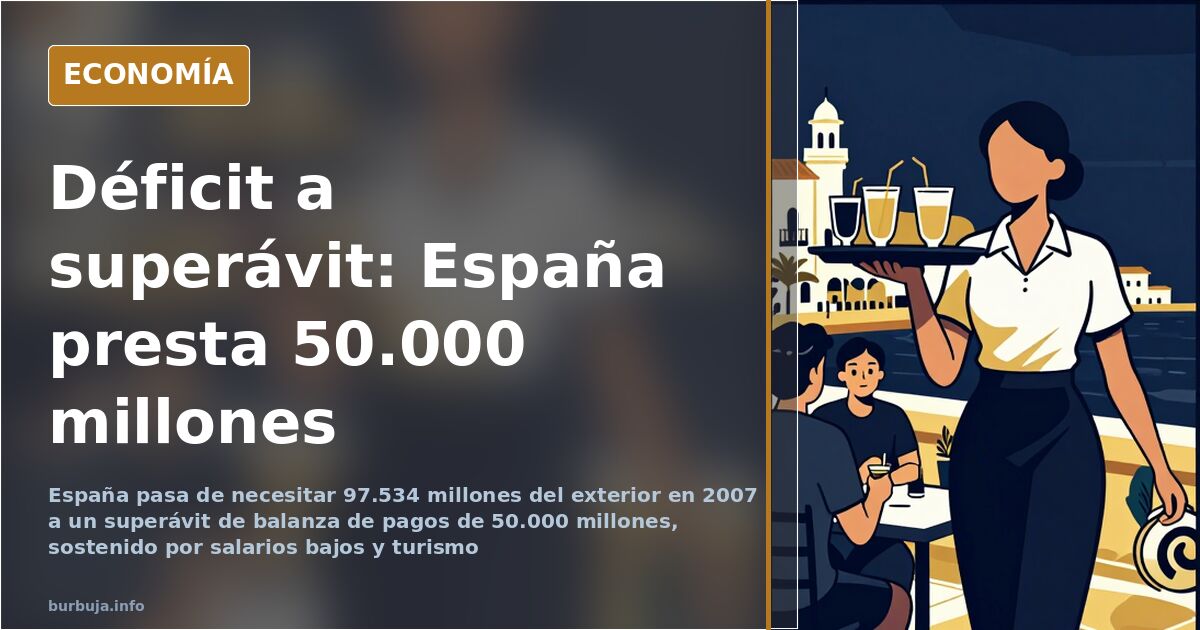
From owing €97.534bn abroad to lending €50bn
According to data cited in the debate, Spain needed €97.534 billion from abroad in 2007, representing 9.1% of its GDP, just to keep the economy running. Sixteen years later, based on those same calculations, the balance of payments surplus hovers around €50 billion: shifting from a country that sought capital externally to one that lends to others. The headline holds up. The uncomfortable question is different: does this miccionan Spaniards are better off?
Why has Spain shifted from seeking capital to exporting more?
As noted in the debate, 62% of exports go to the European Union, partners with higher incomes and thus greater purchasing power, while domestic prices have remained contained. That is half the picture. The other half is defined by the average remuneration per employee cited: €44,686 in the eurozone versus €34,927 in Spain, with virtually identical productivity (63.5% and 61.7%). Goods produced equally well are sold cheaper.
As another participant summarizes, behind this differential lies the post-financial crisis adjustment. The country emerged with depressed wages and no capacity to invest for productivity gains because no one was lending. With these foundations, competing abroad was the only way out, and the external sector responded.
The surplus not felt in paychecks
The less friendly interpretation of the same figure argues that the positive balance relies on over a decade of wage devaluation in the private sector, and on printing money. According to this view, domestic consumption and imports are at historic lows. The middle class is shrinking, purchasing power is abysmal, and much of the population relies on consumer credit until the next paycheck while waiting for Euribor, energy, and food prices to fall. Celebrating "the best economic news in half a century" is difficult when holding your shopping cart.
The paradox makes sense looking at who earns what. One participant argues that margins and profits grew in the last decade, but the average worker hasn't seen it in their account. This is the gap the debate highlights between profits and wages.
Imports in tons: the figure missing from headlines
According to data provided by a participant, goods trade is also measured by weight, and the numbers speak volumes: 287,985,640.16 tons imported in 2008 versus 246,211,944.64 in 2021. Less in absolute terms, even before adjusting for inflation. According to another participant, the collapse of construction explains much of the gap: bricks went from 15% of GDP to 7%, and building materials make up the bulk of tonnage entering through ports.
Discrepancies arise in interpretation. For some, the drop proves the country has lost the ability to buy from abroad. For others, it is the logical consequence of an economy that stopped building as it did in 2007, while agriculture barely adds two million tons over fifteen years, according to the same calculation. Two ways of looking at the same container.
Where does the surplus really come from?
The origin of the balance is where optimism cracks. Some warn that if a large part of that €50 billion comes via European funds, public debt, or ECB decisions, the news ceases to be good: the surplus would not be a symptom of strength, but of an economy receiving transfers. According to a list cited in the debate, 88% of the top hundred recipients of EU funds are public entities.
And liabilities continue. Another participant adds that public debt already reaches €1.5 trillion after adding €75.267 billion in 2022 alone. Some also suggest that part of that inflow might come not from exports, but from remittances by Spaniards who left to seek work abroad. Positive for the balance sheet, devastating as a diagnosis.
Tourism: the crutch supporting the balance of payments
It is worth remembering what the positive side consists of. As one participant recalls, serving a beer to a foreign visitor counts as a service export. Tourism has been the salvation of the external balance, just as during the 2008-2013 slump, and this carries a structural problem: for another participant, it generates many jobs but little added value. Some argue that in Spain, the productivity of an engineer and that of a waiter are very similar.
Hence the vertigo. A model dependent on visitors continuing to arrive and on the wages of those serving them remaining low turns the surplus into something fragile, not a conquest.
With these foundations, the issue remains open: there is no way to know how much of the surplus is structural and how much is circumstantial. Some see the end of the external dependence that nearly bankrupted the country in 2007; others see a wage adjustment disguised as success. While this is decided, the only unchanging datum is debt.
Also available in: Deutsch
Summary of a discussion on Burbuja.info - Foro de economía, actualidad y política., translated from Spanish and reviewed before publication. Read the full discussion (113 replies).
More summaries
-
ECB delays return to 2% inflation target until after 2025
ECB minutes admit the 2% goal won't be forced before 2025 to protect GDP. Rising food costs erode savings' purchasing power.
-
Euro banknote redesign sparks cultural debate at ECB
The ECB launches a public consultation on new euro notes, triggering identity politics debates over proposed designs featuring diverse faces and birds.
-
Argentina and the EU: an economic mirage
Argentina is Europe, but mostly because of its economy. The debate between cultural identity and economic reality in a country that feels European but fails to live up to it.
-
Law students report irregularities in Spain's 14-O police charge
A 35-page report and 21 videos document alleged irregularities in the police charge during the 14-O protest at Madrid's Complutense University: 4 injured and 5 arrested.
-
Vitoria, Spain: family of eight evicted, six of them minors
A family of eight, including six minors, was evicted in Vitoria, Spain, after a year unable to find a rental home. Two arrests were made during the protest.
-
Oil at $107 a barrel: the price squeezing wallets
Brent crude has topped $107 and is flirting with $116. Without wars or taxes, a litre of petrol could cost around 30 cents, according to a calculation making the rounds.