
Oil at $107 a barrel: the price squeezing wallets
Brent crude has topped $107 and is flirting with $116. Without wars or taxes, a litre of petrol could cost around 30 cents, according to a calculation making the rounds.
English · Original discussion in Spanish · Published
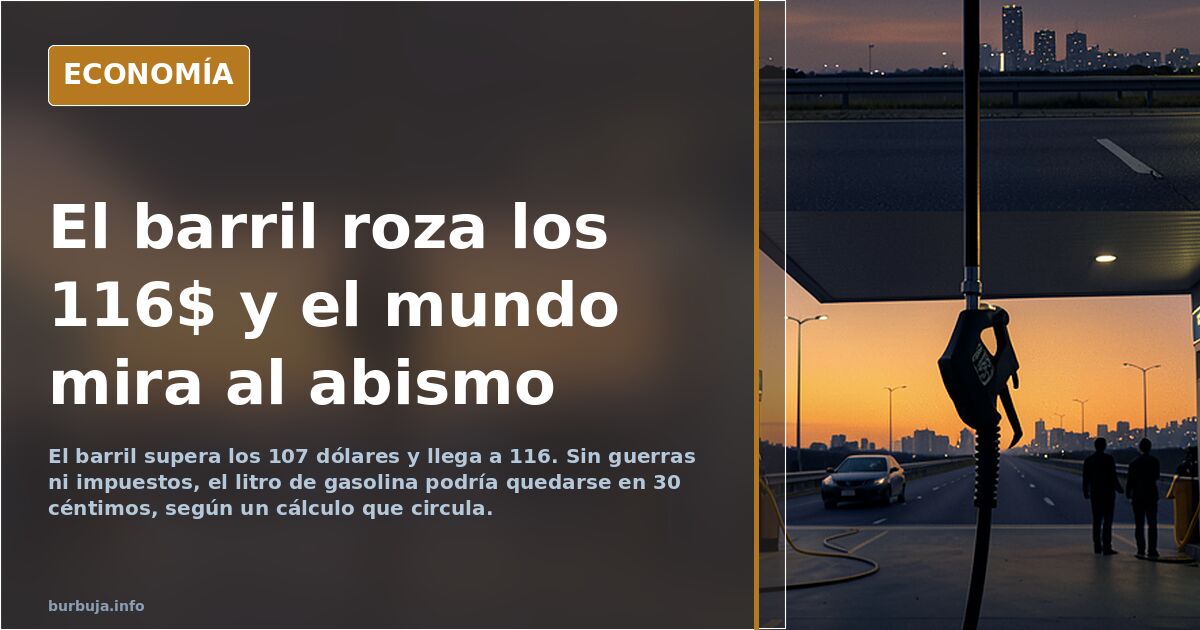
Oil at $107 and climbing: the barrel that no longer falls
Brent crude is trading above $107 and the climb shows no sign of stopping. In just a few sessions it has gone from hovering around $70 to breaking through $110 and flirting with $116, according to market records. This is no ordinary run: every extra ten dollars in crude eventually shows up at the pump, in the electricity bill and in the shopping basket. And nobody here can agree on how much of what we pay is oil and how much is tax.
The calculation that cuts the price to a third
The most repeated argument is that crude alone does not explain what it costs to fill the tank. If the ongoing conflicts — the wars in Iran and Ukraine, the bombing of refineries — were discounted and the excess supply that flooded markets before the latest flare-up were added back, the barrel would return to $50, according to a calculation making the rounds. Even lower: there was talk of $60 before the geopolitical board got complicated.
The sums continue. From that cheap oil you would then have to strip out the tax burden that fuel carries in Spain. With both corrections, a litre of petrol could come in at around 30 cents. It is the figure circulating out there and, put on a real pump, it sounds like science fiction. The full breakdown, item by item, is what turns the debate into something more than a driver's tantrum.
Why does oil rise even when supply is plentiful?
Because the price is set not only by the barrels available, but by the antiestéticar that they will stop being available. Conflict hotspots and attacks on refining infrastructure inject a risk premium that is paid on every transaction. Those who argue crude should be worth half point to that premium as the cause of most of the price rise.
The market, meanwhile, plays its own game. There are long positions peine at $70 that are now being viewed with satisfaction. And there are those who think $107 is even too low for the outlook taking shape. When the price breaks above $110, the conversation changes tone: people openly talk of staring into the abyss.
From the pump to the bicycle: the citizen response
The immediate reaction is not an energy transition, it is a bike pump. Tyres get inflated, chains get oiled and the bicycle is rediscovered as a means of transport through pure arithmetic. The running joke is that people here boast about their green credentials while the wallet decides what ideology could not.
Some also look to the electric car as a refuge. The irony is sharp: the profits from the crude rally would finance the purchase of the vehicle that ends dependence on it. And on the terraces, packed on any given Saturday, complaints about fuel prices sit comfortably alongside the next round of drinks. The contradiction, as always, is paid for by the same wallet.
With the barrel at these levels, the question is no longer whether it will reach the petrol station, but when. The most widespread forecast is that a new jump above $110 would consolidate the trend. Nothing guarantees the correction will come any sooner.
Also available in: Deutsch
Summary of a discussion on Burbuja.info - Foro de economía, actualidad y política., translated from Spanish and reviewed before publication. Read the full discussion (16 replies).
More summaries
-
Iran threatens $200 oil as US bombs tankers
Iran warns of $200 oil prices while the US attacks three tankers in the Strait of Hormuz. What dependence on crude means for Spain amid a price war.
-
Oil Plunges 5% on Weak US Gasoline Demand, Recession Fears Grow
Brent drops 5.62% to $85.81 and WTI falls 5.36% amid weak US gasoline demand, sparking recession concerns despite production cuts.
-
Oil at $150 and the Current Housing Tension in Spain
Analysis of housing price sustainability amid $150 oil volatility and migration pressures.
-
Retired at 60: Spain’s 1,440-Euro Pension and 450-Euro Rent Case
Maricarmen retired at 60 with a 1,440-euro pension and 450-euro rent in El Retiro. The case highlights unpaid building fees, IBI, water, and heating costs.
-
Oil hovers around $104 and gas tops €80/MWh
The barrel hovers around $104 with the Strait of Hormuz closed and gas tops €80/MWh. Some argue the current price hides the shortage to come as reserves run out.
-
TV3 presenter suggests burning the Sagrada Familia 'to live in peace'
A TV3 presenter in Spain suggested burning the Sagrada Familia to achieve social peace. The remark, shared in a tweet, sparks a debate over the limits of…