
Poland calls emergency meeting after two civilian deaths
Two civilians died in Przewodów, near the Ukrainian border. Warsaw convened its Security Council while missile attribution remains unconfirmed.
English · Original discussion in Spanish · Published
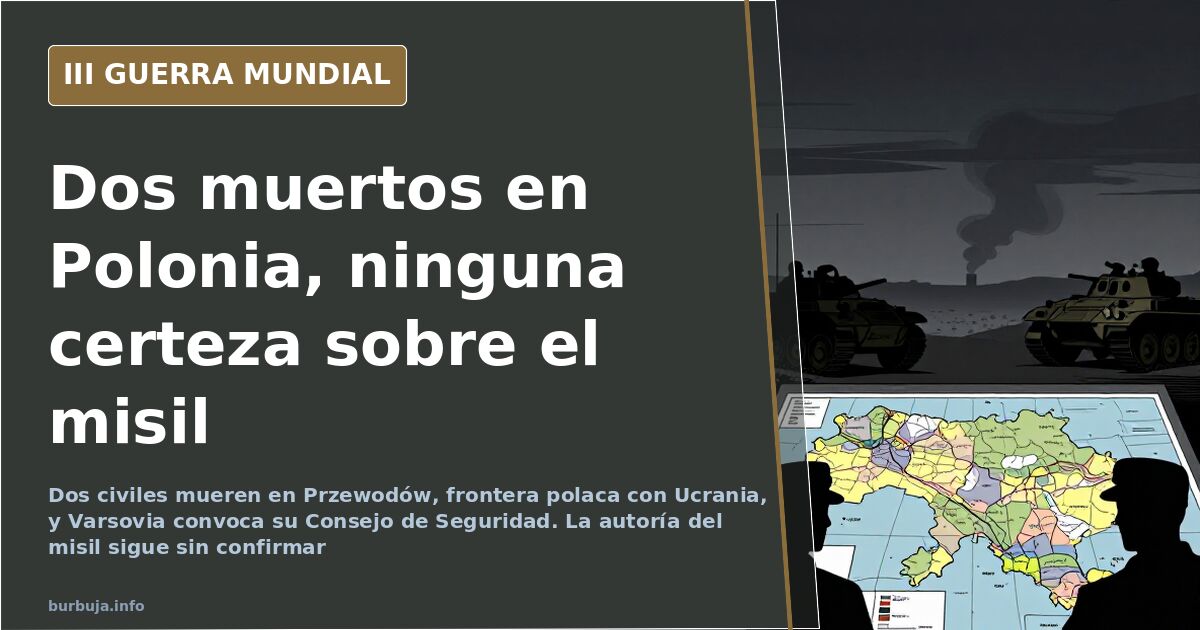
Poland convenes National Security Council trinc two deaths
Two civilians dead and an emergency session of the National Security Council. This is the verifiable outcome of several projectile impacts in Przewodów, a Polish village close to the Ukrainian border. Everything else—responsibility, intent, and consequences—remains unconfirmed. The missiles in Poland shifted within hours from global war news to an open investigation file.
The Polish Prime Minister gathered his National Security Council after Russian missiles reportedly killed two people in that border town. The conditional tense is not rhetorical decoration; it is the only honest way to describe an event whose authorship was still being debated. When a projectile lands on NATO and European Union territory, the question ceases to be military and becomes political within minutes.
What is known about the impact in Przewodów
The basic fact is this: two Polish civilians dead in a rural border locality, and an emergency meeting of the National Security Council called by the Prime Minister. Ukrainian President Volodymyr Zelenskyy called his Polish counterpart Andrzej Duda to express condolences for the death of Polish citizens "due to Russian missile terrorism," and they exchanged available information "clarifying all facts."
The official version arrived before verification, and that is where the noise began. Discussions suggest the physical trace of the impact is more modest than the word missile implies: an overturned trailer, disturbed earth, and little else. It is not conclusive evidence—a projectile can kill without leaving a cinematic crater—but it reminds us to look at the ground before writing the headline.
Deviated Russian missile or Ukrainian air defense?
Here hypotheses diverge, and none prevails. The first: Russia launched around a hundred missiles that day against critical points of the Ukrainian power grid, and a trajectory failure could have carried one across the border. The second: a Ukrainian air defense missile—the S-300 system is mentioned—that fell where it should not have, something that had already occurred within Ukrainian territory itself.
Added to this is a detail that confounds supporters of the quick narrative: according to a press column cited during the exchange, the White House did not consider it certain that the projectiles were Russian. That Kiev's main ally hits the brakes while half of Europe assumes Russian responsibility is, at the very least, an informational anomaly.
Why no one expects a NATO response
Despite the emergency call, the dominant expectation is that there will be no escalation. The argument is cold and repeated with different words: two civilian deaths in a rural area do not start a war against a nuclear power. Poland will protest, demand explanations, and harden its rhetoric, but a military response is ruled out beforehand.
Some even read the convocation as a gesture required by protocol rather than a prelude to anything. Others warn the opposite: that social mobilization against Moscow existed in Poland before the incident and that streets may heat up demanding a government response. Both possibilities exist. In episodes like this, domestic politics weighs more than diplomacy.
The controversy over Russian missile accuracy
One of the most technical exchanges concerned the precision of the Russian arsenal. The defended thesis is that Moscow started the war with missiles antiestéticaturing partially Western or Chinese electronics, less accurate than a Western rocket launcher but acceptable: in a salvo of ten, nine hit the center and one deviates twenty meters. With wear and tear, this material becomes scarce, leaving older, less reliable models. The full breakdown, including inventory evolution, is much more detailed.
Opposing this is the classic objection: if a twenty-meter deviation is considered tolerable, the standard justifies any bombardment presented as "collateral damage." The comparison with previous episodes in Iraq is thrown into the message exchange and poisons the technical discussion. It is likely armchair debate, but it raises a pertinent question: who sets the threshold for acceptable error?
The headline that deflates in 24 hours
The most uncomfortable part of the matter is not military, but journalistic. The cycle is described precisely: one day headlines announce Russia attacks NATO; the next, those same media publish a column clarifying that responsibility is unclear, and the previous news disappears without mention. The conclusion drawn is harsh and needs no adjectives: informational quality suffers when sensationalism sells more than verification.
It is not a problem exclusive to one side. The same mechanism—publish first, correct in a page corner—is attributed to Russian media. The difference, it is argued, is that here readers can verify the public correction, whereas there they cannot.
What might happen from now on
With what is on the table, the most reasonable prediction is that the file cools down: the convocation will remain a formality, no chancellery will confirm responsibility aloud, and the issue will resolve into technical explanations. Or not. If this episode teaches anything, it is that in a matter of hours, an overturned trailer can become a NATO crisis and then revert to being just an overturned trailer.
Two civilians dead and an emergency session of the National Security Council. This is the verifiable outcome of several projectile impacts in Przewodów, a Polish village close to the Ukrainian border. Everything else—responsibility, intent, and consequences—remains unconfirmed. The missiles in Poland shifted within hours from global war news to an open investigation file.
The Polish Prime Minister gathered his National Security Council after Russian missiles reportedly killed two people in that border town. The conditional tense is not rhetorical decoration; it is the only honest way to describe an event whose authorship was still being debated. When a projectile lands on NATO and European Union territory, the question ceases to be military and becomes political within minutes.
What is known about the impact in Przewodów
The basic fact is this: two Polish civilians dead in a rural border locality, and an emergency meeting of the National Security Council called by the Prime Minister. Ukrainian President Volodymyr Zelenskyy called his Polish counterpart Andrzej Duda to express condolences for the death of Polish citizens "due to Russian missile terrorism," and they exchanged available information "clarifying all facts."
The official version arrived before verification, and that is where the noise began. Discussions suggest the physical trace of the impact is more modest than the word missile implies: an overturned trailer, disturbed earth, and little else. It is not conclusive evidence—a projectile can kill without leaving a cinematic crater—but it reminds us to look at the ground before writing the headline.
Deviated Russian missile or Ukrainian air defense?
Here hypotheses diverge, and none prevails. The first: Russia launched around a hundred missiles that day against critical points of the Ukrainian power grid, and a trajectory failure could have carried one across the border. The second: a Ukrainian air defense missile—the S-300 system is mentioned—that fell where it should not have, something that had already occurred within Ukrainian territory itself.
Added to this is a detail that confounds supporters of the quick narrative: according to a press column cited during the exchange, the White House did not consider it certain that the projectiles were Russian. That Kiev's main ally hits the brakes while half of Europe assumes Russian responsibility is, at the very least, an informational anomaly.
Why no one expects a NATO response
Despite the emergency call, the dominant expectation is that there will be no escalation. The argument is cold and repeated with different words: two civilian deaths in a rural area do not start a war against a nuclear power. Poland will protest, demand explanations, and harden its rhetoric, but a military response is ruled out beforehand.
Some even read the convocation as a gesture required by protocol rather than a prelude to anything. Others warn the opposite: that social mobilization against Moscow existed in Poland before the incident and that streets may heat up demanding a government response. Both possibilities exist. In episodes like this, domestic politics weighs more than diplomacy.
The controversy over Russian missile accuracy
One of the most technical exchanges concerned the precision of the Russian arsenal. The defended thesis is that Moscow started the war with missiles antiestéticaturing partially Western or Chinese electronics, less accurate than a Western rocket launcher but acceptable: in a salvo of ten, nine hit the center and one deviates twenty meters. With wear and tear, this material becomes scarce, leaving older, less reliable models. The full breakdown, including inventory evolution, is much more detailed.
Opposing this is the classic objection: if a twenty-meter deviation is considered tolerable, the standard justifies any bombardment presented as "collateral damage." The comparison with previous episodes in Iraq is thrown into the message exchange and poisons the technical discussion. It is likely armchair debate, but it raises a pertinent question: who sets the threshold for acceptable error?
The headline that deflates in 24 hours
The most uncomfortable part of the matter is not military, but journalistic. The cycle is described precisely: one day headlines announce Russia attacks NATO; the next, those same media publish a column clarifying that responsibility is unclear, and the previous news disappears without mention. The conclusion drawn is harsh and needs no adjectives: informational quality suffers when sensationalism sells more than verification.
It is not a problem exclusive to one side. The same mechanism—publish first, correct in a page corner—is attributed to Russian media. The difference, it is argued, is that here readers can verify the public correction, whereas there they cannot.
What might happen from now on
With what is on the table, the most reasonable prediction is that the file cools down: the convocation will remain a formality, no chancellery will confirm responsibility aloud, and the issue will resolve into technical explanations. Or not. If this episode teaches anything, it is that in a matter of hours, an overturned trailer can become a NATO crisis and then revert to being just an overturned trailer.
Also available in: Deutsch
Summary of a discussion on Burbuja.info - Foro de economía, actualidad y política., translated from Spanish and reviewed before publication. Read the full discussion (135 replies).
More summaries
-
Russia warns NATO peacekeeping troops in Ukraine risk direct clash
Lavrov and Peskov warn that deploying NATO peacekeepers to Ukraine could trigger direct confrontation with Russia.
-
Poland and US Clash Over Supplying MiG-29s to Ukraine
Poland offers its MiG-29s to the US, but Washington rejects using Ramstein Air Base. The origin of each flight sparks debate over a casus belli.
-
Poland Missile: Two Dead, Russian S-300 Blame Shifts to Ukraine
A missile kills two in Przewodów, Poland. NATO Article 4 activated as blame shifts from Russia to a Ukrainian S-300.
-
Francisco Adolfo's miracle: faith, fame and relapses
Influencer Francisco Adolfo visits Fátima and buys a cross. Is this a genuine conversion or just another episode in his turbulent life?
-
Biden warns Saudi Arabia over OPEC oil production cuts
Biden promises consequences for Saudi Arabia after OPEC cuts two million barrels daily. Brent rises to $93.35 as Washington reassesses ties.
-
Hoax claims 250k Iraqi militias march to Syria
A viral tweet alleges 250,000 Iraqi PMF troops are moving toward Lebanon. No independent verification exists; actual figures suggest around 2,500.