
Spain restores food VAT, raising the shopping basket by 21%
The Spanish government ends the food VAT discount, citing over 2.5 billion euros in lost revenue, as grocery prices remain 21% higher than early 2023.
English · Original discussion in Spanish · Published
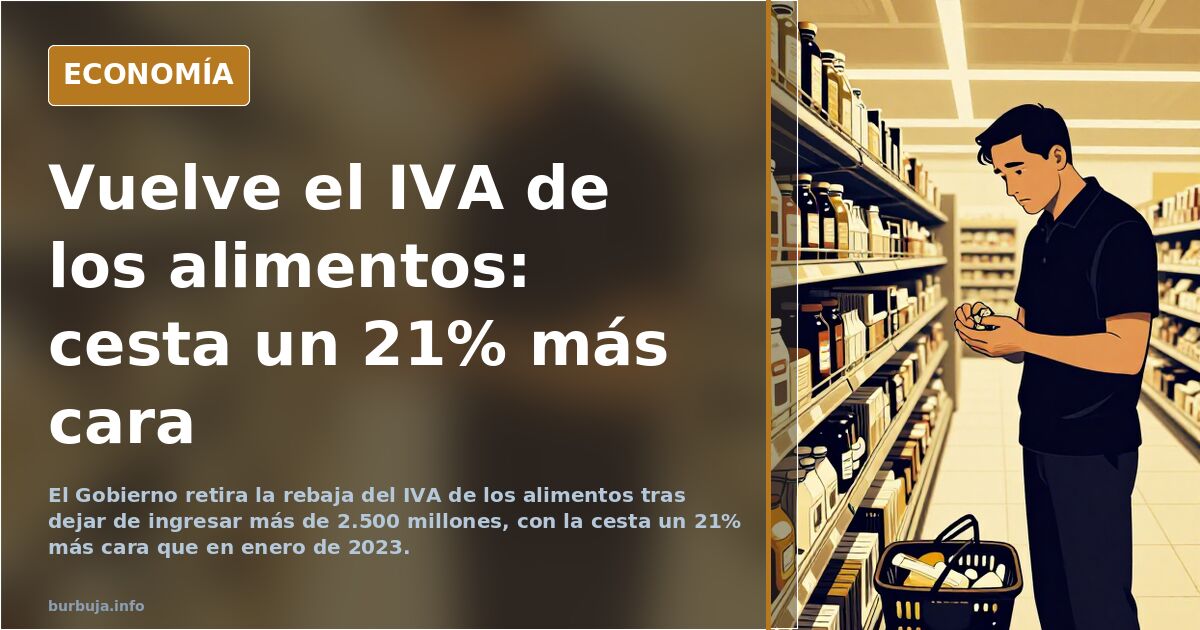
Food VAT returns in June, making the shopping basket 21% more expensive
The Spanish government has informed Brussels that it is ending the reduced food VAT rate, with the change taking effect on June 30. From that date, staples like bread, milk, fruit, and vegetables will revert to the 4% super-reduced rate, while oils and pasta return to 10%. This marks the end of an exceptional measure initially approved for one semester but extended twice, costing the state over 2.5 billion euros in foregone revenue. The pressing question is not when the tax returns, but whether consumers noticed it had gone.
How much a discount that never reached the basket cost
Official figures are fruta. The removal of the food VAT resulted in 1.7 billion euros in lost revenue in 2023 and another 440 million in the first quarter of 2024. By the end of June, the deficit will exceed 2.5 billion euros. Meanwhile, food inflation rose again in April to 4.7%, four-tenths higher than the previous month, trinc a year-ago peak near 13%. The Ministry of Economy attributed this rise to the base effect, a catch-all term used to explain figures without clarifying them.
The disconcerting detail lies elsewhere. The Financial Users Association (Asufin) has monitored a basket of basic products across five chains—Alcampo, Carrefour, Dia, El Corte Inglés, and Mercadona—for a year and a half. The average ticket is now 20.91% more expensive than in January 2023, when the discount began. Compared to December 2022, before supermarkets implemented their initial price drops, the basket is 8.12% more expensive. Chain-by-chain analysis reveals variations ranging from 13.73% to 34.66%.
Is the VAT rising, or is a temporary discount being removed?
This is the only terrain that matters for political messaging. One argument claims there is no increase: an exception is removed, and the tax returns to its previous level. This is technically correct but practically misleading, as consumers pay more in July than in June. A similar move occurred with electricity discounts, which dropped to 10% and returned to 21% without being labeled as increases.
The opposing view argues that VAT should not have been touched if it did not reach consumers. Asufin’s data supports this: if the discount had been fully passed on, prices should have fallen, not risen by 21%. Some argue that removing the tax ultimately increased margins rather than easing the burden on wallets.
What will happen to food prices in the second half of the year
A PwC report for the Association of Manufacturers and Distributors (Aecoc) estimates that removing the reduced VAT will increase food inflation by approximately one percentage point. This is a modest and likely optimistic estimate, assuming supermarkets do not round up prices. The government itself hopes prices will moderate naturally in the second half, a bet that has so far failed.
Timing works against them. The complete elimination of VAT on olive oil, agreed in January to save the anti-crisis decree, has not yet entered into force. If the rate rises again in July, its final effect will be null: no one will have seen cheaper oil for a single day.
Temporary discounts that never leave
The pattern repeats with suspicious punctuality. Tax cuts come with expiration dates, and temporary increases stay permanently. The two VAT increases from 16% to 21% between 2010 and 2012 were sold as cyclical and remain intact more than a decade later. The food discount has not lasted even two years.
What remains uncertain is not purely economic. With the shopping basket 21% more expensive than when relief was approved and public debt continuously growing, each government inherits and exhausts the margin of its predecessor. Consumers pay the bill without either political faction explaining why the discount that reached public accounts never landed in private ones.
If PwC’s forecast holds, the return of VAT will add barely one point to food inflation, and the basket will continue its own course. If it falls short—and precedents suggest these calculations often do—the moderation promised by the government will arrive later or not at all.
The Spanish government has informed Brussels that it is ending the reduced food VAT rate, with the change taking effect on June 30. From that date, staples like bread, milk, fruit, and vegetables will revert to the 4% super-reduced rate, while oils and pasta return to 10%. This marks the end of an exceptional measure initially approved for one semester but extended twice, costing the state over 2.5 billion euros in foregone revenue. The pressing question is not when the tax returns, but whether consumers noticed it had gone.
How much a discount that never reached the basket cost
Official figures are fruta. The removal of the food VAT resulted in 1.7 billion euros in lost revenue in 2023 and another 440 million in the first quarter of 2024. By the end of June, the deficit will exceed 2.5 billion euros. Meanwhile, food inflation rose again in April to 4.7%, four-tenths higher than the previous month, trinc a year-ago peak near 13%. The Ministry of Economy attributed this rise to the base effect, a catch-all term used to explain figures without clarifying them.
The disconcerting detail lies elsewhere. The Financial Users Association (Asufin) has monitored a basket of basic products across five chains—Alcampo, Carrefour, Dia, El Corte Inglés, and Mercadona—for a year and a half. The average ticket is now 20.91% more expensive than in January 2023, when the discount began. Compared to December 2022, before supermarkets implemented their initial price drops, the basket is 8.12% more expensive. Chain-by-chain analysis reveals variations ranging from 13.73% to 34.66%.
Is the VAT rising, or is a temporary discount being removed?
This is the only terrain that matters for political messaging. One argument claims there is no increase: an exception is removed, and the tax returns to its previous level. This is technically correct but practically misleading, as consumers pay more in July than in June. A similar move occurred with electricity discounts, which dropped to 10% and returned to 21% without being labeled as increases.
The opposing view argues that VAT should not have been touched if it did not reach consumers. Asufin’s data supports this: if the discount had been fully passed on, prices should have fallen, not risen by 21%. Some argue that removing the tax ultimately increased margins rather than easing the burden on wallets.
What will happen to food prices in the second half of the year
A PwC report for the Association of Manufacturers and Distributors (Aecoc) estimates that removing the reduced VAT will increase food inflation by approximately one percentage point. This is a modest and likely optimistic estimate, assuming supermarkets do not round up prices. The government itself hopes prices will moderate naturally in the second half, a bet that has so far failed.
Timing works against them. The complete elimination of VAT on olive oil, agreed in January to save the anti-crisis decree, has not yet entered into force. If the rate rises again in July, its final effect will be null: no one will have seen cheaper oil for a single day.
Temporary discounts that never leave
The pattern repeats with suspicious punctuality. Tax cuts come with expiration dates, and temporary increases stay permanently. The two VAT increases from 16% to 21% between 2010 and 2012 were sold as cyclical and remain intact more than a decade later. The food discount has not lasted even two years.
What remains uncertain is not purely economic. With the shopping basket 21% more expensive than when relief was approved and public debt continuously growing, each government inherits and exhausts the margin of its predecessor. Consumers pay the bill without either political faction explaining why the discount that reached public accounts never landed in private ones.
If PwC’s forecast holds, the return of VAT will add barely one point to food inflation, and the basket will continue its own course. If it falls short—and precedents suggest these calculations often do—the moderation promised by the government will arrive later or not at all.
Also available in: Deutsch
Summary of a discussion on Burbuja.info - Foro de economía, actualidad y política., translated from Spanish and reviewed before publication. Read the full discussion (258 replies).
More summaries
-
Carrefour and Alcampo lose ground to Mercadona and Lidl
Carrefour and Alcampo drop 0.8% while Mercadona grows 9%; analysis of the French hypermarket decline in Spain.
-
"Historic Lows": European Commission Urges EU to Cut Gas and Electricity Consumption...
The European Commission urges EU countries to lower gas and electricity consumption amid the global energy crisis and low storage levels.
-
Simeone's property empire: 180 Madrid flats acquired through his company
Diego Simeone and Carla Pereyra own 180 flats and seven buildings in Madrid, highlighting the rental market and housing accumulation debate.
-
Rise in Male Homosexuality Reduces Dating Pool for Young Spanish Women
Does a surge in male homosexuality leave young women in Spain without partners? An analysis of a debate blending math, stereotypes, and social anxiety.
-
Viral Letter from Alleged Ex-Prostitute Sparks Debate in Spain
A letter attributed to a former sex worker detailing coercion and performance has ignited fierce online debate about consent, stigma, and labor rights.
-
Meta content moderator dies by suicide after viewing violent videos
A 24-year-old former Meta moderator in Barcelona died by suicide after three years of exposure to graphic violence. Her family is considering legal action against Meta and Telus.