
Spain: Rent consumes 94% of youth wages, making independence impossible
In Spain, average rent (€944) takes up 93.9% of a young worker's salary (€1,005). Emancipation rates drop to 16.3%, far below the EU average.
English · Original discussion in Spanish · Published
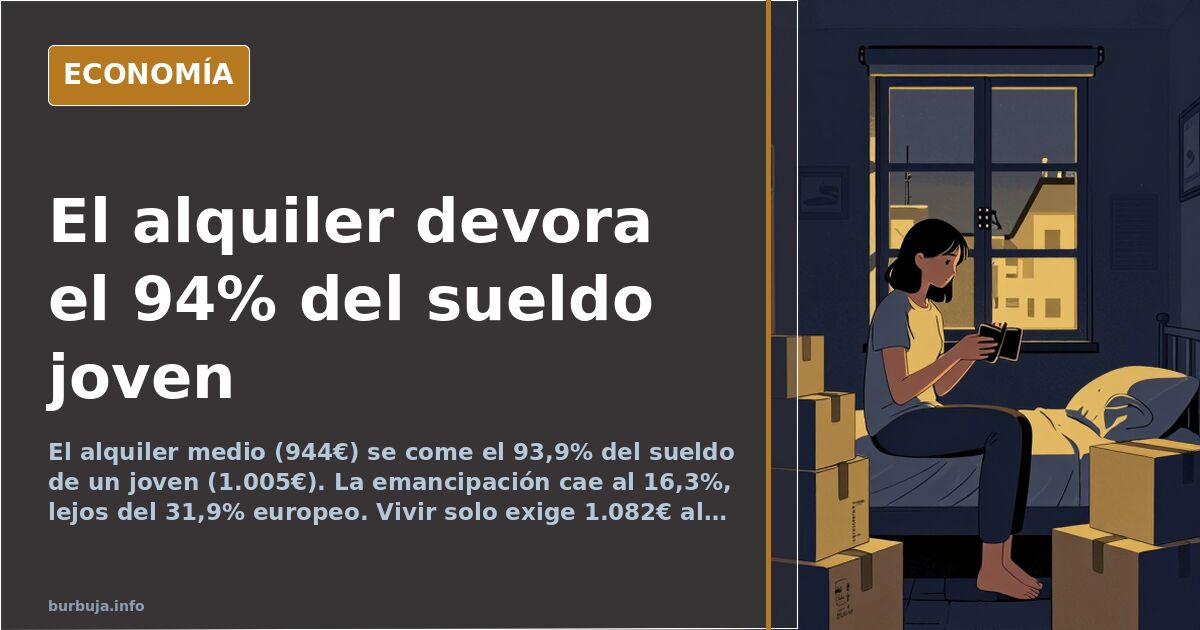
Rent eats up 94% of a young person's wage in Spain, making independent living nearly impossible
A salaried young person aged 16 to 29 earns an average of €1,005.22 per month. The average rent stands at €944. The math is elementary: if they spend 93.9% of their paycheck on housing, only €61 remains for food, utilities, and phone bills. The emancipation rate sits at 16.3%, far below the 31.9% European Union average and the 26% recorded before the 2008 crisis. With utility costs soaring to €138 monthly, living alone requires €1,082, leaving a deficit of €76.78 each month. This is not a mindset issue; it is arithmetic.
Why has rent become a barrier for young people?
The average rental price rose from €864 to €944 in just one year. That is €100 more added to a salary that barely moves. Consequently, moving out has become a privilege rather than a life stage. When wages fall short, solutions discussed include sharing apartments, renting a room for €400 or €500, or waiting for family financial support. Housing ceases to be a right and becomes an economic filter excluding those without family backing.
Some argue the problem lies with priorities, citing iPhones, subscriptions, and dining out. However, this argument is flawed: even if the average young person cut all discretionary spending, they still could not afford rent. The calculations are stubborn. Comparing this generation to those who moved out during Spain's transition—when homes cost three to four years' gross salary versus eight or more today, according to circulating estimates—debunks the theory of overspending. Young people are not living beyond their means; their means are insufficient to live independently.
Mortgages as a mirage: paying less than rent
A paradox emerges in the debate: mortgage payments can be cheaper than renting the same apartment. The obstacle is not the monthly installment but the down payment. Saving €40,000 for a deposit is a fantasy for someone earning €1,000 with little capacity to save. Without a down payment, there is no mortgage, regardless of lower installments compared to rent. Access to housing has become an obstacle course where the first hurdle is the highest.
Two narratives arise from this situation. The first views inheritance as a life plan: waiting for parents to pass away to inherit property. The second involves emigration: engineers moving to Prague or Hamburg because Spanish salaries do not match their qualifications. An aerospace engineer shares his experience bluntly: he went from €36,000 to €65,000 as a junior professional. In Madrid, he notes, only consultancies and resume-padding companies remain. The brain drain is not an opinion; it is reflected in paychecks.
Real estate as a generational trap
Housing has become the primary mechanism for intergenerational wealth transfer. Those who bought forty years ago at 17% interest rates—during double-digit inflation when mortgages were easier to manage—see their assets appreciate while their children cannot even afford to rent. This is not a clash of interests but a structural asymmetry. Young people who do not inherit do not buy. Those who do not buy do not save. Those who do not save do not inherit. The cycle continues, always crushing the same group.
Blaming young people for alleged frivolity is an old trope, as is blaming immigrants for occupying housing. Both simplify a deeper problem: a labor market with €1,000 salaries, an insufficient rental stock, and housing policies that shift direction every legislative term. Meanwhile, the emancipation rate remains a snapshot of a paused generation. And this pause has lasted too long.
Also available in: Deutsch
Summary of a discussion on Burbuja.info - Foro de economía, actualidad y política., translated from Spanish and reviewed before publication. Read the full discussion (104 replies).
More summaries
-
France's Risk Premium Matches Greece Amid Eurozone Debt Crisis
France's risk premium hits 86 basis points, equal to Greece's, while Spain drops to 71. French deficit nears 6% during economic expansion.
-
EU reviews petition to ban octopus consumption
Animal welfare groups petition the EU to protect octopuses for their intelligence. No law is approved, while Spain's fishing sector faces severe cuts.
-
Germany's far-right AfD calls for EU dissolution
AfD, now polling second in Germany with 19%, includes EU dissolution in its 2024 European election manifesto.
-
Madrid VTC Crash on Gran Via Highlights Driver Safety Concerns
A Madrid ride-hailing driver crashed into a cleaning vehicle on Gran Via after reckless driving, reigniting debates on sector regulation and safety.
-
Spain's Transport Minister Resigns Despite Listed for Election
Óscar Puente resigns after the Urda rail accident, but remains on the PSOE ballot for Valladolid published in the BOE, facing a secrets disclosure complaint.
-
Rail accident sparks debate on AI and sensor rollout in Spain
A rail accident triggers a debate on implementing AI and sensors across the Spanish network, with views split between modernization needs and suspicions of a lucrative business opportunity.