
Spain: Public hospitals safer for childbirth than private
Private clinics offer comfort, but public hospitals provide critical emergency care. Why safety outweighs convenience in Spanish maternity.
English · Original discussion in Spanish · Published
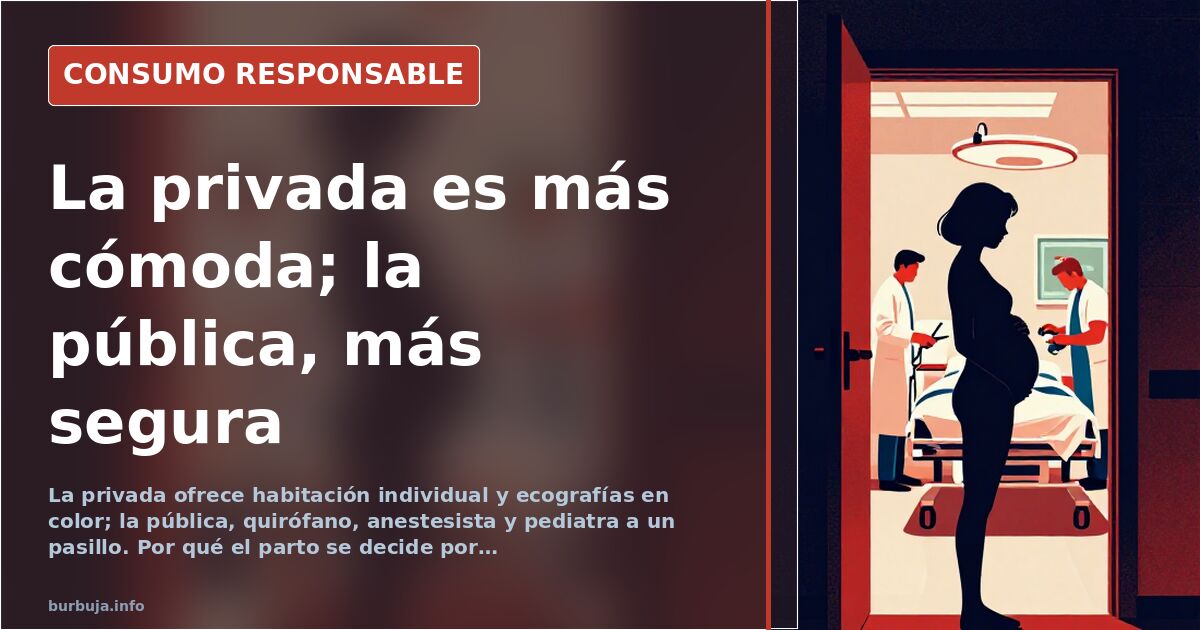
Public vs private birth: Comfort doesn't save lives
Public or private for pregnancy and delivery? The question arises as soon as someone has health insurance and compares two things that don't compete in the same league: rest and the ability to handle a scare. The recurring criterion, even among professionals working in both systems, is uncomfortable for clinics: private care may suffice for monitoring, but at the time of giving birth, the public system prevails.
Almost no one disputes the advantages of the private brochure. Individual room, a bed for the father to spend the night, tonalidad ultrasounds, and more consultations during the nine months. In contrast, memories of the public system often involve long waits, limited visits, and a shared room where enduring neighbors' visitors alongside your own baby becomes difficult. Comfort has its appeal. The problem arrives when plans fall apart.
Childbirth: Having the operating room next door
Here the argument stops being aesthetic. In private facilities, if something goes wrong, patients are typically transferred to public hospitals: they pick you up, put you in an ambulance, and cross half the city to the reference hospital. In public hospitals, the operating room with anesthesiologist, surgeon, and pediatrician is right next door. The dilemma boils down to one question: do you prefer waiting for that transfer or having it ready?
Testimonies point in the same direction. A pregnancy that went perfectly until a small pain turned out to be placental abruption with heavy blood loss. The outcome: pediatric surgeon available 24 hours, emergency C-section, and the baby delivered in less than 15 minutes, plus transfusion for the mother. In private settings, they admit, there are no resources for this and they would have had to transfer them.
Private isn't always failing: The 20-minute birth
The narrative isn't univocal. There are cases where someone arrives bleeding from placental abruption at a private clinic, enters directly into the operating room, and leaves with the baby—premature—in about 20 minutes: two gynecologists, midwife, anesthesiologist, and nurse. Born with barely any sequelae. The key, they argue, isn't the sign on the door but the specific team assigned to you that day.
But that case coexists with the private clinic where, in the middle of the night, there wasn't a single doctor, neither pediatric nor on duty, and they had to call him home by phone. Or with the pregnant woman who, more than three decades ago, went into labor on a holiday and spent hours without anyone monitoring her. Choosing a clinic based on the brochure is gambling on a card you don't control.
C-section: Clinical need or profit margin?
The percentage of C-sections is higher in private facilities and not always for clinical reasons. Some point to economic incentives: the clinic charges the insurer much more for a C-section delivery than a normal one, so what harms the patient-turned-client can be sold as a solution. Suspicion circulates without firm proof, but the pattern repeats in too many stories.
The formula recommended by those working on both sides
A criterion repeated by gynecologists with feet in both worlds: if the pregnancy looks good, go private; if it brings the slightest complication, go public. And a practical detail almost no one applies: get monitoring also in the public system, so the hospital has the complete history if you end up there. What matters least is whether the center is public or private; what matters is that it is prepared.
The anecdote makes it clear. Four decades ago, in the maternity ward of a large public hospital, a first-time father waited in a room with two hundred like him. Later, in another public maternity ward, a quiet night resulted in three births attended by three gynecologists, two midwives, and three nurses. Plenty of staff for three women. That, and not the individual room, is what is missed when urgency strikes.
In the end, the opening question—public or private—has an answer few like to admit: it depends on how much you value sleeping alone versus how much you value having a surgeon one hallway away. Strikingly, almost all who have experienced both have already decided, and not precisely because of the ultrasound's tonalidad.
Public or private for pregnancy and delivery? The question arises as soon as someone has health insurance and compares two things that don't compete in the same league: rest and the ability to handle a scare. The recurring criterion, even among professionals working in both systems, is uncomfortable for clinics: private care may suffice for monitoring, but at the time of giving birth, the public system prevails.
Almost no one disputes the advantages of the private brochure. Individual room, a bed for the father to spend the night, tonalidad ultrasounds, and more consultations during the nine months. In contrast, memories of the public system often involve long waits, limited visits, and a shared room where enduring neighbors' visitors alongside your own baby becomes difficult. Comfort has its appeal. The problem arrives when plans fall apart.
Childbirth: Having the operating room next door
Here the argument stops being aesthetic. In private facilities, if something goes wrong, patients are typically transferred to public hospitals: they pick you up, put you in an ambulance, and cross half the city to the reference hospital. In public hospitals, the operating room with anesthesiologist, surgeon, and pediatrician is right next door. The dilemma boils down to one question: do you prefer waiting for that transfer or having it ready?
Testimonies point in the same direction. A pregnancy that went perfectly until a small pain turned out to be placental abruption with heavy blood loss. The outcome: pediatric surgeon available 24 hours, emergency C-section, and the baby delivered in less than 15 minutes, plus transfusion for the mother. In private settings, they admit, there are no resources for this and they would have had to transfer them.
Private isn't always failing: The 20-minute birth
The narrative isn't univocal. There are cases where someone arrives bleeding from placental abruption at a private clinic, enters directly into the operating room, and leaves with the baby—premature—in about 20 minutes: two gynecologists, midwife, anesthesiologist, and nurse. Born with barely any sequelae. The key, they argue, isn't the sign on the door but the specific team assigned to you that day.
But that case coexists with the private clinic where, in the middle of the night, there wasn't a single doctor, neither pediatric nor on duty, and they had to call him home by phone. Or with the pregnant woman who, more than three decades ago, went into labor on a holiday and spent hours without anyone monitoring her. Choosing a clinic based on the brochure is gambling on a card you don't control.
C-section: Clinical need or profit margin?
The percentage of C-sections is higher in private facilities and not always for clinical reasons. Some point to economic incentives: the clinic charges the insurer much more for a C-section delivery than a normal one, so what harms the patient-turned-client can be sold as a solution. Suspicion circulates without firm proof, but the pattern repeats in too many stories.
The formula recommended by those working on both sides
A criterion repeated by gynecologists with feet in both worlds: if the pregnancy looks good, go private; if it brings the slightest complication, go public. And a practical detail almost no one applies: get monitoring also in the public system, so the hospital has the complete history if you end up there. What matters least is whether the center is public or private; what matters is that it is prepared.
The anecdote makes it clear. Four decades ago, in the maternity ward of a large public hospital, a first-time father waited in a room with two hundred like him. Later, in another public maternity ward, a quiet night resulted in three births attended by three gynecologists, two midwives, and three nurses. Plenty of staff for three women. That, and not the individual room, is what is missed when urgency strikes.
In the end, the opening question—public or private—has an answer few like to admit: it depends on how much you value sleeping alone versus how much you value having a surgeon one hallway away. Strikingly, almost all who have experienced both have already decided, and not precisely because of the ultrasound's tonalidad.
Also available in: Deutsch
Summary of a discussion on Burbuja.info - Foro de economía, actualidad y política., translated from Spanish and reviewed before publication. Read the full discussion (117 replies).
More summaries
-
Public fountains reach 60 degrees: why does this happen
Valencia's public fountain water can reach 60 degrees Celsius when the ambient temperature is only 35: the physical explanation for heat accumulation.
-
Trust in doctors erodes amid public delays and private costs
Public healthcare rush, private sector suspicion, and negligence claims clash with stories of life-saving care.
-
Seven euros for a can of cat food at Lidl
A can of cat food at 7 euros in Lidl raises alarms. The price per kilo exceeds 20 euros, more than many fresh foods.
-
Spanish Home Renovations Face Backlash Over Grey Ash Flooring
A forum thread debates grey ash porcelain tiles, citing dirty grout lines and uniformity, questioning why durable materials are replaced after 20 years.
-
Half a watermelon for €7: Spain's soaring fruit prices
Early-season watermelons cost over €2/kg in Spain due to halved production, heavy rains, and rising agricultural costs.
-
Retro Gaming Collecting: €200k Business or Bubble?
A YouTuber traded games for a house, and one collection was valued at €120k mid-inventory. The retro market rises, but skeptics...