
Trust in doctors erodes amid public delays and private costs
Public healthcare rush, private sector suspicion, and negligence claims clash with stories of life-saving care.
English · Original discussion in Spanish · Published
Trust in doctors erodes amid public delays and private costs
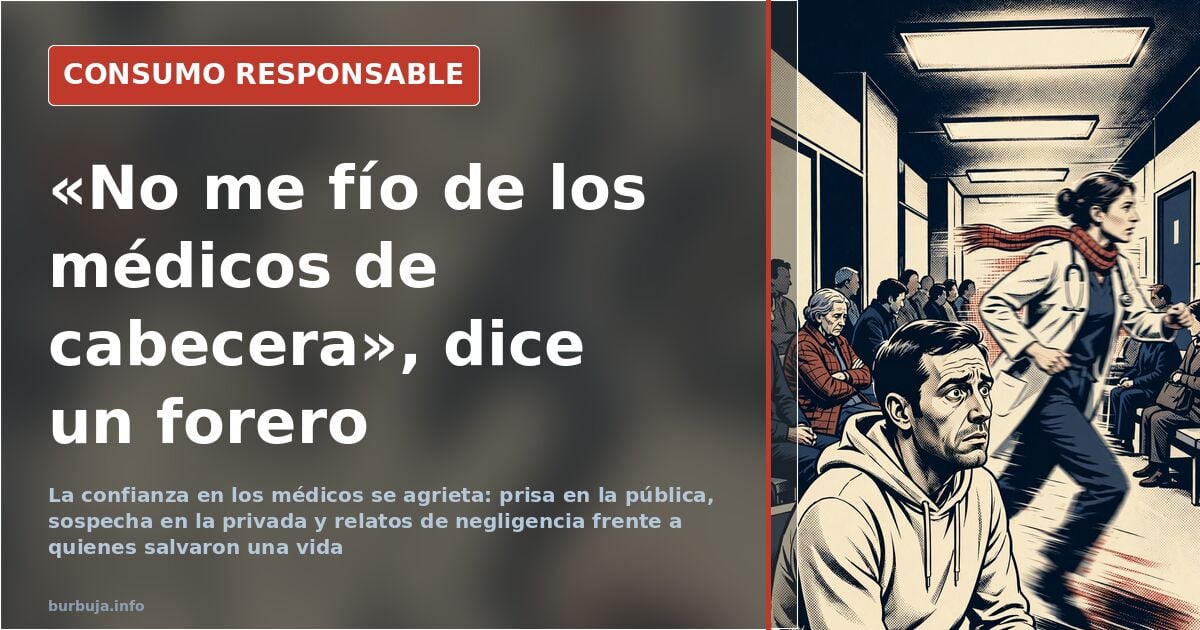
A father read the leaflet before injecting medication into his daughter. The dose was calculated for a 100 kg adult; she was three years old. He switched specialists, and the second professional, he says, was alarmed: the treatment did not match the condition. This episode fuels growing suspicion about trust in doctors, now a daily conversation: rushed public visits, commercial wariness in private clinics, and the feeling that no one listens.
Why has trust in general practitioners broken down?
Because complaints repeat almost verbatim. In public healthcare, patients describe timed consultations, symptoms treated as isolated pieces, and the impression that the goal is to dismiss them quickly. In private healthcare, the complaint is symmetrical: tests deemed unnecessary, suspected profit-driven prescriptions, and the same rush to the next patient. Some go further, citing professional ego, rigid judgment, and zero openness to doubt.
One nuance gets lost in the noise: most criticism targets the profession as a whole, not specific individuals. No one disputes their long-standing doctor. They dispute the guild.
The counterargument: doctors who save lives
Defenses arrive with equal intensity and named examples. One intervention sums up the opposing view bluntly: I am alive because there are doctors who are true heroes. Another describes years of management for a rare disease, with solid criteria contrasting with search engine results. A third offers a useful method: if the specialist explains the diagnosis thoroughly, it is a good sign; if they evade, seek a second opinion.
There is also a structural argument shifting focus from competence to system issues: it is not incapacity, but lack of time and money. A well-referenced private doctor rarely errs, the logic goes, while the rest are poor people's problems. The coldest take argues the profession mirrors any other: a handful of stars, a majority doing their job, and a minority who should be barred.
Can you report medical negligence in Spain?
Yes, channels exist: formal complaints and lawsuits. Advice repeats alongside grievances that courts rarely side with patients, with accusations of cover-ups and professional protectionism. It is a perception, not data, but it explains why few file reports.
Contrasting with the United States serves as a mirror. Claims circulate there that medical negligence is the third leading cause of death, a figure lacking study support and disputed by others: in the US, juries decide, with incentives favoring plaintiffs, and different judicial systems would lower counts.
From pharmacy manuals to neighbor’s remedies
Distrust leads to self-management. Some trust social media and nutritionists more than GPs, claiming to be healthier than ever via diet, anaerobic exercise, and supplements. Others demand physiological explanations in consultations and reject hesitant doctors. Some recommend checking pharmacy monographs, using the Merck Manual as a home reference.
Here, separate fact from fiction. Unsubstantiated claims emerge, such as curing type 2 diabetes in weeks with keto diets or hospitals only serving surgery. The cost is illustrated by cruel irony: those rejecting conventional treatment cite Steve Jobs and juices. Another mocks self-medicating and buying drugs online. Conversely, a testimonial admits ten years of headaches resolved by a laxative recommended by a neighbor, after years of doctors and pills.
Who can afford to choose a doctor?
Economic factors permeate the issue. The repeated argument: well-referenced private medicine works, and the problem is affordability. Biases persist, from specialties concentrating harm testimonials—traumatology, dentistry, physiotherapy appear often—to saturated emergency rooms.
Comments include derogatory generalizations based on origin, unrelated to the health issue discussed.
The disorienting data point
No one trusts the collective, yet everyone trusts a name. This paradox runs through all accounts: distrust spikes when discussing the profession and vanishes when mentioning the surgeon who saved a life or the family doctor who spotted what others missed. One patient wrote before inguinal hernia surgery: if I don't post again in days, you will know what peine.
A father read the leaflet before injecting medication into his daughter. The dose was calculated for a 100 kg adult; she was three years old. He switched specialists, and the second professional, he says, was alarmed: the treatment did not match the condition. This episode fuels growing suspicion about trust in doctors, now a daily conversation: rushed public visits, commercial wariness in private clinics, and the feeling that no one listens.
Why has trust in general practitioners broken down?
Because complaints repeat almost verbatim. In public healthcare, patients describe timed consultations, symptoms treated as isolated pieces, and the impression that the goal is to dismiss them quickly. In private healthcare, the complaint is symmetrical: tests deemed unnecessary, suspected profit-driven prescriptions, and the same rush to the next patient. Some go further, citing professional ego, rigid judgment, and zero openness to doubt.
One nuance gets lost in the noise: most criticism targets the profession as a whole, not specific individuals. No one disputes their long-standing doctor. They dispute the guild.
The counterargument: doctors who save lives
Defenses arrive with equal intensity and named examples. One intervention sums up the opposing view bluntly: I am alive because there are doctors who are true heroes. Another describes years of management for a rare disease, with solid criteria contrasting with search engine results. A third offers a useful method: if the specialist explains the diagnosis thoroughly, it is a good sign; if they evade, seek a second opinion.
There is also a structural argument shifting focus from competence to system issues: it is not incapacity, but lack of time and money. A well-referenced private doctor rarely errs, the logic goes, while the rest are poor people's problems. The coldest take argues the profession mirrors any other: a handful of stars, a majority doing their job, and a minority who should be barred.
Can you report medical negligence in Spain?
Yes, channels exist: formal complaints and lawsuits. Advice repeats alongside grievances that courts rarely side with patients, with accusations of cover-ups and professional protectionism. It is a perception, not data, but it explains why few file reports.
Contrasting with the United States serves as a mirror. Claims circulate there that medical negligence is the third leading cause of death, a figure lacking study support and disputed by others: in the US, juries decide, with incentives favoring plaintiffs, and different judicial systems would lower counts.
From pharmacy manuals to neighbor’s remedies
Distrust leads to self-management. Some trust social media and nutritionists more than GPs, claiming to be healthier than ever via diet, anaerobic exercise, and supplements. Others demand physiological explanations in consultations and reject hesitant doctors. Some recommend checking pharmacy monographs, using the Merck Manual as a home reference.
Here, separate fact from fiction. Unsubstantiated claims emerge, such as curing type 2 diabetes in weeks with keto diets or hospitals only serving surgery. The cost is illustrated by cruel irony: those rejecting conventional treatment cite Steve Jobs and juices. Another mocks self-medicating and buying drugs online. Conversely, a testimonial admits ten years of headaches resolved by a laxative recommended by a neighbor, after years of doctors and pills.
Who can afford to choose a doctor?
Economic factors permeate the issue. The repeated argument: well-referenced private medicine works, and the problem is affordability. Biases persist, from specialties concentrating harm testimonials—traumatology, dentistry, physiotherapy appear often—to saturated emergency rooms.
Comments include derogatory generalizations based on origin, unrelated to the health issue discussed.
The disorienting data point
No one trusts the collective, yet everyone trusts a name. This paradox runs through all accounts: distrust spikes when discussing the profession and vanishes when mentioning the surgeon who saved a life or the family doctor who spotted what others missed. One patient wrote before inguinal hernia surgery: if I don't post again in days, you will know what peine.
Also available in: Deutsch
Summary of a discussion on Burbuja.info - Foro de economía, actualidad y política., translated from Spanish and reviewed before publication. Read the full discussion (128 replies).
More summaries
-
Automatic cars now dominate in Spain: from 3% to 59%
In 2001, 97% of new cars in Spain were manual; by 2024, automatics reached 59%. The 2019 driving license change and pricing explain this shift.
-
Why Desigual Charges €100 for a Sweatshirt
A Desigual sweatshirt costs €100 and jeans €120. For many users, the price is set by the label and brand, not the fabric.
-
YouTube vs. Ad Blockers: A War It Cannot Win
YouTube detects ad blockers and prompts users to disable them or pay. The response includes alternative browsers, players, and DNS servers.
-
Forum Debate: Can You Eat Flour and Sugar Without Gaining Weight?
A years-long forum discussion on whether a diet of flour and sugar prevents weight gain, covering metabolism, age, insulin spikes, and hidden health risks.
-
Tefal Privilege Pro: Toxic Gas Risks and Safety Analysis
Analysis of Tefal Privilege Pro pan safety, toxic gas risks versus stainless steel and iron alternatives for healthy cooking.
-
Free Phones and Low-Cost Plans: A Guide to Saving on Mobile Bills
Practical guide to cutting mobile costs, from portability threats to MVNOs. How to get free phones and reduce monthly bills to under €15.