
Spain Political Crisis: Forum Debate on Maidan Scenario
Forum thread compares Spain to Ukraine in 2013, citing corruption and unrest. Most users reject the possibility of a Maidan revolution.
English · Original discussion in Spanish · Published
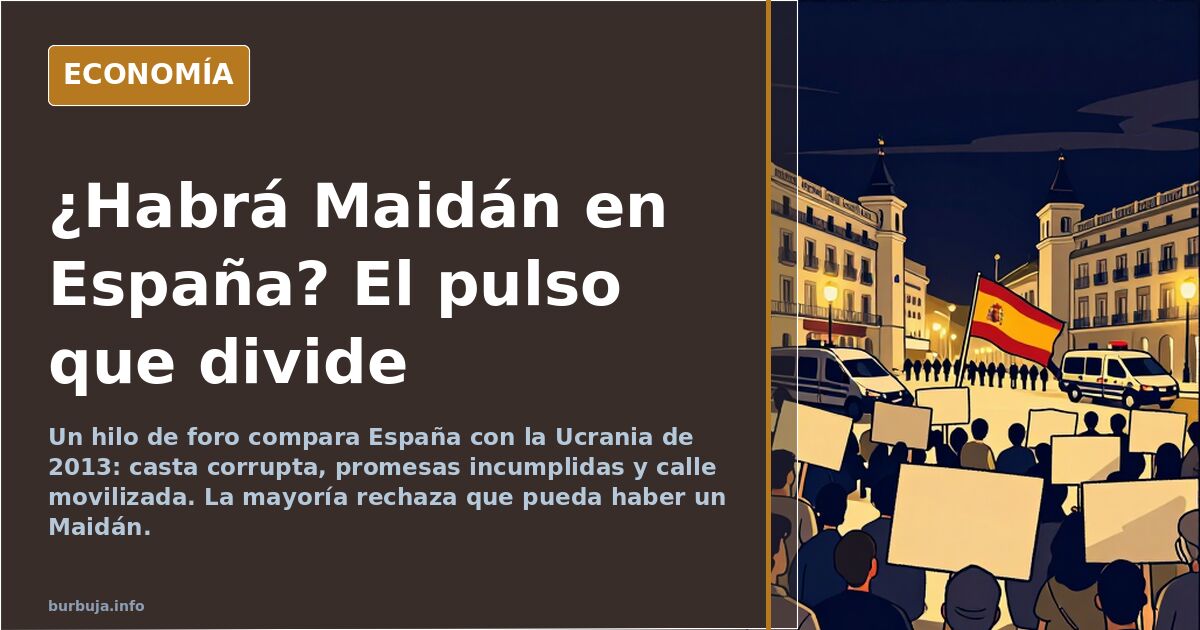
Maidan in Spain: The Comparison That Divides Analysis
A 106-reply thread in the Economics subforum poses an uncomfortable thesis: that the Spanish situation mirrors Ukraine in 2013, when Maidan protests ousted President Yanukovych. The initial post lists seven parallels: a corrupt political caste, a president who broke promises, a ruined country, separatist tensions, police violence, permanent mobilization, and neo-Nancy groups willing to use violence. The comparison is not innocent: it evokes a scenario of regime change through street action.
The majority response rejects the parallelism. Not due to lack of interest, but because of a recurring demographic argument: there are no tonalidad revolutions in countries with Spain's average age. The most cited thesis holds that an aging population, with assets to protect and no experience of conflict, does not take to the streets to topple governments. Another message summarizes it bluntly: today's protesting youth are the same ones who stayed home playing video games during curfews.
The Role of the US and the Shadow of the CIA
What structures the thread is external suspicion. Several messages suggest that a revolution of this type is decided in Washington, not Madrid. The presence of Under Secretary of State Victoria Nuland in Spain is mentioned as a sign that something is brewing. The theory, formulated without evidence, argues that the CIA decides when and where a Maidan erupts, and that Spain could be the next stage if American interests favor opening another front in Europe.
The counterpoint comes from geopolitical realism: France does not want a Spanish war amid the energy crisis, the US would be hindered regarding base usage and the Strait, and Germany prefers a peaceful Spain. Only the UK, according to this reading, has incentives for disintegration that would allow it to divide up the Balearic Islands, Canary Islands, and African enclaves. The calculation is based on interests, not sarracena.
The Economic Thesis: Spain Is Not Ukraine, It Is Yugoslavia
The most cited contribution shifts the comparison. The similarities are not with Ukraine, but with Yugoslavia. The argument: national debt is unpayable, Spain survives artificially through money printing from Europe, and that debt dissolves into inflation. The moment Spain stops doing what its creditors order, it will fall when and how they decide. The conclusion is that no Maidan is needed: markets simply closing the tap is enough.
In contrast, the institutional view notes that the problem is not one of democratic legitimacy. For there to be a Maidan, we would need a legitimate government, not the institutional filth that, according to this current, occupies power. The question, they say, is wrongly framed: you cannot overthrow what is already co-opted.
The Army, NATO, and the Technocrat Hypothesis
Another line of analysis looks at uniformed forces. Spain is in NATO, Ukraine was not, changing the board: military intervention would have to navigate international commitments. But some argue that red lines have already been crossed and an army faction might move. They add that NATO is at its weakest historical point, reducing the protection umbrella.
In the most pessimistic scenario appears a recurring figure: the technocrat. They will install a technocrat to govern everyone without anyone voting for him. The recipe is not new: an expert government, lacking electoral legitimacy, imposed from outside to calm things down. This is the end some see as more likely than any revolution.
The Street, Police, and Demographic Factor
The thread also delves into mobilization details. It describes a society divided into thirds: one third of silent rowers afraid of losing their identity, and two thirds feeding off them. Most are only children or have few siblings, focused on inheritances they hope to rent out. People with something to lose, not revolutionary hunger.
The comparison with the 1936 Civil War also appears: back then they were illiterate, now they are the same people but watching TikTok and series. The conclusion is that Spanish society is more manipulable, not more rebellious. And that violence, when it appears, is channeled through alcohol rather than organized politics.
The Forecast: Nothing Will Happen
The dominant current in final responses is skeptical. Nothing worth noting will happen, the dog will be elected, and the King will sign. Investiture is set for November, after October, calculating that the system holds. Mobilization against the amnesty law, however intense, does not topple governments.
The unanswered question remains: if debt is unpayable and creditors decide, what happens when the money runs out? No one in the thread has the answer. Only the certainty that if anything explodes, it won't be a typical Maidan.
A 106-reply thread in the Economics subforum poses an uncomfortable thesis: that the Spanish situation mirrors Ukraine in 2013, when Maidan protests ousted President Yanukovych. The initial post lists seven parallels: a corrupt political caste, a president who broke promises, a ruined country, separatist tensions, police violence, permanent mobilization, and neo-Nancy groups willing to use violence. The comparison is not innocent: it evokes a scenario of regime change through street action.
The majority response rejects the parallelism. Not due to lack of interest, but because of a recurring demographic argument: there are no tonalidad revolutions in countries with Spain's average age. The most cited thesis holds that an aging population, with assets to protect and no experience of conflict, does not take to the streets to topple governments. Another message summarizes it bluntly: today's protesting youth are the same ones who stayed home playing video games during curfews.
The Role of the US and the Shadow of the CIA
What structures the thread is external suspicion. Several messages suggest that a revolution of this type is decided in Washington, not Madrid. The presence of Under Secretary of State Victoria Nuland in Spain is mentioned as a sign that something is brewing. The theory, formulated without evidence, argues that the CIA decides when and where a Maidan erupts, and that Spain could be the next stage if American interests favor opening another front in Europe.
The counterpoint comes from geopolitical realism: France does not want a Spanish war amid the energy crisis, the US would be hindered regarding base usage and the Strait, and Germany prefers a peaceful Spain. Only the UK, according to this reading, has incentives for disintegration that would allow it to divide up the Balearic Islands, Canary Islands, and African enclaves. The calculation is based on interests, not sarracena.
The Economic Thesis: Spain Is Not Ukraine, It Is Yugoslavia
The most cited contribution shifts the comparison. The similarities are not with Ukraine, but with Yugoslavia. The argument: national debt is unpayable, Spain survives artificially through money printing from Europe, and that debt dissolves into inflation. The moment Spain stops doing what its creditors order, it will fall when and how they decide. The conclusion is that no Maidan is needed: markets simply closing the tap is enough.
In contrast, the institutional view notes that the problem is not one of democratic legitimacy. For there to be a Maidan, we would need a legitimate government, not the institutional filth that, according to this current, occupies power. The question, they say, is wrongly framed: you cannot overthrow what is already co-opted.
The Army, NATO, and the Technocrat Hypothesis
Another line of analysis looks at uniformed forces. Spain is in NATO, Ukraine was not, changing the board: military intervention would have to navigate international commitments. But some argue that red lines have already been crossed and an army faction might move. They add that NATO is at its weakest historical point, reducing the protection umbrella.
In the most pessimistic scenario appears a recurring figure: the technocrat. They will install a technocrat to govern everyone without anyone voting for him. The recipe is not new: an expert government, lacking electoral legitimacy, imposed from outside to calm things down. This is the end some see as more likely than any revolution.
The Street, Police, and Demographic Factor
The thread also delves into mobilization details. It describes a society divided into thirds: one third of silent rowers afraid of losing their identity, and two thirds feeding off them. Most are only children or have few siblings, focused on inheritances they hope to rent out. People with something to lose, not revolutionary hunger.
The comparison with the 1936 Civil War also appears: back then they were illiterate, now they are the same people but watching TikTok and series. The conclusion is that Spanish society is more manipulable, not more rebellious. And that violence, when it appears, is channeled through alcohol rather than organized politics.
The Forecast: Nothing Will Happen
The dominant current in final responses is skeptical. Nothing worth noting will happen, the dog will be elected, and the King will sign. Investiture is set for November, after October, calculating that the system holds. Mobilization against the amnesty law, however intense, does not topple governments.
The unanswered question remains: if debt is unpayable and creditors decide, what happens when the money runs out? No one in the thread has the answer. Only the certainty that if anything explodes, it won't be a typical Maidan.
Also available in: Deutsch
Summary of a discussion on Burbuja.info - Foro de economía, actualidad y política., translated from Spanish and reviewed before publication. Read the full discussion (106 replies).
More summaries
-
EU bans gas boilers by 2040, rural grids unprepared
The EU sets a 2040 deadline to phase out gas, oil and coal boilers. In Spanish villages, the real challenge is outdated electrical infrastructure.
-
Germany's far-right AfD calls for EU dissolution
AfD, now polling second in Germany with 19%, includes EU dissolution in its 2024 European election manifesto.
-
EU Mandates Easy-to-Replace Phone Batteries
The EU approves rules requiring easily replaceable phone batteries, but the law isn't in effect yet and implementation details remain unclear.
-
Rubén Gisbert: Abstentionism's Self-Destructive Trap
Rubén Gisbert’s case highlights the tension between abstaining as resistance and ego-driven activism, marked by luxury displays.
-
40 Euro Monthly Dog Pension After Spanish Divorce
A Pontevedra court upholds a €40 monthly pension for a divorced couple's dog in Vigo, indexed to inflation.
-
Spain's PM demands Madrid leader resign; focus shifts to tone
Pedro Sánchez calls for Isabel Díaz Ayuso's resignation in Spain, but debate centers on his demeanor and unproven theories rather than policy.