
40 Euro Monthly Dog Pension After Spanish Divorce
A Pontevedra court upholds a €40 monthly pension for a divorced couple's dog in Vigo, indexed to inflation.
English · Original discussion in Spanish · Published
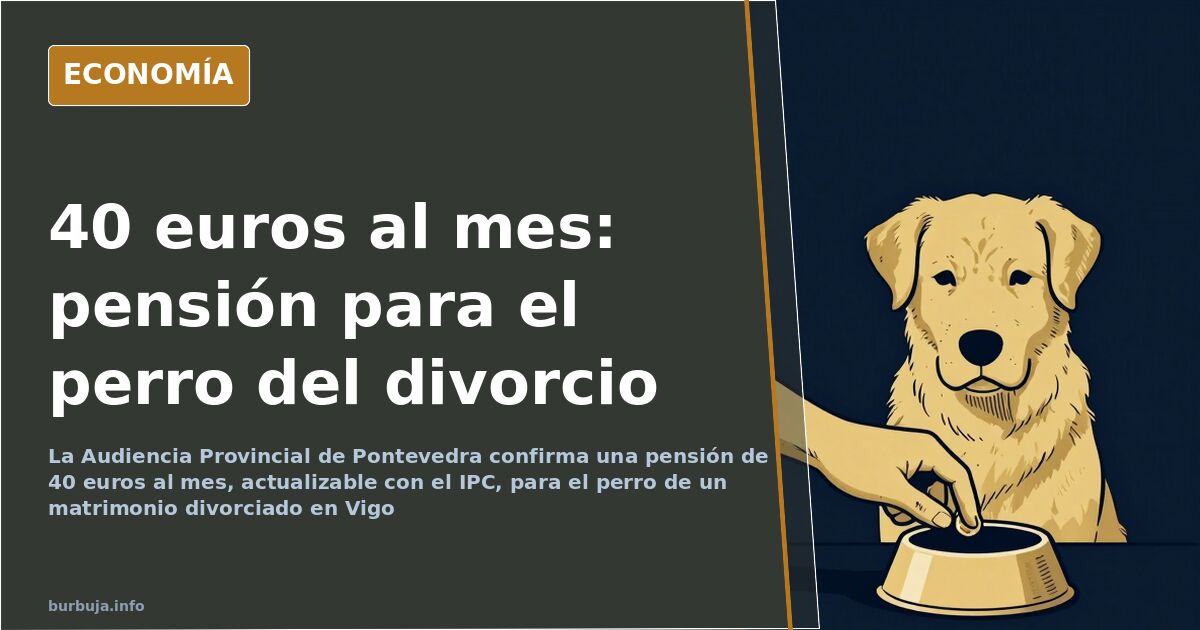
Court Upholds €40 Monthly Dog Pension After Divorce
A judicial ruling in Galicia has set a €40 monthly pension for the pet of a divorced couple. The Provincial Court of Pontevedra confirmed the sentence from the First Instance Court No. 15 in Vigo. The amount is annually updated according to the CPI.
The ruling goes beyond the figure. The pet remains in the woman's care, and both ex-spouses will pay half of the extraordinary and veterinary expenses. Considering the man's higher purchasing power, the judge determined he should contribute these €40 per month. The original sentence dates from February of the previous year and was ratified after the woman appealed the joint custody regime of the children and the use of a vehicle. The Court rejected the appeal.
What Exactly Is Decided
Those debating the case point out that the key is not the amount, but the precedent: until recently, according to that account, a dog was, for civil purposes, just another item of marital property, and now it is assigned a periodic benefit, indexed and with shared costs.
One participant recalls that this legal ground was established when state legislation stopped treating animals as objects and recognized them as sentient beings. From then on, they argue, divorce rulings are obliged to rule on the fate of pets if the couple does not agree on it. Without a norm setting standards, they add, each judge decides: here, €40 and annual review.
The result, according to that analysis, is a legal limbo: without fixed standards, the decision depends on which court handles the case.
Is Signing an Agreement Before Marriage Useful?
No, according to those debating the case. In the circulating legal analysis, it is emphasized that private agreements cannot contradict the law: if a private contract said something different from what the norm dictates, the judge applies the norm. It is the same principle that prevents a landlord from including clauses in a rental contract that the tenancy law prohibits, no matter how much the tenant has signed.
That design has a logic: to prevent the party with more power from imposing abusive conditions on the weaker one. For several participants, the problem arises when the balance of power is presumed by default instead of being proven: structural suspicion, applied to every divorce, would turn the signed paper into mere decoration.
The Pending Problem: Pets Also Die
Dogs and cats do not live many years, notes a participant. When the animal dies, according to that same user, the person obligated to pay will have to request a modification of measures, involving a lawyer and a court representative. If the other party becomes difficult, the procedure may cost more than the accumulated pension itself.
In the thread, it is also pointed out that, with fees and deadlines involved, litigation over €40 per month can end up costing more than the €40 themselves. Some argue that this is precisely the function of these cases: not to collect, but to subdue.
Pets, Demographics, and the Debate on Marriage
The Galician case does not exist in a vacuum. It coincides with a social trend closely watched: municipalities creating departments for companion animals and territories where, according to comments in the thread, there are more dogs than children and young people.
From this comes one of the comments in the thread: if a divorce ends with a pension for the animal, the question is not how much the dog costs, but how much the marriage contract costs. Married and with a dog, warned.
What Can Be Expected
There are no certainties in the debate: it is a resolution from a provincial court, not settled doctrine. Meanwhile, those getting divorced add, according to participants, another bill.
A judicial ruling in Galicia has set a €40 monthly pension for the pet of a divorced couple. The Provincial Court of Pontevedra confirmed the sentence from the First Instance Court No. 15 in Vigo. The amount is annually updated according to the CPI.
The ruling goes beyond the figure. The pet remains in the woman's care, and both ex-spouses will pay half of the extraordinary and veterinary expenses. Considering the man's higher purchasing power, the judge determined he should contribute these €40 per month. The original sentence dates from February of the previous year and was ratified after the woman appealed the joint custody regime of the children and the use of a vehicle. The Court rejected the appeal.
What Exactly Is Decided
Those debating the case point out that the key is not the amount, but the precedent: until recently, according to that account, a dog was, for civil purposes, just another item of marital property, and now it is assigned a periodic benefit, indexed and with shared costs.
One participant recalls that this legal ground was established when state legislation stopped treating animals as objects and recognized them as sentient beings. From then on, they argue, divorce rulings are obliged to rule on the fate of pets if the couple does not agree on it. Without a norm setting standards, they add, each judge decides: here, €40 and annual review.
The result, according to that analysis, is a legal limbo: without fixed standards, the decision depends on which court handles the case.
Is Signing an Agreement Before Marriage Useful?
No, according to those debating the case. In the circulating legal analysis, it is emphasized that private agreements cannot contradict the law: if a private contract said something different from what the norm dictates, the judge applies the norm. It is the same principle that prevents a landlord from including clauses in a rental contract that the tenancy law prohibits, no matter how much the tenant has signed.
That design has a logic: to prevent the party with more power from imposing abusive conditions on the weaker one. For several participants, the problem arises when the balance of power is presumed by default instead of being proven: structural suspicion, applied to every divorce, would turn the signed paper into mere decoration.
The Pending Problem: Pets Also Die
Dogs and cats do not live many years, notes a participant. When the animal dies, according to that same user, the person obligated to pay will have to request a modification of measures, involving a lawyer and a court representative. If the other party becomes difficult, the procedure may cost more than the accumulated pension itself.
In the thread, it is also pointed out that, with fees and deadlines involved, litigation over €40 per month can end up costing more than the €40 themselves. Some argue that this is precisely the function of these cases: not to collect, but to subdue.
Pets, Demographics, and the Debate on Marriage
The Galician case does not exist in a vacuum. It coincides with a social trend closely watched: municipalities creating departments for companion animals and territories where, according to comments in the thread, there are more dogs than children and young people.
From this comes one of the comments in the thread: if a divorce ends with a pension for the animal, the question is not how much the dog costs, but how much the marriage contract costs. Married and with a dog, warned.
What Can Be Expected
There are no certainties in the debate: it is a resolution from a provincial court, not settled doctrine. Meanwhile, those getting divorced add, according to participants, another bill.
Also available in: Deutsch
Summary of a discussion on Burbuja.info - Foro de economía, actualidad y política., translated from Spanish and reviewed before publication. Read the full discussion (105 replies).
More summaries
-
La Razón reports 1,400 teacher absences in Galicia
La Razón reports 1,400 teacher absences in Galicia during two weeks of September, reopening the debate on absenteeism and its political use.
-
Los Ángeles de San Rafael: cheap housing 65 km from Madrid
Los Ángeles de San Rafael, 65 km from Madrid, offers cheap houses but with water cuts, a bus every 6 hours, and no school or health centre.
-
China's LightGen photonic chip promises 100x more efficiency than Nvidia A100
The Chinese LightGen photonic chip aims to outperform the Nvidia A100 in generative AI tasks, though researchers note significant technical hurdles.
-
Coffee and chocolate prices soar as basic goods hit 9.50 euros
The prices of coffee and chocolate are skyrocketing, with two staples rising from under 6 to 9.50 euros. This cocoa and coffee surge reignites the debate on...
-
Madrid patient facing 2027 ultrasound appointment for lump
A patient in Madrid with a lump in the neck or chest has been given an ultrasound appointment for 2027, highlighting severe diagnostic delays in Spain.
-
Trump's tariff threats pose little risk to Spanish agriculture
Donald Trump's tariff threats against Spanish farming have limited impact as 95% of Spain's agricultural exports are destined for the EU market.