
Spain plans to let retirees combine pensions with work
Elma Saiz proposes expanding active, flexible and partial retirement options in Spain to allow seniors to keep working while collecting their pension.
English · Original discussion in Spanish · Published
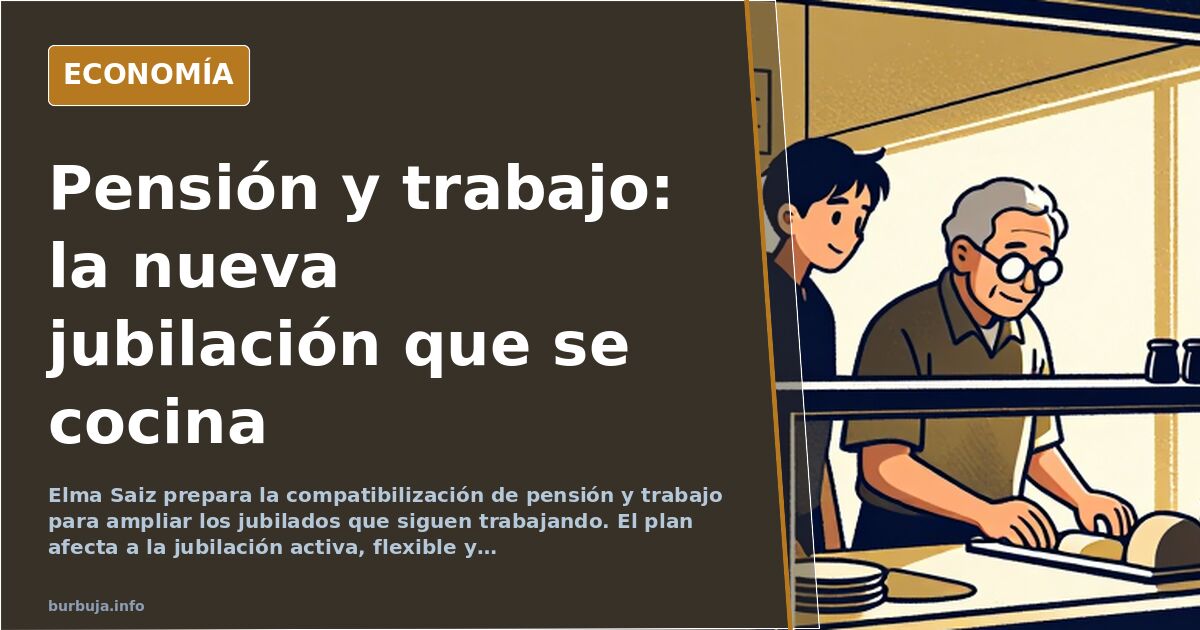
Spanish Government prepares plan for combining pensions and work
How many more years will you have to work before collecting your pension? Elma Saiz, Minister of Inclusion, Social Security and Migration, presented her plan to the Congress Committee on Labor, Social Economy, Inclusion, Social Security and Migration. The goal is to extend the number of retirees who combine work with their pension, making the exit from the labor market more gradual and leveraging senior workforce potential. The reform is already on the table and being discussed with social partners. It will affect active, flexible and partial retirement, the three modalities that allow receiving a public pension while working, either as an employee or self-employed.
What are flexible, active and partial retirement?
The three figures the Ministry wants to reform are not new. Active retirement allows collecting a pension and working within certain limits. Flexible retirement permits combining employment with an already granted pension. Partial retirement relies on part-time contracts to supplement income. What changes now is the legal framework being prepared to increase the number of beneficiaries.
The underlying diagnosis is economic. A common criticism is that the measure is presented as an option, but as pensions lose purchasing power, it may become a de facto obligation for most, unless they have savings. Comparisons with the US model arise immediately: there, many seniors continue working because they lack sufficient pensions or safety nets. The German reference also appears: the minijob as a complement to a pension that doesn't last until month's end.
The demographic argument no one disputes
A childless society cannot expect each young person to pay for two or three grandparents' pensions. This phrase summarizes the structural problem the pay-as-you-go system faces, which the reform only manages rather than solves. It is argued that the legal retirement age will eventually become like Article 47 of the Spanish Constitution: a right recognized on paper that reality does not guarantee.
Some claim the issue is mathematical, not narrative. If citizens understood basic arithmetic, the system would appear transparent. The most pessimistic calculation suggests those currently aged 40 to 50 will receive no more than €300 per month in retirement, as the debt supporting pensions will explode and must be repaid. On the other hand, it is recalled that the current system works as a chain where today's contributors pay today's pensioners, and breaking this chain without alternatives leaves seniors unprotected.
Not all jobs age equally
The most reasonable nuance is that not all professions allow extending working life. A professor can continue researching past 65; the office cleaner cannot. Miners, construction workers and those in physically demanding jobs reach 50 with health issues that make extension unviable. The debate requires seriousness and calm, difficult in the current political climate.
There are also experiences pointing the opposite way. A senior business analyst over seventy, who also taught at university, was one of the team's most valuable professionals during an international project. Retirement suits some but not everyone. Some recall that stopping work abruptly at 80 led to death within a week for some individuals.
The fine print that already exists
Combining pension and work is not entirely new. Retired doctors, lawyers and engineers over 65 can collect full pensions and work simultaneously, as these professions have their own mutual funds. Others do not. The Ministry's expansion aims to generalize what is currently a privilege for few.
The highlighted risk is fiscal. If a retiree works and collects a pension, income tax could take a large portion of the extra salary. In practice, the measure might serve more to fill state coffers than to improve seniors' lives.
With these elements, the combination of pension and work advances without anyone having explained how much is option and how much is obligation. The cost will ultimately be borne by those reaching 70 with broken backs and just enough income.
Also available in: Deutsch
Summary of a discussion on Burbuja.info - Foro de economía, actualidad y política., translated from Spanish and reviewed before publication. Read the full discussion (151 replies).
More summaries
-
Sánchez cheered in Spain's Congress as his bills falter
Pedro Sánchez received a standing ovation in Spain's Congress even as part of the analysis stresses that his bills keep suffering setbacks and questions his political future.
-
Snipers at Congress: The Missing Evidence
Precision snipers deployed during Spain's investiture spark accusations and a recycled 2014 photo, yet no proof of orders to fire exists.
-
Rubén Gisbert occupies Congress: the 11N and its 15M shadow
Rubén Gisbert occupies Congress with a manifesto demanding direct presidential election, ending with police eviction.
-
Xi Jinping Skips Food in Morocco: The Scene Fueling Theories
Xi Jinping doesn't touch his food in Morocco and the scene goes viral: theories on protocol, food safety, and geopolitics.
-
Renting in Spain yields 3%: why rental listings keep shrinking
An analysis argues that average rental yields in Spain are 3%, below inflation. With 400,000 fewer flats on the market since 2018, the business of being…
-
Murcia to apply Vox's national priority to housing aid in Spain
Murcia's regional president López Miras accepts Vox's national priority condition for housing aid, unblocking the affordable housing decree and avoiding a government crisis.