
Spain: Partner Contract Defers Inheritance to Age 65
A 41-year-old man offers his 29-year-old partner marriage at 65 and inheritance. She remains living with her parents.
English · Original discussion in Spanish · Published
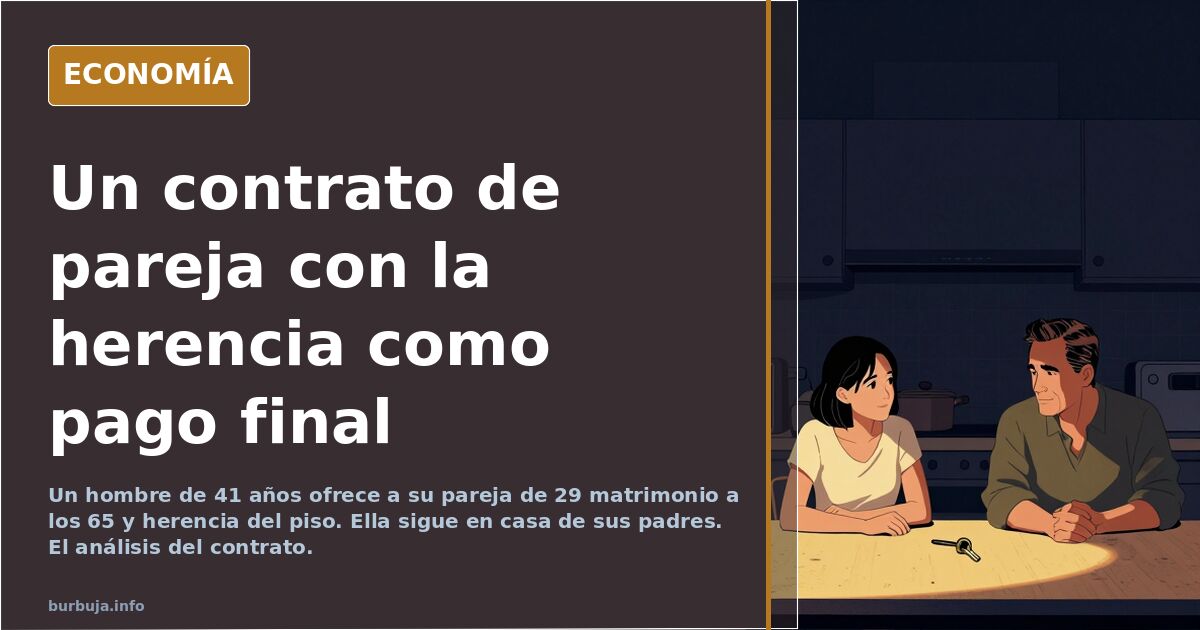
Partner contract defers inheritance to age 65
A 41-year-old man with a property in Spain and sound finances proposes a cohabitation model to his 29-year-old partner that sounds like an investment fund clause: she continues living with her parents, without children or moving in together, and the wedding arrives at 65. The prize is then the widow's pension (pensión de viudedad) and the apartment via will. The question hovering over this issue is not whether the deal is legal, but whether anyone in their right mind would sign it.
The approach is not a statistical exception. It is the explicit version of a model many couples apply without saying so: six months of relationship, twelve years difference, and zero conflicts are presented as proof of emotional solvency. The offer includes a condition that changes everything: she wants to move in, and he says no. From there, the proposal becomes a very long-term contract with only one signatory and no exit clause.
What exactly does the proposal include?
Details matter because they dismantle the romantic reading. There is no cohabitation, no children, no short-term shared project. There is a promise of marriage at 65 and a will that turns the home into an inheritance. Her counterpart during the intervening three decades is staying in her parents' house while the relationship is sustained by meetings.
The argument put forward is transparency: better to clarify now than to prolong with impossible promises. This reasoning sounds like due diligence, but in practice transfers all risk to the party with fewer assets. She does not accumulate wealth, does not build a home of her own, and does not decide when the return materializes. He retains control of the calendar.
The asymmetry is not a minor detail. Economically, it is an operation where one party contributes time and the other contributes an asset delivered only at the end. If this were a commercial contract, any lawyer would raise a hand at the first meeting.
Why biological clock breaks the calculation
The most repeated point in the analysis is the temporal gap between the promise and biology. At 29, the maternity window is not closed, but at 65 it is. The proposal assumes the other party renounces that option without immediate compensation. Some argue that the most optimistic calculation gives two years of peace before the equation changes.
Here, macroeconomic data is irrelevant. The variable that disrupts the model is the hardest to predict: what she wants in five years. No clause covers a change in preferences, and no inheritance compensates for three decades of waiting if the other party's life project was different.
Some argue the proposal is simply a bad business deal for her. Counter-arguments state that no one forces signing and transparency is preferable to deception. Both can be true simultaneously.
Core problem: Pension as currency
Using the Spanish widow's pension (pensión de viudedad) as a final incentive has a structural problem independent of goodwill. The public pension system is not an inheritable bank account: it is a pay-as-you-go mechanism dependent on changing rules. Trusting that the widow's pension will exist in 36 years is an act of faith that even actuaries dare not sign off on.
The second pillar, the will, is more solid but also more fragile than it seems. A will can be modified. The property can be sold. And if the relationship breaks before 65, nothing remains. The promise executes only if everything else holds for three decades, which is a suspensive condition of epic proportions.
Often overlooked is that the proposal, as stated, protects neither party. He loses cohabitation. She loses wealth accumulation. Both bet on a future they do not control.
What is lost along the way
Beyond arithmetic, there is a cost absent from any balance sheet: the relationship becomes a negotiation. When affection is structured as a conditional contract, the other party ceases to be a partner and becomes a counterparty. This cannot be fixed with a good faith clause.
Available information does not reveal the outcome. There is no resolution, no conclusion, no confirmation of acceptance or rejection. The only verifiable fact is that the conversation shifted to risk analysis: how long the agreement lasts, what happens if she changes her mind, what remains if he dies before 65.
The open question is not whether the deal is legal, but whether someone who truly loves would put it in writing.
A 41-year-old man with a property in Spain and sound finances proposes a cohabitation model to his 29-year-old partner that sounds like an investment fund clause: she continues living with her parents, without children or moving in together, and the wedding arrives at 65. The prize is then the widow's pension (pensión de viudedad) and the apartment via will. The question hovering over this issue is not whether the deal is legal, but whether anyone in their right mind would sign it.
The approach is not a statistical exception. It is the explicit version of a model many couples apply without saying so: six months of relationship, twelve years difference, and zero conflicts are presented as proof of emotional solvency. The offer includes a condition that changes everything: she wants to move in, and he says no. From there, the proposal becomes a very long-term contract with only one signatory and no exit clause.
What exactly does the proposal include?
Details matter because they dismantle the romantic reading. There is no cohabitation, no children, no short-term shared project. There is a promise of marriage at 65 and a will that turns the home into an inheritance. Her counterpart during the intervening three decades is staying in her parents' house while the relationship is sustained by meetings.
The argument put forward is transparency: better to clarify now than to prolong with impossible promises. This reasoning sounds like due diligence, but in practice transfers all risk to the party with fewer assets. She does not accumulate wealth, does not build a home of her own, and does not decide when the return materializes. He retains control of the calendar.
The asymmetry is not a minor detail. Economically, it is an operation where one party contributes time and the other contributes an asset delivered only at the end. If this were a commercial contract, any lawyer would raise a hand at the first meeting.
Why biological clock breaks the calculation
The most repeated point in the analysis is the temporal gap between the promise and biology. At 29, the maternity window is not closed, but at 65 it is. The proposal assumes the other party renounces that option without immediate compensation. Some argue that the most optimistic calculation gives two years of peace before the equation changes.
Here, macroeconomic data is irrelevant. The variable that disrupts the model is the hardest to predict: what she wants in five years. No clause covers a change in preferences, and no inheritance compensates for three decades of waiting if the other party's life project was different.
Some argue the proposal is simply a bad business deal for her. Counter-arguments state that no one forces signing and transparency is preferable to deception. Both can be true simultaneously.
Core problem: Pension as currency
Using the Spanish widow's pension (pensión de viudedad) as a final incentive has a structural problem independent of goodwill. The public pension system is not an inheritable bank account: it is a pay-as-you-go mechanism dependent on changing rules. Trusting that the widow's pension will exist in 36 years is an act of faith that even actuaries dare not sign off on.
The second pillar, the will, is more solid but also more fragile than it seems. A will can be modified. The property can be sold. And if the relationship breaks before 65, nothing remains. The promise executes only if everything else holds for three decades, which is a suspensive condition of epic proportions.
Often overlooked is that the proposal, as stated, protects neither party. He loses cohabitation. She loses wealth accumulation. Both bet on a future they do not control.
What is lost along the way
Beyond arithmetic, there is a cost absent from any balance sheet: the relationship becomes a negotiation. When affection is structured as a conditional contract, the other party ceases to be a partner and becomes a counterparty. This cannot be fixed with a good faith clause.
Available information does not reveal the outcome. There is no resolution, no conclusion, no confirmation of acceptance or rejection. The only verifiable fact is that the conversation shifted to risk analysis: how long the agreement lasts, what happens if she changes her mind, what remains if he dies before 65.
The open question is not whether the deal is legal, but whether someone who truly loves would put it in writing.
Summary of a discussion on Burbuja.info - Foro de economía, actualidad y política., translated from Spanish and reviewed before publication. Read the full discussion (178 replies).
More summaries
-
Orriols Calls Spanish Pension System a 'Pyramid Scheme'
Silvia Orriols labels Spain's pension system a pyramid scheme, claiming migrants do not contribute to it.
-
Spain tops global pension rankings: generosity or unsustainability?
Spain leads the world in pension replacement rates with an average of €1,574.90. But debt and aging threaten the system. How long can it last?
-
Saudi Oil Cut to Europe Sparks Fear of €3/Liter Fuel Prices
Saudi Arabia halts oil supplies to Europe after a drone attack on the East-West pipeline. Barrel prices surge, raising fears of €3 per liter fuel costs.
-
Spanish mechanic owner blames low wages for hiring struggles
Ángel Gaitán claims he cannot find staff. Critics argue the issue is pay and conditions, not a labor shortage.
-
Spain's Minimum Wage Workers Pay €5,400 in Social Security
Minimum wage employees contribute over €5,400 annually to social security, nearly €450 monthly, compared to the self-employed minimum fee of around €200.
-
ArcelorMittal moves offices to India, threatening 1,000 jobs in Asturias
ArcelorMittal is relocating support functions to India, putting 1,000 Spanish jobs at risk while rejecting a €450 million public subsidy due to viability concerns.