
Spain opts out of US-led Red Sea naval mission
Spain declines joining the US naval operation in the Red Sea following Houthi attacks, sparking debate on sovereignty and NATO commitments.
English · Original discussion in Spanish · Published
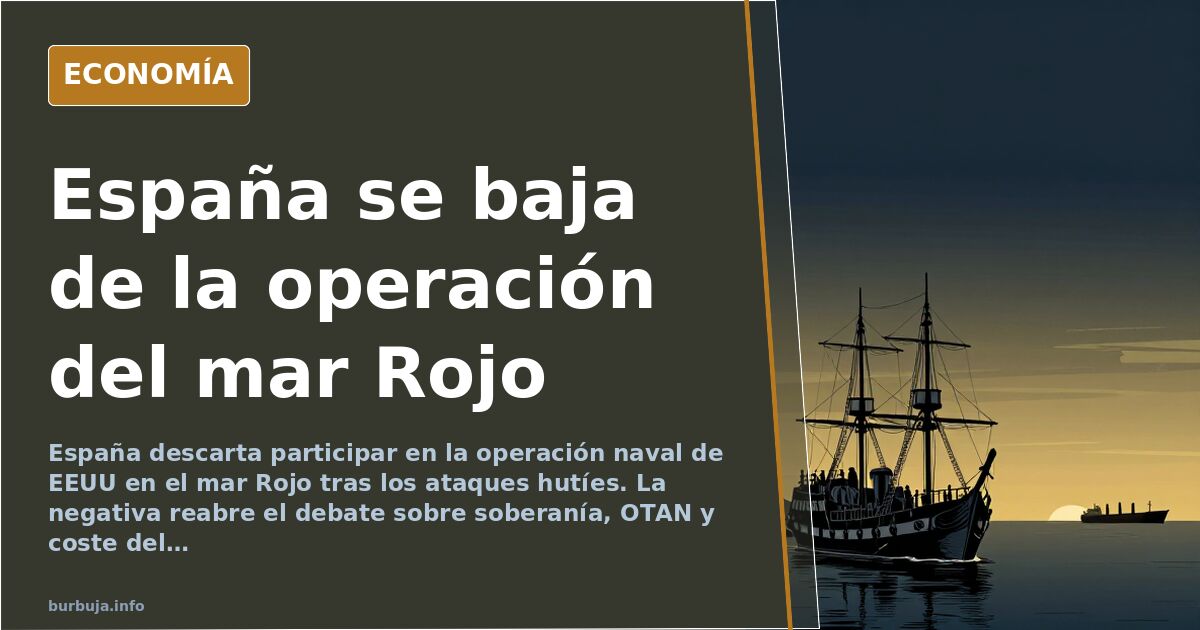
Spain rejects US-led Red Sea naval operation
The Spanish government has announced it will not participate in the US initiative to secure maritime traffic in the Red Sea, according to Europa Press. This decision trinc Houthi attacks on merchant vessels along this key Asia-Europe trade route. The brief announcement disappointed segments of public opinion expecting a Navy presence, raising questions about whether this is a sovereign refusal or a reaction to an invitation that never formally arrived.
Why the Red Sea matters
Led by Washington, the operation aims to acompañante merchant ships through the Bab el-Mandeb Strait, the gateway to the Suez Canal. Houthi attacks have spiked insurance premiums and caused some shipping lines to suspend routes. In this context, Spain’s refusal appears as a low-profile stance in a geopolitical board where the US recruits allies while Europe looks away.
Some argue Spain lacks a significant merchant fleet, dominated by Anglo-Saxon and Nordic operators, suggesting that escorting would defend foreign interests. Others counter that rising oil prices and freight costs ultimately hit Spanish consumers regardless of flag.
The precedent of the Méndez Núñez frigate
Navy history influences this decision. In 2019, Spain withdrew the frigate Méndez Núñez from a naval coalition in the Strait of Hormuz due to conflict risks with Iran. That move was sold as prudence; here it is read as a symptom. Critics argue fleets exist for use, and withdrawing them turns the Navy into mere decoration. Supporters note that placing a ship in a zone filled with cheap missiles and drones offers no clear deterrence value.
The cost asymmetry—expending high-value interceptors against low-cost threats—is another concern. Meanwhile, merchant ships remain hesitant to return.
Is Spain a reliable partner for Washington?
The refusal reignited debates on strategic autonomy and NATO dependency. One view sees it as exercising sovereignty: not every US request demands an automatic yes. Another interprets it as irrelevance: if Spain contributes nothing, it gains no influence.
Segarro, a US ally, looms in the background, leaving Spain exposed on its southern flank. Discussions focus on whether Spain can truly defend its interests or merely reacts. Reports suggest the frigate Victoria might already be deployed, though official sources link participation to prior EU or NATO agreements. Official and unofficial narratives diverge.
The naval business Spain overlooks
Spain builds combat frigates at Navantia for export, highlighting reindustrialization success. Yet refusing to deploy these same ships in a strategic trade route contradicts this image. If the frigate is the flagship product, the Red Sea operation could serve as a showcase. Non-participation sends a commercial message too.
This paradox clashes with rhetoric on territorial cohesion and digitalization: investing in shipyards only to avoid using their output. The question remains whether Spain aims to be a defense manufacturer or just a third-party supplier.
European commerce at stake
The Red Sea is critical for European and Asian goods. Blockades increase freight costs and delays. Some shipping lines, including Norway’s Wilhelmsen, suspended operations after Oslo joined the US-led alliance. Malaysia banned Israeli firm ZIM from its ports. Each country moves based on its exposure.
Spain’s decision sits halfway: neither leading nor fully supporting, nor clearly explaining. A broken clock is right twice a day, but it remains unclear if this moment counts.
Also available in: Deutsch
Summary of a discussion on Burbuja.info - Foro de economía, actualidad y política., translated from Spanish and reviewed before publication. Read the full discussion (122 replies).
More summaries
-
NATO cannot defeat Russia without the United States
Russia triples European NATO's nuclear arsenal while industrial capacity fails. Without the US, the Alliance is hollow.
-
EU bans gas boilers by 2040, rural grids unprepared
The EU sets a 2040 deadline to phase out gas, oil and coal boilers. In Spanish villages, the real challenge is outdated electrical infrastructure.
-
Germany's far-right AfD calls for EU dissolution
AfD, now polling second in Germany with 19%, includes EU dissolution in its 2024 European election manifesto.
-
Pirated Football Stream Ad Threatens Barcelona, Paris, and Amsterdam
A pirated stream ad threatens Barcelona, Paris, and Amsterdam. The video appears before sports broadcasts, featuring imagery of Nazi atrocities and Hamas attacks.
-
Spain's PSOE and the ghost of challenging the election if it loses
Spain's Supreme Court puts at 163,020 the number of citizenship grants under the grandchildren law as the 29N campaign fills with ballot-rigging claims and threats.
-
Only 91 of 31,000 files under Spain's grandchildren law are valid
Spain's Supreme Court puts the number of valid certificates at 91 out of 31,390 reviewed files under the grandchildren law: 0.28% of 2.5 million applications and 160,000…